{"title":"氘增强多不饱和脂肪酸对stz诱导的糖尿病小鼠肌肉萎缩有保护作用。","authors":"Hiroaki Eshima , Tomoaki Ishihara , Ayaka Tabuchi , Yutaka Kano , Kenji Kurokawa , Mikhail S. Shchepinov","doi":"10.1016/j.freeradbiomed.2025.02.015","DOIUrl":null,"url":null,"abstract":"<div><div>Oxidative stress and reactive oxygen species (ROS) have been linked to muscle atrophy and weakness. Diabetes increases the oxidative status in all tissues, including muscle tissues, but the role of lipid ROS on diabetes-induced muscle atrophy is not fully understood. Deuterium reinforced polyunsaturated fatty acids (D-PUFA) are more resistant to ROS-initiated chain reaction of lipid peroxidation than regular hydrogenated PUFA (H-PUFA). In this study, we tested the hypothesis that D-PUFA would protect muscle atrophy induced by diabetes driven by an accumulation of lipid hydroperoxides (LOOH). C57BL/6J mice were dosed with H-PUFA or D-PUFA for four weeks through dietary supplementation (10 mg/day) and then injected with streptozotocin (STZ) to induce insulin-deficient diabetes. After two weeks, muscles tissues were analyzed for individual muscle mass, force generating capacity and cross-sectional area. Skeletal muscle fibers from diabetic mice exhibited increased total ROS and LOOH. This was abolished by the D-PUFA supplementation regardless of accumulated iron. D-PUFA were found to be protective against muscle atrophy and weakness from STZ-induced diabetes. Prevention of muscle atrophy and weakness by D-PUFA might be independent of ACSL4/LPCAT3/15-LOX pathway. These findings provide novel insights into the role of LOOH in the mechanistic link between oxidative stress and diabetic myopathy and suggest a novel therapeutic approach to diabetes-associated muscle weakness.</div></div>","PeriodicalId":12407,"journal":{"name":"Free Radical Biology and Medicine","volume":"230 ","pages":"Pages 273-282"},"PeriodicalIF":8.0000,"publicationDate":"2025-03-16","publicationTypes":"Journal Article","fieldsOfStudy":null,"isOpenAccess":false,"openAccessPdf":"","citationCount":"0","resultStr":"{\"title\":\"Deuterium-reinforced polyunsaturated fatty acids protect against muscle atrophy by STZ-induced diabetic mice\",\"authors\":\"Hiroaki Eshima , Tomoaki Ishihara , Ayaka Tabuchi , Yutaka Kano , Kenji Kurokawa , Mikhail S. Shchepinov\",\"doi\":\"10.1016/j.freeradbiomed.2025.02.015\",\"DOIUrl\":null,\"url\":null,\"abstract\":\"<div><div>Oxidative stress and reactive oxygen species (ROS) have been linked to muscle atrophy and weakness. Diabetes increases the oxidative status in all tissues, including muscle tissues, but the role of lipid ROS on diabetes-induced muscle atrophy is not fully understood. Deuterium reinforced polyunsaturated fatty acids (D-PUFA) are more resistant to ROS-initiated chain reaction of lipid peroxidation than regular hydrogenated PUFA (H-PUFA). In this study, we tested the hypothesis that D-PUFA would protect muscle atrophy induced by diabetes driven by an accumulation of lipid hydroperoxides (LOOH). C57BL/6J mice were dosed with H-PUFA or D-PUFA for four weeks through dietary supplementation (10 mg/day) and then injected with streptozotocin (STZ) to induce insulin-deficient diabetes. After two weeks, muscles tissues were analyzed for individual muscle mass, force generating capacity and cross-sectional area. Skeletal muscle fibers from diabetic mice exhibited increased total ROS and LOOH. This was abolished by the D-PUFA supplementation regardless of accumulated iron. D-PUFA were found to be protective against muscle atrophy and weakness from STZ-induced diabetes. Prevention of muscle atrophy and weakness by D-PUFA might be independent of ACSL4/LPCAT3/15-LOX pathway. These findings provide novel insights into the role of LOOH in the mechanistic link between oxidative stress and diabetic myopathy and suggest a novel therapeutic approach to diabetes-associated muscle weakness.</div></div>\",\"PeriodicalId\":12407,\"journal\":{\"name\":\"Free Radical Biology and Medicine\",\"volume\":\"230 \",\"pages\":\"Pages 273-282\"},\"PeriodicalIF\":8.0000,\"publicationDate\":\"2025-03-16\",\"publicationTypes\":\"Journal Article\",\"fieldsOfStudy\":null,\"isOpenAccess\":false,\"openAccessPdf\":\"\",\"citationCount\":\"0\",\"resultStr\":null,\"platform\":\"Semanticscholar\",\"paperid\":null,\"PeriodicalName\":\"Free Radical Biology and Medicine\",\"FirstCategoryId\":\"3\",\"ListUrlMain\":\"https://www.sciencedirect.com/science/article/pii/S0891584925000905\",\"RegionNum\":2,\"RegionCategory\":\"生物学\",\"ArticlePicture\":[],\"TitleCN\":null,\"AbstractTextCN\":null,\"PMCID\":null,\"EPubDate\":\"2025/2/14 0:00:00\",\"PubModel\":\"Epub\",\"JCR\":\"Q1\",\"JCRName\":\"BIOCHEMISTRY & MOLECULAR BIOLOGY\",\"Score\":null,\"Total\":0}","platform":"Semanticscholar","paperid":null,"PeriodicalName":"Free Radical Biology and Medicine","FirstCategoryId":"3","ListUrlMain":"https://www.sciencedirect.com/science/article/pii/S0891584925000905","RegionNum":2,"RegionCategory":"生物学","ArticlePicture":[],"TitleCN":null,"AbstractTextCN":null,"PMCID":null,"EPubDate":"2025/2/14 0:00:00","PubModel":"Epub","JCR":"Q1","JCRName":"BIOCHEMISTRY & MOLECULAR BIOLOGY","Score":null,"Total":0}
Deuterium-reinforced polyunsaturated fatty acids protect against muscle atrophy by STZ-induced diabetic mice
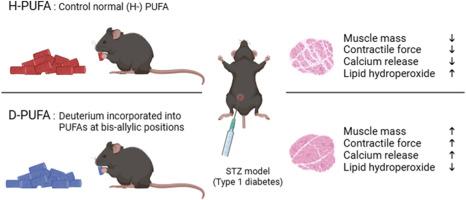
Oxidative stress and reactive oxygen species (ROS) have been linked to muscle atrophy and weakness. Diabetes increases the oxidative status in all tissues, including muscle tissues, but the role of lipid ROS on diabetes-induced muscle atrophy is not fully understood. Deuterium reinforced polyunsaturated fatty acids (D-PUFA) are more resistant to ROS-initiated chain reaction of lipid peroxidation than regular hydrogenated PUFA (H-PUFA). In this study, we tested the hypothesis that D-PUFA would protect muscle atrophy induced by diabetes driven by an accumulation of lipid hydroperoxides (LOOH). C57BL/6J mice were dosed with H-PUFA or D-PUFA for four weeks through dietary supplementation (10 mg/day) and then injected with streptozotocin (STZ) to induce insulin-deficient diabetes. After two weeks, muscles tissues were analyzed for individual muscle mass, force generating capacity and cross-sectional area. Skeletal muscle fibers from diabetic mice exhibited increased total ROS and LOOH. This was abolished by the D-PUFA supplementation regardless of accumulated iron. D-PUFA were found to be protective against muscle atrophy and weakness from STZ-induced diabetes. Prevention of muscle atrophy and weakness by D-PUFA might be independent of ACSL4/LPCAT3/15-LOX pathway. These findings provide novel insights into the role of LOOH in the mechanistic link between oxidative stress and diabetic myopathy and suggest a novel therapeutic approach to diabetes-associated muscle weakness.
期刊介绍:
Free Radical Biology and Medicine is a leading journal in the field of redox biology, which is the study of the role of reactive oxygen species (ROS) and other oxidizing agents in biological systems. The journal serves as a premier forum for publishing innovative and groundbreaking research that explores the redox biology of health and disease, covering a wide range of topics and disciplines. Free Radical Biology and Medicine also commissions Special Issues that highlight recent advances in both basic and clinical research, with a particular emphasis on the mechanisms underlying altered metabolism and redox signaling. These Special Issues aim to provide a focused platform for the latest research in the field, fostering collaboration and knowledge exchange among researchers and clinicians.




 京公网安备 11010802042870号
京ICP备2023020795号-1
京公网安备 11010802042870号
京ICP备2023020795号-1

 分享
分享
 求助内容:
求助内容: 应助结果提醒方式:
 扫码关注我们
