{"title":"两个人在合作互动中的行为同步性:通过眼睛读心术测试测量的心智化能力的作用。","authors":"Brigitta Kakuszi, István Bitter, Pál Czobor","doi":"10.1186/s40359-025-02457-x","DOIUrl":null,"url":null,"abstract":"<p><strong>Background: </strong>Interpersonally synchronized behaviors play a fundamental role in social interactions. An important prereqvisite for behavioral synchronization is the mentalization ability of the individuals involved in the interaction. While the Reading the Mind in the Eyes Test (RMET) is widely applied to measure mentalization, most studies of RMET used single-subject designs, which lack ecological validity and have limited generalizability for real, on-going, reciprocal social interactions. Using a two-subject design, our objectives were to examine (i) the predictive validity of RMET for the synchronous behavior of two interacting individuals during a reaction time task; (ii) the association of age-related RMET performance with interpersonal coordination; and (iii) the influence of various potentially important covariates on the association, including psychological distress, basic personality domains such as impulsive responding, and lack of attention.</p><p><strong>Methods: </strong>We investigated 24 dyads, using 48 subjects (mean age 32.9 [SD = 12.8] years). Synchronous behavior was indexed by the correlation of participants' responses in terms of reaction times (RTs) to visual stimuli. We used the correct recognition rate from the RMET as a measure of mentalization ability.</p><p><strong>Results: </strong>Our results indicated that the synchronization of the behavioral responses (i.e., RTs) between the interacting pairs and their mentalization ability, as measured by the RMET, showed significant association. Specifically, with good performance (100% correct recognition), the behavioral response synchronization was significantly (F = 153.34, p < 0.0001) higher (Pearson correlation, r = 0.41) than with poor performance (50% correct recognition, r = 0.25). Higher age was inversely related to behavioral synchronization, with no interaction (p > 0.1) with RMET performance). The inclusion of additional covariates (e.g., measures for psychological distress and basic personality domains) in the analyses did not alter the significance of the association between RMET performance and behavioral synchronization (p < 0.05, after adjustment).</p><p><strong>Conclusions: </strong>Our results confirm the utility of RMET, as a measure of mentalization, to predict participants' ability to achieve behavioral synchronization during cooperative interaction. These results may facilitate research into mental disorders, where problems with social interactions play a role in symptom presentation. For this purpose, future studies with larger sample size should examine whether our findings can be dimensionally extrapolated to patients with such disorders.</p>","PeriodicalId":37867,"journal":{"name":"BMC Psychology","volume":"13 1","pages":"126"},"PeriodicalIF":4.6000,"publicationDate":"2025-02-16","publicationTypes":"Journal Article","fieldsOfStudy":null,"isOpenAccess":false,"openAccessPdf":"https://www.ncbi.nlm.nih.gov/pmc/articles/PMC11830189/pdf/","citationCount":"0","resultStr":"{\"title\":\"Behavioral synchronization of two individuals during cooperative interaction: the role of the mentalization ability as measured by the reading the mind in the eyes test.\",\"authors\":\"Brigitta Kakuszi, István Bitter, Pál Czobor\",\"doi\":\"10.1186/s40359-025-02457-x\",\"DOIUrl\":null,\"url\":null,\"abstract\":\"<p><strong>Background: </strong>Interpersonally synchronized behaviors play a fundamental role in social interactions. An important prereqvisite for behavioral synchronization is the mentalization ability of the individuals involved in the interaction. While the Reading the Mind in the Eyes Test (RMET) is widely applied to measure mentalization, most studies of RMET used single-subject designs, which lack ecological validity and have limited generalizability for real, on-going, reciprocal social interactions. Using a two-subject design, our objectives were to examine (i) the predictive validity of RMET for the synchronous behavior of two interacting individuals during a reaction time task; (ii) the association of age-related RMET performance with interpersonal coordination; and (iii) the influence of various potentially important covariates on the association, including psychological distress, basic personality domains such as impulsive responding, and lack of attention.</p><p><strong>Methods: </strong>We investigated 24 dyads, using 48 subjects (mean age 32.9 [SD = 12.8] years). Synchronous behavior was indexed by the correlation of participants' responses in terms of reaction times (RTs) to visual stimuli. We used the correct recognition rate from the RMET as a measure of mentalization ability.</p><p><strong>Results: </strong>Our results indicated that the synchronization of the behavioral responses (i.e., RTs) between the interacting pairs and their mentalization ability, as measured by the RMET, showed significant association. Specifically, with good performance (100% correct recognition), the behavioral response synchronization was significantly (F = 153.34, p < 0.0001) higher (Pearson correlation, r = 0.41) than with poor performance (50% correct recognition, r = 0.25). Higher age was inversely related to behavioral synchronization, with no interaction (p > 0.1) with RMET performance). The inclusion of additional covariates (e.g., measures for psychological distress and basic personality domains) in the analyses did not alter the significance of the association between RMET performance and behavioral synchronization (p < 0.05, after adjustment).</p><p><strong>Conclusions: </strong>Our results confirm the utility of RMET, as a measure of mentalization, to predict participants' ability to achieve behavioral synchronization during cooperative interaction. These results may facilitate research into mental disorders, where problems with social interactions play a role in symptom presentation. For this purpose, future studies with larger sample size should examine whether our findings can be dimensionally extrapolated to patients with such disorders.</p>\",\"PeriodicalId\":37867,\"journal\":{\"name\":\"BMC Psychology\",\"volume\":\"13 1\",\"pages\":\"126\"},\"PeriodicalIF\":4.6000,\"publicationDate\":\"2025-02-16\",\"publicationTypes\":\"Journal Article\",\"fieldsOfStudy\":null,\"isOpenAccess\":false,\"openAccessPdf\":\"https://www.ncbi.nlm.nih.gov/pmc/articles/PMC11830189/pdf/\",\"citationCount\":\"0\",\"resultStr\":null,\"platform\":\"Semanticscholar\",\"paperid\":null,\"PeriodicalName\":\"BMC Psychology\",\"FirstCategoryId\":\"102\",\"ListUrlMain\":\"https://doi.org/10.1186/s40359-025-02457-x\",\"RegionNum\":3,\"RegionCategory\":\"心理学\",\"ArticlePicture\":[],\"TitleCN\":null,\"AbstractTextCN\":null,\"PMCID\":null,\"EPubDate\":\"\",\"PubModel\":\"\",\"JCR\":\"Q1\",\"JCRName\":\"PSYCHOLOGY, MULTIDISCIPLINARY\",\"Score\":null,\"Total\":0}","platform":"Semanticscholar","paperid":null,"PeriodicalName":"BMC Psychology","FirstCategoryId":"102","ListUrlMain":"https://doi.org/10.1186/s40359-025-02457-x","RegionNum":3,"RegionCategory":"心理学","ArticlePicture":[],"TitleCN":null,"AbstractTextCN":null,"PMCID":null,"EPubDate":"","PubModel":"","JCR":"Q1","JCRName":"PSYCHOLOGY, MULTIDISCIPLINARY","Score":null,"Total":0}
引用次数: 0
摘要
背景:人际同步行为在社会互动中起着重要作用。行为同步的一个重要先决条件是参与互动的个体的心智化能力。虽然眼睛读心术测试(RMET)被广泛用于测量心理化,但大多数RMET研究使用的是单受试者设计,缺乏生态效度,对真实、持续、互惠的社会互动的推广能力有限。采用双受试者设计,我们的目标是检验(i) RMET对两个相互作用的个体在反应时间任务中的同步行为的预测有效性;(ii)与年龄相关的RMET表现与人际协调的关系;(iii)各种潜在重要协变量对关联的影响,包括心理困扰,基本人格领域,如冲动反应和缺乏注意力。方法:共调查24对,48例,平均年龄32.9岁[SD = 12.8]岁。同步行为是通过参与者对视觉刺激的反应时间(RTs)的相关性来索引的。我们使用RMET的正确识别率作为心智化能力的衡量标准。结果:实验结果表明,被试行为反应(RTs)的同步性与其心智化能力(RMET)存在显著的相关性。具体而言,当表现良好(100%正确识别)时,行为反应同步与RMET表现显著(F = 153.34, p 0.1)。在分析中纳入其他协变量(例如,心理困扰和基本人格域的测量)并没有改变RMET表现与行为同步之间关联的重要性(p结论:我们的研究结果证实了RMET作为一种心理化测量的效用,可以预测参与者在合作互动中实现行为同步的能力。这些结果可能促进对精神障碍的研究,其中社会互动问题在症状表现中起作用。为此,未来更大样本量的研究应该检验我们的发现是否可以从维度上外推到患有此类疾病的患者。
Behavioral synchronization of two individuals during cooperative interaction: the role of the mentalization ability as measured by the reading the mind in the eyes test.
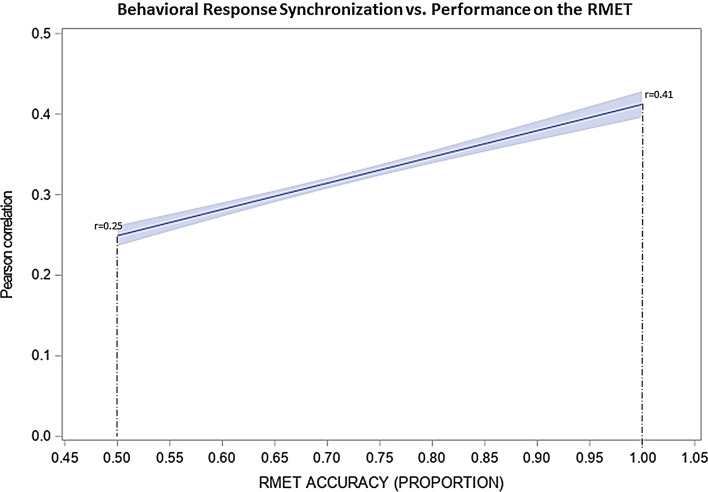
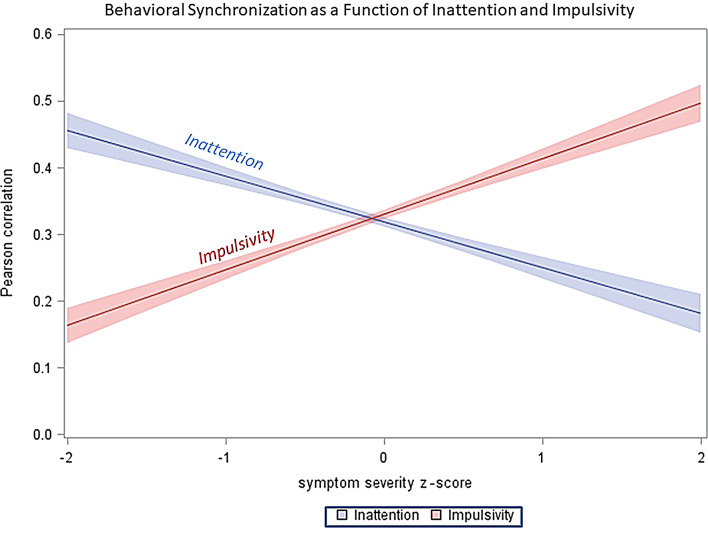
Background: Interpersonally synchronized behaviors play a fundamental role in social interactions. An important prereqvisite for behavioral synchronization is the mentalization ability of the individuals involved in the interaction. While the Reading the Mind in the Eyes Test (RMET) is widely applied to measure mentalization, most studies of RMET used single-subject designs, which lack ecological validity and have limited generalizability for real, on-going, reciprocal social interactions. Using a two-subject design, our objectives were to examine (i) the predictive validity of RMET for the synchronous behavior of two interacting individuals during a reaction time task; (ii) the association of age-related RMET performance with interpersonal coordination; and (iii) the influence of various potentially important covariates on the association, including psychological distress, basic personality domains such as impulsive responding, and lack of attention.
Methods: We investigated 24 dyads, using 48 subjects (mean age 32.9 [SD = 12.8] years). Synchronous behavior was indexed by the correlation of participants' responses in terms of reaction times (RTs) to visual stimuli. We used the correct recognition rate from the RMET as a measure of mentalization ability.
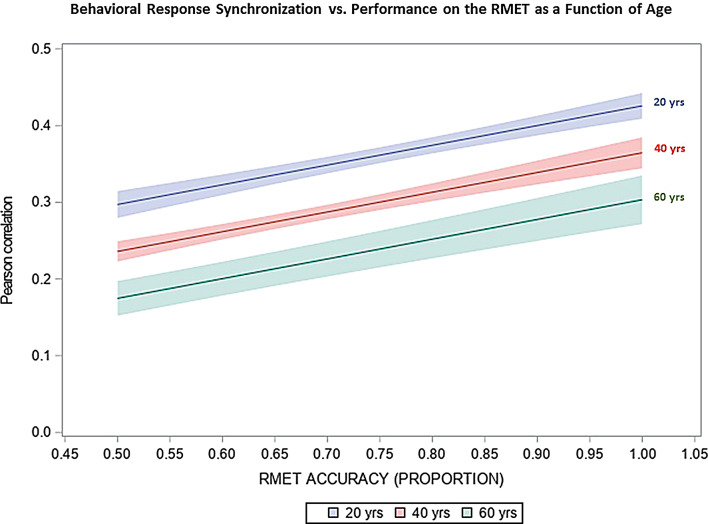
Results: Our results indicated that the synchronization of the behavioral responses (i.e., RTs) between the interacting pairs and their mentalization ability, as measured by the RMET, showed significant association. Specifically, with good performance (100% correct recognition), the behavioral response synchronization was significantly (F = 153.34, p < 0.0001) higher (Pearson correlation, r = 0.41) than with poor performance (50% correct recognition, r = 0.25). Higher age was inversely related to behavioral synchronization, with no interaction (p > 0.1) with RMET performance). The inclusion of additional covariates (e.g., measures for psychological distress and basic personality domains) in the analyses did not alter the significance of the association between RMET performance and behavioral synchronization (p < 0.05, after adjustment).
Conclusions: Our results confirm the utility of RMET, as a measure of mentalization, to predict participants' ability to achieve behavioral synchronization during cooperative interaction. These results may facilitate research into mental disorders, where problems with social interactions play a role in symptom presentation. For this purpose, future studies with larger sample size should examine whether our findings can be dimensionally extrapolated to patients with such disorders.
期刊介绍:
BMC Psychology is an open access, peer-reviewed journal that considers manuscripts on all aspects of psychology, human behavior and the mind, including developmental, clinical, cognitive, experimental, health and social psychology, as well as personality and individual differences. The journal welcomes quantitative and qualitative research methods, including animal studies.




 京公网安备 11010802042870号
京ICP备2023020795号-1
京公网安备 11010802042870号
京ICP备2023020795号-1

 分享
分享
 求助内容:
求助内容: 应助结果提醒方式:
 扫码关注我们
