Gianluigi Lauro , Michela Aliberti , Mauro De Nisco , Silvana Pedatella , Giacomo Pepe , Manuela Giovanna Basilicata , Maria Giovanna Chini , Katrin Fischer , Robert K. Hofstetter , Oliver Werz , Maria Grazia Ferraro , Marialuisa Piccolo , Carlo Irace , Anella Saviano , Pietro Campiglia , Alessia Bertamino , Carmine Ostacolo , Tania Ciaglia , Michele Manfra , Giuseppe Bifulco
{"title":"基于呋喃唑吡嗪的新型抗癌药物通过双重mPGES-1和sEH抑制干扰类二十烷生物合成途径","authors":"Gianluigi Lauro , Michela Aliberti , Mauro De Nisco , Silvana Pedatella , Giacomo Pepe , Manuela Giovanna Basilicata , Maria Giovanna Chini , Katrin Fischer , Robert K. Hofstetter , Oliver Werz , Maria Grazia Ferraro , Marialuisa Piccolo , Carlo Irace , Anella Saviano , Pietro Campiglia , Alessia Bertamino , Carmine Ostacolo , Tania Ciaglia , Michele Manfra , Giuseppe Bifulco","doi":"10.1016/j.ejmech.2025.117402","DOIUrl":null,"url":null,"abstract":"<div><div>We report the identification of a new set of compounds based on the furazanopyrazine core interfering with eicosanoid biosynthesis and acting as potentially effective anti-inflammatory and anticancer agents. Based on our previous promising results on a set of furazanopyrazine-based compounds against the microsomal prostaglandin E<sub>2</sub> synthase-1 (mPGES-1) enzyme, we here identified derivatives with improved pharmacokinetic properties by replacing the ester moiety with a more stable ether group.</div><div>A focused virtual library of 1 × 10<sup>4</sup> molecules was built and screened against mPGES-1 through molecular docking experiments, leading to the selection of 10 candidates for synthesis and biological evaluation. Several molecules were found to inhibit mPGES-1 and, among them, two items featured IC<sub>50</sub> values in the low micromolar range. Additional computational studies on the collection of synthesized compounds demonstrated that compound <strong>3b</strong>, previously emerged as an mPGES-1 inhibitor, interfered with soluble epoxide hydrolase (sEH) activity, thus emerging as a valuable dual mPGES-1/sEH inhibitor. The pharmacokinetic features of the most potent compounds were accurately estimated. Unfortunately, poor outcomes were obtained for <strong>3b</strong>; on the other hand, compound <strong>7e</strong> exhibited promising mPGES-1 inhibition and excellent pharmacokinetic profile, demonstrating that the novel furazanopyrazine-based items with ether moiety possess improved pharmacokinetic properties compared to the ester-based compounds reported in our previous study. Additionally, the anticancer properties of <strong>7e</strong> and <strong>7d</strong>, the latter emerged as the most active mPGES-1 inhibitor, were evaluated and both compounds showed promising activities against HCT-116 human colorectal cancer (CRC) cells.</div><div>These findings highlight the furazanopyrazine core as a promising scaffold for disclosing new anti-inflammatory drugs with the ability to inhibit targets belonging to arachidonic acid cascade.</div></div>","PeriodicalId":314,"journal":{"name":"European Journal of Medicinal Chemistry","volume":"289 ","pages":"Article 117402"},"PeriodicalIF":5.9000,"publicationDate":"2025-05-05","publicationTypes":"Journal Article","fieldsOfStudy":null,"isOpenAccess":false,"openAccessPdf":"","citationCount":"0","resultStr":"{\"title\":\"Furazanopyrazine-based novel promising anticancer agents interfering with the eicosanoid biosynthesis pathways by dual mPGES-1 and sEH inhibition\",\"authors\":\"Gianluigi Lauro , Michela Aliberti , Mauro De Nisco , Silvana Pedatella , Giacomo Pepe , Manuela Giovanna Basilicata , Maria Giovanna Chini , Katrin Fischer , Robert K. Hofstetter , Oliver Werz , Maria Grazia Ferraro , Marialuisa Piccolo , Carlo Irace , Anella Saviano , Pietro Campiglia , Alessia Bertamino , Carmine Ostacolo , Tania Ciaglia , Michele Manfra , Giuseppe Bifulco\",\"doi\":\"10.1016/j.ejmech.2025.117402\",\"DOIUrl\":null,\"url\":null,\"abstract\":\"<div><div>We report the identification of a new set of compounds based on the furazanopyrazine core interfering with eicosanoid biosynthesis and acting as potentially effective anti-inflammatory and anticancer agents. Based on our previous promising results on a set of furazanopyrazine-based compounds against the microsomal prostaglandin E<sub>2</sub> synthase-1 (mPGES-1) enzyme, we here identified derivatives with improved pharmacokinetic properties by replacing the ester moiety with a more stable ether group.</div><div>A focused virtual library of 1 × 10<sup>4</sup> molecules was built and screened against mPGES-1 through molecular docking experiments, leading to the selection of 10 candidates for synthesis and biological evaluation. Several molecules were found to inhibit mPGES-1 and, among them, two items featured IC<sub>50</sub> values in the low micromolar range. Additional computational studies on the collection of synthesized compounds demonstrated that compound <strong>3b</strong>, previously emerged as an mPGES-1 inhibitor, interfered with soluble epoxide hydrolase (sEH) activity, thus emerging as a valuable dual mPGES-1/sEH inhibitor. The pharmacokinetic features of the most potent compounds were accurately estimated. Unfortunately, poor outcomes were obtained for <strong>3b</strong>; on the other hand, compound <strong>7e</strong> exhibited promising mPGES-1 inhibition and excellent pharmacokinetic profile, demonstrating that the novel furazanopyrazine-based items with ether moiety possess improved pharmacokinetic properties compared to the ester-based compounds reported in our previous study. Additionally, the anticancer properties of <strong>7e</strong> and <strong>7d</strong>, the latter emerged as the most active mPGES-1 inhibitor, were evaluated and both compounds showed promising activities against HCT-116 human colorectal cancer (CRC) cells.</div><div>These findings highlight the furazanopyrazine core as a promising scaffold for disclosing new anti-inflammatory drugs with the ability to inhibit targets belonging to arachidonic acid cascade.</div></div>\",\"PeriodicalId\":314,\"journal\":{\"name\":\"European Journal of Medicinal Chemistry\",\"volume\":\"289 \",\"pages\":\"Article 117402\"},\"PeriodicalIF\":5.9000,\"publicationDate\":\"2025-05-05\",\"publicationTypes\":\"Journal Article\",\"fieldsOfStudy\":null,\"isOpenAccess\":false,\"openAccessPdf\":\"\",\"citationCount\":\"0\",\"resultStr\":null,\"platform\":\"Semanticscholar\",\"paperid\":null,\"PeriodicalName\":\"European Journal of Medicinal Chemistry\",\"FirstCategoryId\":\"3\",\"ListUrlMain\":\"https://www.sciencedirect.com/science/article/pii/S0223523425001679\",\"RegionNum\":2,\"RegionCategory\":\"医学\",\"ArticlePicture\":[],\"TitleCN\":null,\"AbstractTextCN\":null,\"PMCID\":null,\"EPubDate\":\"2025/2/18 0:00:00\",\"PubModel\":\"Epub\",\"JCR\":\"Q1\",\"JCRName\":\"CHEMISTRY, MEDICINAL\",\"Score\":null,\"Total\":0}","platform":"Semanticscholar","paperid":null,"PeriodicalName":"European Journal of Medicinal Chemistry","FirstCategoryId":"3","ListUrlMain":"https://www.sciencedirect.com/science/article/pii/S0223523425001679","RegionNum":2,"RegionCategory":"医学","ArticlePicture":[],"TitleCN":null,"AbstractTextCN":null,"PMCID":null,"EPubDate":"2025/2/18 0:00:00","PubModel":"Epub","JCR":"Q1","JCRName":"CHEMISTRY, MEDICINAL","Score":null,"Total":0}
Furazanopyrazine-based novel promising anticancer agents interfering with the eicosanoid biosynthesis pathways by dual mPGES-1 and sEH inhibition
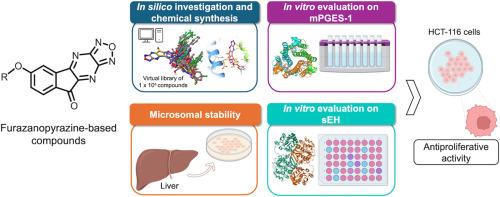
We report the identification of a new set of compounds based on the furazanopyrazine core interfering with eicosanoid biosynthesis and acting as potentially effective anti-inflammatory and anticancer agents. Based on our previous promising results on a set of furazanopyrazine-based compounds against the microsomal prostaglandin E2 synthase-1 (mPGES-1) enzyme, we here identified derivatives with improved pharmacokinetic properties by replacing the ester moiety with a more stable ether group.
A focused virtual library of 1 × 10⁴ molecules was built and screened against mPGES-1 through molecular docking experiments, leading to the selection of 10 candidates for synthesis and biological evaluation. Several molecules were found to inhibit mPGES-1 and, among them, two items featured IC50 values in the low micromolar range. Additional computational studies on the collection of synthesized compounds demonstrated that compound 3b, previously emerged as an mPGES-1 inhibitor, interfered with soluble epoxide hydrolase (sEH) activity, thus emerging as a valuable dual mPGES-1/sEH inhibitor. The pharmacokinetic features of the most potent compounds were accurately estimated. Unfortunately, poor outcomes were obtained for 3b; on the other hand, compound 7e exhibited promising mPGES-1 inhibition and excellent pharmacokinetic profile, demonstrating that the novel furazanopyrazine-based items with ether moiety possess improved pharmacokinetic properties compared to the ester-based compounds reported in our previous study. Additionally, the anticancer properties of 7e and 7d, the latter emerged as the most active mPGES-1 inhibitor, were evaluated and both compounds showed promising activities against HCT-116 human colorectal cancer (CRC) cells.
These findings highlight the furazanopyrazine core as a promising scaffold for disclosing new anti-inflammatory drugs with the ability to inhibit targets belonging to arachidonic acid cascade.
期刊介绍:
The European Journal of Medicinal Chemistry is a global journal that publishes studies on all aspects of medicinal chemistry. It provides a medium for publication of original papers and also welcomes critical review papers.
A typical paper would report on the organic synthesis, characterization and pharmacological evaluation of compounds. Other topics of interest are drug design, QSAR, molecular modeling, drug-receptor interactions, molecular aspects of drug metabolism, prodrug synthesis and drug targeting. The journal expects manuscripts to present the rational for a study, provide insight into the design of compounds or understanding of mechanism, or clarify the targets.





 京公网安备 11010802042870号
京ICP备2023020795号-1
京公网安备 11010802042870号
京ICP备2023020795号-1

 分享
分享
 求助内容:
求助内容: 应助结果提醒方式:
 扫码关注我们
