{"title":"磁反应性人工细胞线粒体移植通过支持小胶质细胞免疫稳态促进脑出血恢复","authors":"Mi Zhou, Jinhui Zang, Yuxuan Qian, Qiang Zhang, Yifan Wang, Tingting Yao, Hongyu Yan, Kai Zhang, Xiaojun Cai, Lixian Jiang, Yuanyi Zheng","doi":"10.1002/adma.202500303","DOIUrl":null,"url":null,"abstract":"<p>The immune-inflammatory responses in the brain represent a key therapeutic target to ameliorate brain injury following intracerebral hemorrhage (ICH), where pro-inflammatory microglia and its mitochondrial dysfunction plays a pivotal role. Mitochondrial transplantation is a promising strategy to improve the cellular mitochondrial function and thus modulate their immune properties. However, the transplantation of naked mitochondria into the brain has been constrained by the peripheral clearance and the difficulty in achieving selective access to the brain. Here, a novel strategy for mitochondrial transplantation via intravenous injection of magnetically responsive artificial cells (ACs) are proposed. ACs can protect the loaded mitochondria and selectively accumulate around the lesion under an external magnetic field (EMF). In this study, mitochondria released from ACs can effectively improve microglial mitochondrial function, attenuate their pro-inflammatory attributes, and elevate the proportion of immunosuppressive microglia. In this way, microglia immune homeostasis in the brain is reestablished, and inflammation is attenuated, ultimately promoting functional recovery. This study presents an effective approach to transplant mitochondria into the brain, offering a promising alternative to modulate the immune-inflammatory cascade in the brain following ICH.</p>","PeriodicalId":114,"journal":{"name":"Advanced Materials","volume":"37 13","pages":""},"PeriodicalIF":26.8000,"publicationDate":"2025-02-17","publicationTypes":"Journal Article","fieldsOfStudy":null,"isOpenAccess":false,"openAccessPdf":"https://onlinelibrary.wiley.com/doi/epdf/10.1002/adma.202500303","citationCount":"0","resultStr":"{\"title\":\"Mitochondrial Transplantation via Magnetically Responsive Artificial Cells Promotes Intracerebral Hemorrhage Recovery by Supporting Microglia Immunological Homeostasis\",\"authors\":\"Mi Zhou, Jinhui Zang, Yuxuan Qian, Qiang Zhang, Yifan Wang, Tingting Yao, Hongyu Yan, Kai Zhang, Xiaojun Cai, Lixian Jiang, Yuanyi Zheng\",\"doi\":\"10.1002/adma.202500303\",\"DOIUrl\":null,\"url\":null,\"abstract\":\"<p>The immune-inflammatory responses in the brain represent a key therapeutic target to ameliorate brain injury following intracerebral hemorrhage (ICH), where pro-inflammatory microglia and its mitochondrial dysfunction plays a pivotal role. Mitochondrial transplantation is a promising strategy to improve the cellular mitochondrial function and thus modulate their immune properties. However, the transplantation of naked mitochondria into the brain has been constrained by the peripheral clearance and the difficulty in achieving selective access to the brain. Here, a novel strategy for mitochondrial transplantation via intravenous injection of magnetically responsive artificial cells (ACs) are proposed. ACs can protect the loaded mitochondria and selectively accumulate around the lesion under an external magnetic field (EMF). In this study, mitochondria released from ACs can effectively improve microglial mitochondrial function, attenuate their pro-inflammatory attributes, and elevate the proportion of immunosuppressive microglia. In this way, microglia immune homeostasis in the brain is reestablished, and inflammation is attenuated, ultimately promoting functional recovery. This study presents an effective approach to transplant mitochondria into the brain, offering a promising alternative to modulate the immune-inflammatory cascade in the brain following ICH.</p>\",\"PeriodicalId\":114,\"journal\":{\"name\":\"Advanced Materials\",\"volume\":\"37 13\",\"pages\":\"\"},\"PeriodicalIF\":26.8000,\"publicationDate\":\"2025-02-17\",\"publicationTypes\":\"Journal Article\",\"fieldsOfStudy\":null,\"isOpenAccess\":false,\"openAccessPdf\":\"https://onlinelibrary.wiley.com/doi/epdf/10.1002/adma.202500303\",\"citationCount\":\"0\",\"resultStr\":null,\"platform\":\"Semanticscholar\",\"paperid\":null,\"PeriodicalName\":\"Advanced Materials\",\"FirstCategoryId\":\"88\",\"ListUrlMain\":\"https://advanced.onlinelibrary.wiley.com/doi/10.1002/adma.202500303\",\"RegionNum\":1,\"RegionCategory\":\"材料科学\",\"ArticlePicture\":[],\"TitleCN\":null,\"AbstractTextCN\":null,\"PMCID\":null,\"EPubDate\":\"\",\"PubModel\":\"\",\"JCR\":\"Q1\",\"JCRName\":\"CHEMISTRY, MULTIDISCIPLINARY\",\"Score\":null,\"Total\":0}","platform":"Semanticscholar","paperid":null,"PeriodicalName":"Advanced Materials","FirstCategoryId":"88","ListUrlMain":"https://advanced.onlinelibrary.wiley.com/doi/10.1002/adma.202500303","RegionNum":1,"RegionCategory":"材料科学","ArticlePicture":[],"TitleCN":null,"AbstractTextCN":null,"PMCID":null,"EPubDate":"","PubModel":"","JCR":"Q1","JCRName":"CHEMISTRY, MULTIDISCIPLINARY","Score":null,"Total":0}
Mitochondrial Transplantation via Magnetically Responsive Artificial Cells Promotes Intracerebral Hemorrhage Recovery by Supporting Microglia Immunological Homeostasis
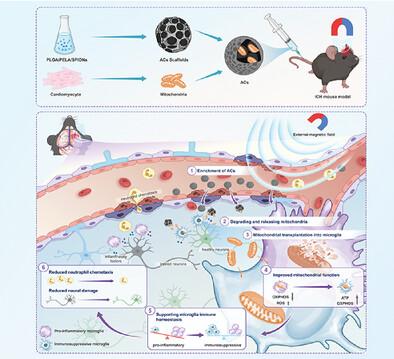
The immune-inflammatory responses in the brain represent a key therapeutic target to ameliorate brain injury following intracerebral hemorrhage (ICH), where pro-inflammatory microglia and its mitochondrial dysfunction plays a pivotal role. Mitochondrial transplantation is a promising strategy to improve the cellular mitochondrial function and thus modulate their immune properties. However, the transplantation of naked mitochondria into the brain has been constrained by the peripheral clearance and the difficulty in achieving selective access to the brain. Here, a novel strategy for mitochondrial transplantation via intravenous injection of magnetically responsive artificial cells (ACs) are proposed. ACs can protect the loaded mitochondria and selectively accumulate around the lesion under an external magnetic field (EMF). In this study, mitochondria released from ACs can effectively improve microglial mitochondrial function, attenuate their pro-inflammatory attributes, and elevate the proportion of immunosuppressive microglia. In this way, microglia immune homeostasis in the brain is reestablished, and inflammation is attenuated, ultimately promoting functional recovery. This study presents an effective approach to transplant mitochondria into the brain, offering a promising alternative to modulate the immune-inflammatory cascade in the brain following ICH.
期刊介绍:
Advanced Materials, one of the world's most prestigious journals and the foundation of the Advanced portfolio, is the home of choice for best-in-class materials science for more than 30 years. Following this fast-growing and interdisciplinary field, we are considering and publishing the most important discoveries on any and all materials from materials scientists, chemists, physicists, engineers as well as health and life scientists and bringing you the latest results and trends in modern materials-related research every week.








 京公网安备 11010802042870号
京ICP备2023020795号-1
京公网安备 11010802042870号
京ICP备2023020795号-1

 分享
分享
 求助内容:
求助内容: 应助结果提醒方式:
 扫码关注我们
