{"title":"利用机器学习预测有机化合物与单线态氧的反应速率常数并揭示其影响因素","authors":"Tengyi Zhu, Fulei Qi, Cuicui Tao, Yi Li, Shuyin Li, Xiaofan Lv","doi":"10.1021/acs.iecr.4c04008","DOIUrl":null,"url":null,"abstract":"Singlet oxygen (<sup>1</sup>O<sub>2</sub>), as an electrophilic reagent, is widely used for oxidative degradation of organic compounds (OCs). The <sup>1</sup>O<sub>2</sub> reaction rate constant (<i>k</i>) is an important index for evaluating the OCs degradation rate. Under limited conditions, owing to the difficulty in experimentally determining <i>k</i> of all OCs, researchers have gradually developed predictive models. However, research on how to evaluate the best modeling method from multiple models is still lacking. In addition, this study also introduces the environmental variable (pH) in log <i>k</i> model development for the first time. On this basis, eight models were developed using linear and nonlinear methods, and a comprehensive evaluation system based on the TOPSIS method was proposed. The evaluation results indicated that the CatB model (<i>R</i><sub>tra</sub><sup>2</sup> = 0.980, <i>Q</i><sub>Loo</sub><sup>2</sup> = 0.775, <i>Q</i><sub>test</sub><sup>2</sup> = 0.868) exhibited outstanding comprehensive performance and the best prediction effect. The interpretation based on the SHAP values revealed that the key influences of <i>E</i><sub>(HOMO)</sub>, pH, electronegativity, van der Waals surface area and molecular structure had major effects on the degradation of OCs by <sup>1</sup>O<sub>2</sub>. Interpretable machine learning methods provide a potential shortcut for predicting <i>k</i>, offering significant guidance for optimizing experimental design and improving environmental management efficiency.","PeriodicalId":39,"journal":{"name":"Industrial & Engineering Chemistry Research","volume":"4 1","pages":""},"PeriodicalIF":3.9000,"publicationDate":"2025-02-18","publicationTypes":"Journal Article","fieldsOfStudy":null,"isOpenAccess":false,"openAccessPdf":"","citationCount":"0","resultStr":"{\"title\":\"Predicting Reaction Rate Constant of Organic Compounds with Singlet Oxygen and Revealing Its Contributors Using Machine Learning\",\"authors\":\"Tengyi Zhu, Fulei Qi, Cuicui Tao, Yi Li, Shuyin Li, Xiaofan Lv\",\"doi\":\"10.1021/acs.iecr.4c04008\",\"DOIUrl\":null,\"url\":null,\"abstract\":\"Singlet oxygen (<sup>1</sup>O<sub>2</sub>), as an electrophilic reagent, is widely used for oxidative degradation of organic compounds (OCs). The <sup>1</sup>O<sub>2</sub> reaction rate constant (<i>k</i>) is an important index for evaluating the OCs degradation rate. Under limited conditions, owing to the difficulty in experimentally determining <i>k</i> of all OCs, researchers have gradually developed predictive models. However, research on how to evaluate the best modeling method from multiple models is still lacking. In addition, this study also introduces the environmental variable (pH) in log <i>k</i> model development for the first time. On this basis, eight models were developed using linear and nonlinear methods, and a comprehensive evaluation system based on the TOPSIS method was proposed. The evaluation results indicated that the CatB model (<i>R</i><sub>tra</sub><sup>2</sup> = 0.980, <i>Q</i><sub>Loo</sub><sup>2</sup> = 0.775, <i>Q</i><sub>test</sub><sup>2</sup> = 0.868) exhibited outstanding comprehensive performance and the best prediction effect. The interpretation based on the SHAP values revealed that the key influences of <i>E</i><sub>(HOMO)</sub>, pH, electronegativity, van der Waals surface area and molecular structure had major effects on the degradation of OCs by <sup>1</sup>O<sub>2</sub>. Interpretable machine learning methods provide a potential shortcut for predicting <i>k</i>, offering significant guidance for optimizing experimental design and improving environmental management efficiency.\",\"PeriodicalId\":39,\"journal\":{\"name\":\"Industrial & Engineering Chemistry Research\",\"volume\":\"4 1\",\"pages\":\"\"},\"PeriodicalIF\":3.9000,\"publicationDate\":\"2025-02-18\",\"publicationTypes\":\"Journal Article\",\"fieldsOfStudy\":null,\"isOpenAccess\":false,\"openAccessPdf\":\"\",\"citationCount\":\"0\",\"resultStr\":null,\"platform\":\"Semanticscholar\",\"paperid\":null,\"PeriodicalName\":\"Industrial & Engineering Chemistry Research\",\"FirstCategoryId\":\"5\",\"ListUrlMain\":\"https://doi.org/10.1021/acs.iecr.4c04008\",\"RegionNum\":3,\"RegionCategory\":\"工程技术\",\"ArticlePicture\":[],\"TitleCN\":null,\"AbstractTextCN\":null,\"PMCID\":null,\"EPubDate\":\"\",\"PubModel\":\"\",\"JCR\":\"Q2\",\"JCRName\":\"ENGINEERING, CHEMICAL\",\"Score\":null,\"Total\":0}","platform":"Semanticscholar","paperid":null,"PeriodicalName":"Industrial & Engineering Chemistry Research","FirstCategoryId":"5","ListUrlMain":"https://doi.org/10.1021/acs.iecr.4c04008","RegionNum":3,"RegionCategory":"工程技术","ArticlePicture":[],"TitleCN":null,"AbstractTextCN":null,"PMCID":null,"EPubDate":"","PubModel":"","JCR":"Q2","JCRName":"ENGINEERING, CHEMICAL","Score":null,"Total":0}
Predicting Reaction Rate Constant of Organic Compounds with Singlet Oxygen and Revealing Its Contributors Using Machine Learning
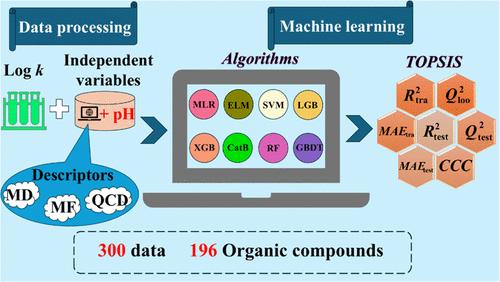
Singlet oxygen (1O2), as an electrophilic reagent, is widely used for oxidative degradation of organic compounds (OCs). The 1O2 reaction rate constant (k) is an important index for evaluating the OCs degradation rate. Under limited conditions, owing to the difficulty in experimentally determining k of all OCs, researchers have gradually developed predictive models. However, research on how to evaluate the best modeling method from multiple models is still lacking. In addition, this study also introduces the environmental variable (pH) in log k model development for the first time. On this basis, eight models were developed using linear and nonlinear methods, and a comprehensive evaluation system based on the TOPSIS method was proposed. The evaluation results indicated that the CatB model (Rtra2 = 0.980, QLoo2 = 0.775, Qtest2 = 0.868) exhibited outstanding comprehensive performance and the best prediction effect. The interpretation based on the SHAP values revealed that the key influences of E(HOMO), pH, electronegativity, van der Waals surface area and molecular structure had major effects on the degradation of OCs by 1O2. Interpretable machine learning methods provide a potential shortcut for predicting k, offering significant guidance for optimizing experimental design and improving environmental management efficiency.
期刊介绍:
ndustrial & Engineering Chemistry, with variations in title and format, has been published since 1909 by the American Chemical Society. Industrial & Engineering Chemistry Research is a weekly publication that reports industrial and academic research in the broad fields of applied chemistry and chemical engineering with special focus on fundamentals, processes, and products.




 京公网安备 11010802042870号
京ICP备2023020795号-1
京公网安备 11010802042870号
京ICP备2023020795号-1

 分享
分享
 求助内容:
求助内容: 应助结果提醒方式:
 扫码关注我们
