{"title":"双增强纳米氧化铁/碳核壳纳米棒实现耐用钠离子混合电容器","authors":"Zengwei Pang, Miaomiao Liu, Shenteng Wan, Yongdong Liu, Xiaohui Niu, Deyi Zhang, Kunjie Wang, Hongxia Li","doi":"10.1002/smll.202411436","DOIUrl":null,"url":null,"abstract":"<p>Sodium-ion hybrid capacitors (SIHCs) represent a promising option for cost-effective grid-scale energy storage due to their combination of high energy and power densities, as well as excellent cycle stability. However, the practical application of SIHCs is hindered by the lack of advanced anode materials that exhibit fast ion diffusion kinetics and robust structures. Herein, a novel design featuring a nano-sized Fe<sub>3</sub>O<sub>4</sub> is developed, that is double-reinforced by porous carbon derived from metal-organic frameworks (MOFs) as the inner core support and N, P-co-doped carbon from a polymer decomposition as the outer shell, resulting in a robust pencil-like core–shell structural composite (Fe<sub>3</sub>O<sub>4</sub>/NPC). The Fe<sub>3</sub>O<sub>4</sub> nanograins and abundant surface groups containing N and P reduce the charge/electron transfer distance and provide numerous pseudocapacitive active sites, guaranteeing high energy output and superior rate capability. The optimized core–shell structure and interconnected carbon framework effectively accommodate volume changes, prevent nanoparticle agglomeration, and facilitate ion/electron transport, thereby ensuring structural integrity and rapid kinetics. In testing, Fe<sub>3</sub>O<sub>4</sub>/NPC demonstrated superior cycling durability, retaining 86.6% of its initial capacity after 2500 cycles in sodium-ion batteries (SIBs). Impressively, the assembled SIHC achieved a notable energy density of 147.1 W h kg<sup>−1</sup> and maintained 92% capacity after 8000 cycles.</p>","PeriodicalId":228,"journal":{"name":"Small","volume":"21 13","pages":""},"PeriodicalIF":12.1000,"publicationDate":"2025-02-17","publicationTypes":"Journal Article","fieldsOfStudy":null,"isOpenAccess":false,"openAccessPdf":"","citationCount":"0","resultStr":"{\"title\":\"Double-Reinforced Nano-Sized Ferrosoferric Oxide/Carbon Core–Shell Nanorods Enabling Durable Sodium-Ion Hybrid Capacitors\",\"authors\":\"Zengwei Pang, Miaomiao Liu, Shenteng Wan, Yongdong Liu, Xiaohui Niu, Deyi Zhang, Kunjie Wang, Hongxia Li\",\"doi\":\"10.1002/smll.202411436\",\"DOIUrl\":null,\"url\":null,\"abstract\":\"<p>Sodium-ion hybrid capacitors (SIHCs) represent a promising option for cost-effective grid-scale energy storage due to their combination of high energy and power densities, as well as excellent cycle stability. However, the practical application of SIHCs is hindered by the lack of advanced anode materials that exhibit fast ion diffusion kinetics and robust structures. Herein, a novel design featuring a nano-sized Fe<sub>3</sub>O<sub>4</sub> is developed, that is double-reinforced by porous carbon derived from metal-organic frameworks (MOFs) as the inner core support and N, P-co-doped carbon from a polymer decomposition as the outer shell, resulting in a robust pencil-like core–shell structural composite (Fe<sub>3</sub>O<sub>4</sub>/NPC). The Fe<sub>3</sub>O<sub>4</sub> nanograins and abundant surface groups containing N and P reduce the charge/electron transfer distance and provide numerous pseudocapacitive active sites, guaranteeing high energy output and superior rate capability. The optimized core–shell structure and interconnected carbon framework effectively accommodate volume changes, prevent nanoparticle agglomeration, and facilitate ion/electron transport, thereby ensuring structural integrity and rapid kinetics. In testing, Fe<sub>3</sub>O<sub>4</sub>/NPC demonstrated superior cycling durability, retaining 86.6% of its initial capacity after 2500 cycles in sodium-ion batteries (SIBs). Impressively, the assembled SIHC achieved a notable energy density of 147.1 W h kg<sup>−1</sup> and maintained 92% capacity after 8000 cycles.</p>\",\"PeriodicalId\":228,\"journal\":{\"name\":\"Small\",\"volume\":\"21 13\",\"pages\":\"\"},\"PeriodicalIF\":12.1000,\"publicationDate\":\"2025-02-17\",\"publicationTypes\":\"Journal Article\",\"fieldsOfStudy\":null,\"isOpenAccess\":false,\"openAccessPdf\":\"\",\"citationCount\":\"0\",\"resultStr\":null,\"platform\":\"Semanticscholar\",\"paperid\":null,\"PeriodicalName\":\"Small\",\"FirstCategoryId\":\"88\",\"ListUrlMain\":\"https://onlinelibrary.wiley.com/doi/10.1002/smll.202411436\",\"RegionNum\":2,\"RegionCategory\":\"材料科学\",\"ArticlePicture\":[],\"TitleCN\":null,\"AbstractTextCN\":null,\"PMCID\":null,\"EPubDate\":\"\",\"PubModel\":\"\",\"JCR\":\"Q1\",\"JCRName\":\"CHEMISTRY, MULTIDISCIPLINARY\",\"Score\":null,\"Total\":0}","platform":"Semanticscholar","paperid":null,"PeriodicalName":"Small","FirstCategoryId":"88","ListUrlMain":"https://onlinelibrary.wiley.com/doi/10.1002/smll.202411436","RegionNum":2,"RegionCategory":"材料科学","ArticlePicture":[],"TitleCN":null,"AbstractTextCN":null,"PMCID":null,"EPubDate":"","PubModel":"","JCR":"Q1","JCRName":"CHEMISTRY, MULTIDISCIPLINARY","Score":null,"Total":0}
引用次数: 0
摘要
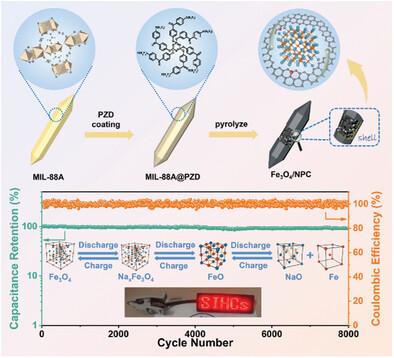
钠离子混合电容器(sihc)由于其高能量和功率密度的组合以及出色的循环稳定性,代表了具有成本效益的电网规模储能的有前途的选择。然而,由于缺乏具有快速离子扩散动力学和坚固结构的先进阳极材料,sihc的实际应用受到阻碍。本文提出了一种新型的纳米Fe3O4结构设计,该结构由金属有机框架(MOFs)衍生的多孔碳作为内核支撑,由聚合物分解产生的N, p共掺杂碳作为外壳进行双重增强,从而形成坚固的铅笔状核-壳结构复合材料(Fe3O4/NPC)。Fe3O4纳米颗粒和丰富的含有N和P的表面基团减少了电荷/电子转移距离,提供了大量的假电容活性位点,保证了高能量输出和优越的速率能力。优化后的核壳结构和相互连接的碳框架有效地适应了体积变化,防止了纳米颗粒团聚,促进了离子/电子的传递,从而保证了结构的完整性和快速动力学。在测试中,Fe3O4/NPC表现出优异的循环耐久性,在钠离子电池(sib)中循环2500次后仍能保持86.6%的初始容量。令人印象深刻的是,组装的SIHC达到了147.1 W h kg−1的能量密度,并在8000次循环后保持了92%的容量。
Sodium-ion hybrid capacitors (SIHCs) represent a promising option for cost-effective grid-scale energy storage due to their combination of high energy and power densities, as well as excellent cycle stability. However, the practical application of SIHCs is hindered by the lack of advanced anode materials that exhibit fast ion diffusion kinetics and robust structures. Herein, a novel design featuring a nano-sized Fe3O4 is developed, that is double-reinforced by porous carbon derived from metal-organic frameworks (MOFs) as the inner core support and N, P-co-doped carbon from a polymer decomposition as the outer shell, resulting in a robust pencil-like core–shell structural composite (Fe3O4/NPC). The Fe3O4 nanograins and abundant surface groups containing N and P reduce the charge/electron transfer distance and provide numerous pseudocapacitive active sites, guaranteeing high energy output and superior rate capability. The optimized core–shell structure and interconnected carbon framework effectively accommodate volume changes, prevent nanoparticle agglomeration, and facilitate ion/electron transport, thereby ensuring structural integrity and rapid kinetics. In testing, Fe3O4/NPC demonstrated superior cycling durability, retaining 86.6% of its initial capacity after 2500 cycles in sodium-ion batteries (SIBs). Impressively, the assembled SIHC achieved a notable energy density of 147.1 W h kg−1 and maintained 92% capacity after 8000 cycles.
期刊介绍:
Small serves as an exceptional platform for both experimental and theoretical studies in fundamental and applied interdisciplinary research at the nano- and microscale. The journal offers a compelling mix of peer-reviewed Research Articles, Reviews, Perspectives, and Comments.
With a remarkable 2022 Journal Impact Factor of 13.3 (Journal Citation Reports from Clarivate Analytics, 2023), Small remains among the top multidisciplinary journals, covering a wide range of topics at the interface of materials science, chemistry, physics, engineering, medicine, and biology.
Small's readership includes biochemists, biologists, biomedical scientists, chemists, engineers, information technologists, materials scientists, physicists, and theoreticians alike.





 京公网安备 11010802042870号
京ICP备2023020795号-1
京公网安备 11010802042870号
京ICP备2023020795号-1

 分享
分享
 求助内容:
求助内容: 应助结果提醒方式:
 扫码关注我们
