Henry Ruiz-Guzman , Tyler Adams , Afolabi Agbona , Matthew Wolfe , Mark Everett , Jean-Francois Chamberland , Dirk B. Hays
{"title":"基于阈值和连续小波变换的探地雷达(GPR)数据估算马铃薯生物量","authors":"Henry Ruiz-Guzman , Tyler Adams , Afolabi Agbona , Matthew Wolfe , Mark Everett , Jean-Francois Chamberland , Dirk B. Hays","doi":"10.1016/j.compag.2025.110114","DOIUrl":null,"url":null,"abstract":"<div><div>Potato <em>(Solanum tuberosum)</em> is widely recognized as the leading vegetable crop in the United States, with millions of tons produced annually. Despite many advancements in cultivars, crop production still suffers from meager progress in the assessment of early maturity. One potential solution to this problem is Ground-Penetrating Radar (GPR), a near-surface geophysical tool that has recently been applied to agriculture for assessment of root systems by detecting dielectric variations in sub-surface and soil layers by means of electromagnetic waves emitted into the ground. This study seeks to assess GPR’s capability to serve as a non-destructive proximal-sensing technique for quantifying potato tuber biomass by estimating the size of potatoes by measuring changes in the reflected GPR signal. Two methods, thresholding analysis and continuous wavelet transform (CWT), were employed in this study to extract features from GPR responses to predict tuber biomass. The dataset was collected in a controlled sandbox system. Thresholding analysis on the interpolated amplitude values yielded significant results, being able to predict tuber biomass with an accuracy of r = 0.82 and R2 = 0.64 based upon Multiple Linear regression. CWT was somewhat less successful, yet still significant, with a prediction accuracy of r = 0.6 and R2 = 0.32. These results indicate that GPR technology is suitable as a decision-support tool for potato breeders seeking to monitor tuber growth.</div></div>","PeriodicalId":50627,"journal":{"name":"Computers and Electronics in Agriculture","volume":"232 ","pages":"Article 110114"},"PeriodicalIF":10.3000,"publicationDate":"2025-05-01","publicationTypes":"Journal Article","fieldsOfStudy":null,"isOpenAccess":false,"openAccessPdf":"","citationCount":"0","resultStr":"{\"title\":\"Thresholding and continuous wavelet transform (CWT) analysis of Ground Penetrating Radar (GPR) data for estimation of potato biomass\",\"authors\":\"Henry Ruiz-Guzman , Tyler Adams , Afolabi Agbona , Matthew Wolfe , Mark Everett , Jean-Francois Chamberland , Dirk B. Hays\",\"doi\":\"10.1016/j.compag.2025.110114\",\"DOIUrl\":null,\"url\":null,\"abstract\":\"<div><div>Potato <em>(Solanum tuberosum)</em> is widely recognized as the leading vegetable crop in the United States, with millions of tons produced annually. Despite many advancements in cultivars, crop production still suffers from meager progress in the assessment of early maturity. One potential solution to this problem is Ground-Penetrating Radar (GPR), a near-surface geophysical tool that has recently been applied to agriculture for assessment of root systems by detecting dielectric variations in sub-surface and soil layers by means of electromagnetic waves emitted into the ground. This study seeks to assess GPR’s capability to serve as a non-destructive proximal-sensing technique for quantifying potato tuber biomass by estimating the size of potatoes by measuring changes in the reflected GPR signal. Two methods, thresholding analysis and continuous wavelet transform (CWT), were employed in this study to extract features from GPR responses to predict tuber biomass. The dataset was collected in a controlled sandbox system. Thresholding analysis on the interpolated amplitude values yielded significant results, being able to predict tuber biomass with an accuracy of r = 0.82 and R2 = 0.64 based upon Multiple Linear regression. CWT was somewhat less successful, yet still significant, with a prediction accuracy of r = 0.6 and R2 = 0.32. These results indicate that GPR technology is suitable as a decision-support tool for potato breeders seeking to monitor tuber growth.</div></div>\",\"PeriodicalId\":50627,\"journal\":{\"name\":\"Computers and Electronics in Agriculture\",\"volume\":\"232 \",\"pages\":\"Article 110114\"},\"PeriodicalIF\":10.3000,\"publicationDate\":\"2025-05-01\",\"publicationTypes\":\"Journal Article\",\"fieldsOfStudy\":null,\"isOpenAccess\":false,\"openAccessPdf\":\"\",\"citationCount\":\"0\",\"resultStr\":null,\"platform\":\"Semanticscholar\",\"paperid\":null,\"PeriodicalName\":\"Computers and Electronics in Agriculture\",\"FirstCategoryId\":\"97\",\"ListUrlMain\":\"https://www.sciencedirect.com/science/article/pii/S0168169925002200\",\"RegionNum\":1,\"RegionCategory\":\"农林科学\",\"ArticlePicture\":[],\"TitleCN\":null,\"AbstractTextCN\":null,\"PMCID\":null,\"EPubDate\":\"2025/2/19 0:00:00\",\"PubModel\":\"Epub\",\"JCR\":\"Q1\",\"JCRName\":\"AGRICULTURE, MULTIDISCIPLINARY\",\"Score\":null,\"Total\":0}","platform":"Semanticscholar","paperid":null,"PeriodicalName":"Computers and Electronics in Agriculture","FirstCategoryId":"97","ListUrlMain":"https://www.sciencedirect.com/science/article/pii/S0168169925002200","RegionNum":1,"RegionCategory":"农林科学","ArticlePicture":[],"TitleCN":null,"AbstractTextCN":null,"PMCID":null,"EPubDate":"2025/2/19 0:00:00","PubModel":"Epub","JCR":"Q1","JCRName":"AGRICULTURE, MULTIDISCIPLINARY","Score":null,"Total":0}
Thresholding and continuous wavelet transform (CWT) analysis of Ground Penetrating Radar (GPR) data for estimation of potato biomass
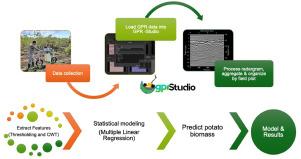
Potato (Solanum tuberosum) is widely recognized as the leading vegetable crop in the United States, with millions of tons produced annually. Despite many advancements in cultivars, crop production still suffers from meager progress in the assessment of early maturity. One potential solution to this problem is Ground-Penetrating Radar (GPR), a near-surface geophysical tool that has recently been applied to agriculture for assessment of root systems by detecting dielectric variations in sub-surface and soil layers by means of electromagnetic waves emitted into the ground. This study seeks to assess GPR’s capability to serve as a non-destructive proximal-sensing technique for quantifying potato tuber biomass by estimating the size of potatoes by measuring changes in the reflected GPR signal. Two methods, thresholding analysis and continuous wavelet transform (CWT), were employed in this study to extract features from GPR responses to predict tuber biomass. The dataset was collected in a controlled sandbox system. Thresholding analysis on the interpolated amplitude values yielded significant results, being able to predict tuber biomass with an accuracy of r = 0.82 and R2 = 0.64 based upon Multiple Linear regression. CWT was somewhat less successful, yet still significant, with a prediction accuracy of r = 0.6 and R2 = 0.32. These results indicate that GPR technology is suitable as a decision-support tool for potato breeders seeking to monitor tuber growth.
期刊介绍:
Computers and Electronics in Agriculture provides international coverage of advancements in computer hardware, software, electronic instrumentation, and control systems applied to agricultural challenges. Encompassing agronomy, horticulture, forestry, aquaculture, and animal farming, the journal publishes original papers, reviews, and applications notes. It explores the use of computers and electronics in plant or animal agricultural production, covering topics like agricultural soils, water, pests, controlled environments, and waste. The scope extends to on-farm post-harvest operations and relevant technologies, including artificial intelligence, sensors, machine vision, robotics, networking, and simulation modeling. Its companion journal, Smart Agricultural Technology, continues the focus on smart applications in production agriculture.




 京公网安备 11010802042870号
京ICP备2023020795号-1
京公网安备 11010802042870号
京ICP备2023020795号-1

 分享
分享
 求助内容:
求助内容: 应助结果提醒方式:
 扫码关注我们
