{"title":"一种巨噬细胞样仿生纳米颗粒,具有高效的生物膜破坏和先天免疫激活,用于植入物相关感染治疗","authors":"Guoqing Wei , Tiantian Xiao , Yufeng Xi, Rong Ju","doi":"10.1016/j.mtbio.2025.101575","DOIUrl":null,"url":null,"abstract":"<div><div>The innate immune system's inactivation and microbial biofilm-induced antibiotic resistance are the main causes of implant-associated infections (IAIs), which frequently result in implant surgical failure. Refractory recolonization is the consequence of standard therapies that are unable to consistently suppress escaping planktonic bacteria from biofilm, thereby enabling IAIs to thrive. Here, we specifically designed a macrophage-like biomimetic nanoparticle (F/R@PM) for a biofilm microenvironment (BME), which was fabricated by coating the cell membrane derived from macrophage onto poly (lactic-co-glycolic acid) (PLGA) namoparticles (NPs) loaded with FOT (NO donor) and R837 (TLR7 agonist). After injecting F/R@PM into mice with implant-associated infections, it was able to selectively target macrophages through macrophage membrane proteins on its surface and effectively release FOT and R837. Then, FOT that spreads outside the cell could react with glutathione (GSH) in the BEM to rapidly produce a large amount of NO inside biofilms to destroy the biofilm and kill bacteria. At the same time, R837 would encourage macrophages to scavenge planktonic bacteria that had escaped biofilm disintegration through improved phagocytosis. Overall, this work shows that NO treatment and immunotherapy together have promising potential for the long-term and efficient control and eradication of IAIs.</div></div>","PeriodicalId":18310,"journal":{"name":"Materials Today Bio","volume":"31 ","pages":"Article 101575"},"PeriodicalIF":10.2000,"publicationDate":"2025-04-01","publicationTypes":"Journal Article","fieldsOfStudy":null,"isOpenAccess":false,"openAccessPdf":"","citationCount":"0","resultStr":"{\"title\":\"A macrophage-like biomimetic nanoparticle with high-efficiency biofilm disruption and innate immunity activation for implant-related infection therapy\",\"authors\":\"Guoqing Wei , Tiantian Xiao , Yufeng Xi, Rong Ju\",\"doi\":\"10.1016/j.mtbio.2025.101575\",\"DOIUrl\":null,\"url\":null,\"abstract\":\"<div><div>The innate immune system's inactivation and microbial biofilm-induced antibiotic resistance are the main causes of implant-associated infections (IAIs), which frequently result in implant surgical failure. Refractory recolonization is the consequence of standard therapies that are unable to consistently suppress escaping planktonic bacteria from biofilm, thereby enabling IAIs to thrive. Here, we specifically designed a macrophage-like biomimetic nanoparticle (F/R@PM) for a biofilm microenvironment (BME), which was fabricated by coating the cell membrane derived from macrophage onto poly (lactic-co-glycolic acid) (PLGA) namoparticles (NPs) loaded with FOT (NO donor) and R837 (TLR7 agonist). After injecting F/R@PM into mice with implant-associated infections, it was able to selectively target macrophages through macrophage membrane proteins on its surface and effectively release FOT and R837. Then, FOT that spreads outside the cell could react with glutathione (GSH) in the BEM to rapidly produce a large amount of NO inside biofilms to destroy the biofilm and kill bacteria. At the same time, R837 would encourage macrophages to scavenge planktonic bacteria that had escaped biofilm disintegration through improved phagocytosis. Overall, this work shows that NO treatment and immunotherapy together have promising potential for the long-term and efficient control and eradication of IAIs.</div></div>\",\"PeriodicalId\":18310,\"journal\":{\"name\":\"Materials Today Bio\",\"volume\":\"31 \",\"pages\":\"Article 101575\"},\"PeriodicalIF\":10.2000,\"publicationDate\":\"2025-04-01\",\"publicationTypes\":\"Journal Article\",\"fieldsOfStudy\":null,\"isOpenAccess\":false,\"openAccessPdf\":\"\",\"citationCount\":\"0\",\"resultStr\":null,\"platform\":\"Semanticscholar\",\"paperid\":null,\"PeriodicalName\":\"Materials Today Bio\",\"FirstCategoryId\":\"5\",\"ListUrlMain\":\"https://www.sciencedirect.com/science/article/pii/S2590006425001334\",\"RegionNum\":1,\"RegionCategory\":\"医学\",\"ArticlePicture\":[],\"TitleCN\":null,\"AbstractTextCN\":null,\"PMCID\":null,\"EPubDate\":\"2025/2/14 0:00:00\",\"PubModel\":\"Epub\",\"JCR\":\"Q1\",\"JCRName\":\"ENGINEERING, BIOMEDICAL\",\"Score\":null,\"Total\":0}","platform":"Semanticscholar","paperid":null,"PeriodicalName":"Materials Today Bio","FirstCategoryId":"5","ListUrlMain":"https://www.sciencedirect.com/science/article/pii/S2590006425001334","RegionNum":1,"RegionCategory":"医学","ArticlePicture":[],"TitleCN":null,"AbstractTextCN":null,"PMCID":null,"EPubDate":"2025/2/14 0:00:00","PubModel":"Epub","JCR":"Q1","JCRName":"ENGINEERING, BIOMEDICAL","Score":null,"Total":0}
A macrophage-like biomimetic nanoparticle with high-efficiency biofilm disruption and innate immunity activation for implant-related infection therapy
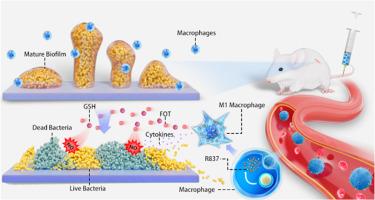
The innate immune system's inactivation and microbial biofilm-induced antibiotic resistance are the main causes of implant-associated infections (IAIs), which frequently result in implant surgical failure. Refractory recolonization is the consequence of standard therapies that are unable to consistently suppress escaping planktonic bacteria from biofilm, thereby enabling IAIs to thrive. Here, we specifically designed a macrophage-like biomimetic nanoparticle (F/R@PM) for a biofilm microenvironment (BME), which was fabricated by coating the cell membrane derived from macrophage onto poly (lactic-co-glycolic acid) (PLGA) namoparticles (NPs) loaded with FOT (NO donor) and R837 (TLR7 agonist). After injecting F/R@PM into mice with implant-associated infections, it was able to selectively target macrophages through macrophage membrane proteins on its surface and effectively release FOT and R837. Then, FOT that spreads outside the cell could react with glutathione (GSH) in the BEM to rapidly produce a large amount of NO inside biofilms to destroy the biofilm and kill bacteria. At the same time, R837 would encourage macrophages to scavenge planktonic bacteria that had escaped biofilm disintegration through improved phagocytosis. Overall, this work shows that NO treatment and immunotherapy together have promising potential for the long-term and efficient control and eradication of IAIs.
期刊介绍:
Materials Today Bio is a multidisciplinary journal that specializes in the intersection between biology and materials science, chemistry, physics, engineering, and medicine. It covers various aspects such as the design and assembly of new structures, their interaction with biological systems, functionalization, bioimaging, therapies, and diagnostics in healthcare. The journal aims to showcase the most significant advancements and discoveries in this field. As part of the Materials Today family, Materials Today Bio provides rigorous peer review, quick decision-making, and high visibility for authors. It is indexed in Scopus, PubMed Central, Emerging Sources, Citation Index (ESCI), and Directory of Open Access Journals (DOAJ).




 京公网安备 11010802042870号
京ICP备2023020795号-1
京公网安备 11010802042870号
京ICP备2023020795号-1

 分享
分享
 求助内容:
求助内容: 应助结果提醒方式:
 扫码关注我们
