Hanumesh Vaidya , K.V. Prasad , Rajashekhar Choudhari , Shruthi Karanth , Neelufer Z. Basha , Kiran V
{"title":"蠕动Rabinowitsch纳米流体通过温度随变流体性质的非均匀管的传热传质特性","authors":"Hanumesh Vaidya , K.V. Prasad , Rajashekhar Choudhari , Shruthi Karanth , Neelufer Z. Basha , Kiran V","doi":"10.1016/j.ijft.2025.101126","DOIUrl":null,"url":null,"abstract":"<div><div>This paper gives a quantitative examination of peristaltic flow in a non-uniform tube, which includes temperature-dependent fluid characteristics and second-order slip conditions. The research uses the Rabinowitsch fluid model to describe non-Newtonian behaviour, while Buongiorno's nanofluid model characterises the fluid's thermophysical characteristics. To answer the current physical puzzle, a set of highly nonlinear equations must be translated utilising nondimensional parameters and fundamental assumptions such as a low Reynolds number and a long wavelength. The Optimal Homotopy Analysis Method (OHAM) is used to develop the solution.. We examine the impact of various physiological limitations through the generation of graphs. The graphs presented here demonstrate how various parameters affect Nusselt number, Sherwood number, temperature, velocity, concentration, skin friction, and streamlines. As a consequence of the Lorentz force, the current investigation found that the axial velocity reduces as <em>M<sub>n</sub></em> increases. The fluid's shear-thinning behaviour causes axial velocity to drop as slip parameters rise. The findings provide practical insights for enhancing heat transfer efficiency in industrial applications, particularly in systems utilizing non-Newtonian nanofluids, such as chemical processing and microfluidic devices.</div></div>","PeriodicalId":36341,"journal":{"name":"International Journal of Thermofluids","volume":"26 ","pages":"Article 101126"},"PeriodicalIF":0.0000,"publicationDate":"2025-03-01","publicationTypes":"Journal Article","fieldsOfStudy":null,"isOpenAccess":false,"openAccessPdf":"","citationCount":"0","resultStr":"{\"title\":\"Heat and mass transfer characteristics in peristaltic Rabinowitsch nano-fluid passing through a non-uniform tube with temperature dependent variable fluid properties\",\"authors\":\"Hanumesh Vaidya , K.V. Prasad , Rajashekhar Choudhari , Shruthi Karanth , Neelufer Z. Basha , Kiran V\",\"doi\":\"10.1016/j.ijft.2025.101126\",\"DOIUrl\":null,\"url\":null,\"abstract\":\"<div><div>This paper gives a quantitative examination of peristaltic flow in a non-uniform tube, which includes temperature-dependent fluid characteristics and second-order slip conditions. The research uses the Rabinowitsch fluid model to describe non-Newtonian behaviour, while Buongiorno's nanofluid model characterises the fluid's thermophysical characteristics. To answer the current physical puzzle, a set of highly nonlinear equations must be translated utilising nondimensional parameters and fundamental assumptions such as a low Reynolds number and a long wavelength. The Optimal Homotopy Analysis Method (OHAM) is used to develop the solution.. We examine the impact of various physiological limitations through the generation of graphs. The graphs presented here demonstrate how various parameters affect Nusselt number, Sherwood number, temperature, velocity, concentration, skin friction, and streamlines. As a consequence of the Lorentz force, the current investigation found that the axial velocity reduces as <em>M<sub>n</sub></em> increases. The fluid's shear-thinning behaviour causes axial velocity to drop as slip parameters rise. The findings provide practical insights for enhancing heat transfer efficiency in industrial applications, particularly in systems utilizing non-Newtonian nanofluids, such as chemical processing and microfluidic devices.</div></div>\",\"PeriodicalId\":36341,\"journal\":{\"name\":\"International Journal of Thermofluids\",\"volume\":\"26 \",\"pages\":\"Article 101126\"},\"PeriodicalIF\":0.0000,\"publicationDate\":\"2025-03-01\",\"publicationTypes\":\"Journal Article\",\"fieldsOfStudy\":null,\"isOpenAccess\":false,\"openAccessPdf\":\"\",\"citationCount\":\"0\",\"resultStr\":null,\"platform\":\"Semanticscholar\",\"paperid\":null,\"PeriodicalName\":\"International Journal of Thermofluids\",\"FirstCategoryId\":\"1085\",\"ListUrlMain\":\"https://www.sciencedirect.com/science/article/pii/S2666202725000734\",\"RegionNum\":0,\"RegionCategory\":null,\"ArticlePicture\":[],\"TitleCN\":null,\"AbstractTextCN\":null,\"PMCID\":null,\"EPubDate\":\"2025/2/5 0:00:00\",\"PubModel\":\"Epub\",\"JCR\":\"Q1\",\"JCRName\":\"Chemical Engineering\",\"Score\":null,\"Total\":0}","platform":"Semanticscholar","paperid":null,"PeriodicalName":"International Journal of Thermofluids","FirstCategoryId":"1085","ListUrlMain":"https://www.sciencedirect.com/science/article/pii/S2666202725000734","RegionNum":0,"RegionCategory":null,"ArticlePicture":[],"TitleCN":null,"AbstractTextCN":null,"PMCID":null,"EPubDate":"2025/2/5 0:00:00","PubModel":"Epub","JCR":"Q1","JCRName":"Chemical Engineering","Score":null,"Total":0}
Heat and mass transfer characteristics in peristaltic Rabinowitsch nano-fluid passing through a non-uniform tube with temperature dependent variable fluid properties
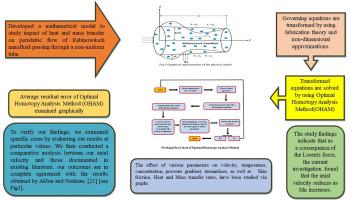
This paper gives a quantitative examination of peristaltic flow in a non-uniform tube, which includes temperature-dependent fluid characteristics and second-order slip conditions. The research uses the Rabinowitsch fluid model to describe non-Newtonian behaviour, while Buongiorno's nanofluid model characterises the fluid's thermophysical characteristics. To answer the current physical puzzle, a set of highly nonlinear equations must be translated utilising nondimensional parameters and fundamental assumptions such as a low Reynolds number and a long wavelength. The Optimal Homotopy Analysis Method (OHAM) is used to develop the solution.. We examine the impact of various physiological limitations through the generation of graphs. The graphs presented here demonstrate how various parameters affect Nusselt number, Sherwood number, temperature, velocity, concentration, skin friction, and streamlines. As a consequence of the Lorentz force, the current investigation found that the axial velocity reduces as Mn increases. The fluid's shear-thinning behaviour causes axial velocity to drop as slip parameters rise. The findings provide practical insights for enhancing heat transfer efficiency in industrial applications, particularly in systems utilizing non-Newtonian nanofluids, such as chemical processing and microfluidic devices.




 京公网安备 11010802042870号
京ICP备2023020795号-1
京公网安备 11010802042870号
京ICP备2023020795号-1

 分享
分享
 求助内容:
求助内容: 应助结果提醒方式:
 扫码关注我们
