{"title":"Sb2S3:Eu薄膜在可见光下高效光催化降解罗丹明B (RhB)染料的合成","authors":"Adel Chihi","doi":"10.1039/D4RA07208A","DOIUrl":null,"url":null,"abstract":"<p >Eu was successfully incorporated into Sb<small><sub>2</sub></small>S<small><sub>3</sub></small> thin films for proficient photocatalytic degradation of rhodamine B (RhB) dye under visible light. In this work, we reported the effect of incorporating Eu ions into Sb<small><sub>2</sub></small>S<small><sub>3</sub></small> thin films at different doping levels to tailor their structural, optical, electrical, and photocatalytic properties. Grazing incidence X-ray diffraction (GIXRD) analysis revealed that the fabricated films exhibited an orthorhombic crystalline structure. Additionally, the GIXRD peaks shifted towards lower angles as the doping level increased. The Williamson–Hall method was used to estimate the effective crystallite size considering the strain components. The field emission scanning electron microscope (FESEM) characterisation demonstrated that the grain size decreased and a denser microstructure was observed as the Eu degree increased. The estimated optical band gap (<em>E</em><small><sub>g</sub></small>) value increases from 1.67 eV to 1.72 eV as the level of Eu doping rises from 0 to 8 at%, making the films suitable for photocatalytic applications. The photocatalytic activities of the pristine and Eu-doped Sb<small><sub>2</sub></small>S<small><sub>3</sub></small> thin films were evaluated by the degradation of highly toxic Rhodamine B (RhB) dye under dark and various light conditions for 120 min. A remarkable photodegradation rate was achieved with the optimal doping level of 4 at% of Eu, demonstrating a 90.99% degradation of RhB. Electrochemical impedance spectroscopy (EIS) measurements show that the lifespan of photoinduced electrons for 4 at% Eu<small><sup>3+</sup></small> samples is approximately 10 fold higher than that of the pristine sample. In terms of chemical kinetics, the degradation of RhB by the Sb<small><sub>2</sub></small>S<small><sub>3</sub></small>:Eu (4 at% of Eu) photocatalyst was found to follow pseudo-first-order kinetics with a rate constant of 0.049 min<small><sup>−1</sup></small> under visible light irradiation. A conceivable molecular mechanism for photocatalytic degradation of the RhB dye by Sb<small><sub>2</sub></small>S<small><sub>3</sub></small>:Eu photocatalysts is also provided. These results highlight the potential of Eu-doped Sb<small><sub>2</sub></small>S<small><sub>3</sub></small> thin films for advanced photocatalytic applications. Specifically, Sb<small><sub>2</sub></small>S<small><sub>3</sub></small>:Eu 4 at% exhibits favourable properties. Thus, it was concluded that these photocatalysts are highly suitable for the remediation of dye-contaminated wastewater.</p>","PeriodicalId":102,"journal":{"name":"RSC Advances","volume":" 8","pages":" 5681-5697"},"PeriodicalIF":4.6000,"publicationDate":"2025-02-19","publicationTypes":"Journal Article","fieldsOfStudy":null,"isOpenAccess":false,"openAccessPdf":"https://pubs.rsc.org/en/content/articlepdf/2025/ra/d4ra07208a?page=search","citationCount":"0","resultStr":"{\"title\":\"Synthesis of Sb2S3:Eu thin films as a catalyst for the efficient photocatalytic degradation of rhodamine B (RhB) dye under visible light†\",\"authors\":\"Adel Chihi\",\"doi\":\"10.1039/D4RA07208A\",\"DOIUrl\":null,\"url\":null,\"abstract\":\"<p >Eu was successfully incorporated into Sb<small><sub>2</sub></small>S<small><sub>3</sub></small> thin films for proficient photocatalytic degradation of rhodamine B (RhB) dye under visible light. In this work, we reported the effect of incorporating Eu ions into Sb<small><sub>2</sub></small>S<small><sub>3</sub></small> thin films at different doping levels to tailor their structural, optical, electrical, and photocatalytic properties. Grazing incidence X-ray diffraction (GIXRD) analysis revealed that the fabricated films exhibited an orthorhombic crystalline structure. Additionally, the GIXRD peaks shifted towards lower angles as the doping level increased. The Williamson–Hall method was used to estimate the effective crystallite size considering the strain components. The field emission scanning electron microscope (FESEM) characterisation demonstrated that the grain size decreased and a denser microstructure was observed as the Eu degree increased. The estimated optical band gap (<em>E</em><small><sub>g</sub></small>) value increases from 1.67 eV to 1.72 eV as the level of Eu doping rises from 0 to 8 at%, making the films suitable for photocatalytic applications. The photocatalytic activities of the pristine and Eu-doped Sb<small><sub>2</sub></small>S<small><sub>3</sub></small> thin films were evaluated by the degradation of highly toxic Rhodamine B (RhB) dye under dark and various light conditions for 120 min. A remarkable photodegradation rate was achieved with the optimal doping level of 4 at% of Eu, demonstrating a 90.99% degradation of RhB. Electrochemical impedance spectroscopy (EIS) measurements show that the lifespan of photoinduced electrons for 4 at% Eu<small><sup>3+</sup></small> samples is approximately 10 fold higher than that of the pristine sample. In terms of chemical kinetics, the degradation of RhB by the Sb<small><sub>2</sub></small>S<small><sub>3</sub></small>:Eu (4 at% of Eu) photocatalyst was found to follow pseudo-first-order kinetics with a rate constant of 0.049 min<small><sup>−1</sup></small> under visible light irradiation. A conceivable molecular mechanism for photocatalytic degradation of the RhB dye by Sb<small><sub>2</sub></small>S<small><sub>3</sub></small>:Eu photocatalysts is also provided. These results highlight the potential of Eu-doped Sb<small><sub>2</sub></small>S<small><sub>3</sub></small> thin films for advanced photocatalytic applications. Specifically, Sb<small><sub>2</sub></small>S<small><sub>3</sub></small>:Eu 4 at% exhibits favourable properties. Thus, it was concluded that these photocatalysts are highly suitable for the remediation of dye-contaminated wastewater.</p>\",\"PeriodicalId\":102,\"journal\":{\"name\":\"RSC Advances\",\"volume\":\" 8\",\"pages\":\" 5681-5697\"},\"PeriodicalIF\":4.6000,\"publicationDate\":\"2025-02-19\",\"publicationTypes\":\"Journal Article\",\"fieldsOfStudy\":null,\"isOpenAccess\":false,\"openAccessPdf\":\"https://pubs.rsc.org/en/content/articlepdf/2025/ra/d4ra07208a?page=search\",\"citationCount\":\"0\",\"resultStr\":null,\"platform\":\"Semanticscholar\",\"paperid\":null,\"PeriodicalName\":\"RSC Advances\",\"FirstCategoryId\":\"92\",\"ListUrlMain\":\"https://pubs.rsc.org/en/content/articlelanding/2025/ra/d4ra07208a\",\"RegionNum\":3,\"RegionCategory\":\"化学\",\"ArticlePicture\":[],\"TitleCN\":null,\"AbstractTextCN\":null,\"PMCID\":null,\"EPubDate\":\"\",\"PubModel\":\"\",\"JCR\":\"Q2\",\"JCRName\":\"CHEMISTRY, MULTIDISCIPLINARY\",\"Score\":null,\"Total\":0}","platform":"Semanticscholar","paperid":null,"PeriodicalName":"RSC Advances","FirstCategoryId":"92","ListUrlMain":"https://pubs.rsc.org/en/content/articlelanding/2025/ra/d4ra07208a","RegionNum":3,"RegionCategory":"化学","ArticlePicture":[],"TitleCN":null,"AbstractTextCN":null,"PMCID":null,"EPubDate":"","PubModel":"","JCR":"Q2","JCRName":"CHEMISTRY, MULTIDISCIPLINARY","Score":null,"Total":0}
Synthesis of Sb2S3:Eu thin films as a catalyst for the efficient photocatalytic degradation of rhodamine B (RhB) dye under visible light†
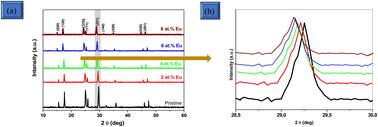
Eu was successfully incorporated into Sb2S3 thin films for proficient photocatalytic degradation of rhodamine B (RhB) dye under visible light. In this work, we reported the effect of incorporating Eu ions into Sb2S3 thin films at different doping levels to tailor their structural, optical, electrical, and photocatalytic properties. Grazing incidence X-ray diffraction (GIXRD) analysis revealed that the fabricated films exhibited an orthorhombic crystalline structure. Additionally, the GIXRD peaks shifted towards lower angles as the doping level increased. The Williamson–Hall method was used to estimate the effective crystallite size considering the strain components. The field emission scanning electron microscope (FESEM) characterisation demonstrated that the grain size decreased and a denser microstructure was observed as the Eu degree increased. The estimated optical band gap (Eg) value increases from 1.67 eV to 1.72 eV as the level of Eu doping rises from 0 to 8 at%, making the films suitable for photocatalytic applications. The photocatalytic activities of the pristine and Eu-doped Sb2S3 thin films were evaluated by the degradation of highly toxic Rhodamine B (RhB) dye under dark and various light conditions for 120 min. A remarkable photodegradation rate was achieved with the optimal doping level of 4 at% of Eu, demonstrating a 90.99% degradation of RhB. Electrochemical impedance spectroscopy (EIS) measurements show that the lifespan of photoinduced electrons for 4 at% Eu3+ samples is approximately 10 fold higher than that of the pristine sample. In terms of chemical kinetics, the degradation of RhB by the Sb2S3:Eu (4 at% of Eu) photocatalyst was found to follow pseudo-first-order kinetics with a rate constant of 0.049 min−1 under visible light irradiation. A conceivable molecular mechanism for photocatalytic degradation of the RhB dye by Sb2S3:Eu photocatalysts is also provided. These results highlight the potential of Eu-doped Sb2S3 thin films for advanced photocatalytic applications. Specifically, Sb2S3:Eu 4 at% exhibits favourable properties. Thus, it was concluded that these photocatalysts are highly suitable for the remediation of dye-contaminated wastewater.
期刊介绍:
An international, peer-reviewed journal covering all of the chemical sciences, including multidisciplinary and emerging areas. RSC Advances is a gold open access journal allowing researchers free access to research articles, and offering an affordable open access publishing option for authors around the world.




 京公网安备 11010802042870号
京ICP备2023020795号-1
京公网安备 11010802042870号
京ICP备2023020795号-1

 分享
分享
 求助内容:
求助内容: 应助结果提醒方式:
 扫码关注我们
