Chang-Sheng Yu, Ming Wang, Jian-Bo Zhou, Richard M. Palin, Jin Liu, Bin Wan, Di Shen, Quewang Danzeng, Sheng-Shuo Zhang
{"title":"澳大利亚遗产为北拉萨地","authors":"Chang-Sheng Yu, Ming Wang, Jian-Bo Zhou, Richard M. Palin, Jin Liu, Bin Wan, Di Shen, Quewang Danzeng, Sheng-Shuo Zhang","doi":"10.1029/2024GL113338","DOIUrl":null,"url":null,"abstract":"<p>The Precambrian history of the Lhasa terrane, southern Tibet is intensely debated, which hinders global plate tectonic reconstructions throughout the Proterozoic. Previous research on Precambrian basement has suggested that the Lhasa terrane originated from India or Africa, although the paucity of exposed pre-Neoproterozoic rocks in the North Lhasa terrane (NL) has led to significant uncertainty. We document newly identified Neoarchean granites and Mesoproterozoic Guomangtso Suite from the NL. These pre-Neoproterozoic rocks reveal a 2.62 Ga anorogenic rifting event and a 1.30–1.10 Ga transition from subduction to back-arc extension, related to the 2.7–2.6 Ga rifting of the Pilbara Craton and the Proterozoic assembly between the North and West Australian Cratons, respectively. However, these tectono-magmatic events have no equivalents in the South Lhasa terrane (SL). These observations suggest that the NL originated from Western Australia, and the NL and SL may have distinct origins.</p>","PeriodicalId":12523,"journal":{"name":"Geophysical Research Letters","volume":"52 4","pages":""},"PeriodicalIF":4.6000,"publicationDate":"2025-02-19","publicationTypes":"Journal Article","fieldsOfStudy":null,"isOpenAccess":false,"openAccessPdf":"https://onlinelibrary.wiley.com/doi/epdf/10.1029/2024GL113338","citationCount":"0","resultStr":"{\"title\":\"Australian Heritage for the North Lhasa Terrane\",\"authors\":\"Chang-Sheng Yu, Ming Wang, Jian-Bo Zhou, Richard M. Palin, Jin Liu, Bin Wan, Di Shen, Quewang Danzeng, Sheng-Shuo Zhang\",\"doi\":\"10.1029/2024GL113338\",\"DOIUrl\":null,\"url\":null,\"abstract\":\"<p>The Precambrian history of the Lhasa terrane, southern Tibet is intensely debated, which hinders global plate tectonic reconstructions throughout the Proterozoic. Previous research on Precambrian basement has suggested that the Lhasa terrane originated from India or Africa, although the paucity of exposed pre-Neoproterozoic rocks in the North Lhasa terrane (NL) has led to significant uncertainty. We document newly identified Neoarchean granites and Mesoproterozoic Guomangtso Suite from the NL. These pre-Neoproterozoic rocks reveal a 2.62 Ga anorogenic rifting event and a 1.30–1.10 Ga transition from subduction to back-arc extension, related to the 2.7–2.6 Ga rifting of the Pilbara Craton and the Proterozoic assembly between the North and West Australian Cratons, respectively. However, these tectono-magmatic events have no equivalents in the South Lhasa terrane (SL). These observations suggest that the NL originated from Western Australia, and the NL and SL may have distinct origins.</p>\",\"PeriodicalId\":12523,\"journal\":{\"name\":\"Geophysical Research Letters\",\"volume\":\"52 4\",\"pages\":\"\"},\"PeriodicalIF\":4.6000,\"publicationDate\":\"2025-02-19\",\"publicationTypes\":\"Journal Article\",\"fieldsOfStudy\":null,\"isOpenAccess\":false,\"openAccessPdf\":\"https://onlinelibrary.wiley.com/doi/epdf/10.1029/2024GL113338\",\"citationCount\":\"0\",\"resultStr\":null,\"platform\":\"Semanticscholar\",\"paperid\":null,\"PeriodicalName\":\"Geophysical Research Letters\",\"FirstCategoryId\":\"89\",\"ListUrlMain\":\"https://agupubs.onlinelibrary.wiley.com/doi/10.1029/2024GL113338\",\"RegionNum\":1,\"RegionCategory\":\"地球科学\",\"ArticlePicture\":[],\"TitleCN\":null,\"AbstractTextCN\":null,\"PMCID\":null,\"EPubDate\":\"\",\"PubModel\":\"\",\"JCR\":\"Q1\",\"JCRName\":\"GEOSCIENCES, MULTIDISCIPLINARY\",\"Score\":null,\"Total\":0}","platform":"Semanticscholar","paperid":null,"PeriodicalName":"Geophysical Research Letters","FirstCategoryId":"89","ListUrlMain":"https://agupubs.onlinelibrary.wiley.com/doi/10.1029/2024GL113338","RegionNum":1,"RegionCategory":"地球科学","ArticlePicture":[],"TitleCN":null,"AbstractTextCN":null,"PMCID":null,"EPubDate":"","PubModel":"","JCR":"Q1","JCRName":"GEOSCIENCES, MULTIDISCIPLINARY","Score":null,"Total":0}
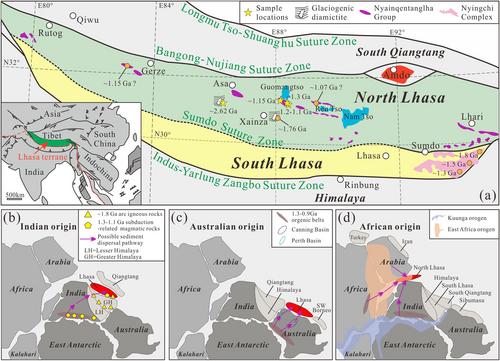
The Precambrian history of the Lhasa terrane, southern Tibet is intensely debated, which hinders global plate tectonic reconstructions throughout the Proterozoic. Previous research on Precambrian basement has suggested that the Lhasa terrane originated from India or Africa, although the paucity of exposed pre-Neoproterozoic rocks in the North Lhasa terrane (NL) has led to significant uncertainty. We document newly identified Neoarchean granites and Mesoproterozoic Guomangtso Suite from the NL. These pre-Neoproterozoic rocks reveal a 2.62 Ga anorogenic rifting event and a 1.30–1.10 Ga transition from subduction to back-arc extension, related to the 2.7–2.6 Ga rifting of the Pilbara Craton and the Proterozoic assembly between the North and West Australian Cratons, respectively. However, these tectono-magmatic events have no equivalents in the South Lhasa terrane (SL). These observations suggest that the NL originated from Western Australia, and the NL and SL may have distinct origins.
期刊介绍:
Geophysical Research Letters (GRL) publishes high-impact, innovative, and timely research on major scientific advances in all the major geoscience disciplines. Papers are communications-length articles and should have broad and immediate implications in their discipline or across the geosciences. GRLmaintains the fastest turn-around of all high-impact publications in the geosciences and works closely with authors to ensure broad visibility of top papers.






 京公网安备 11010802042870号
京ICP备2023020795号-1
京公网安备 11010802042870号
京ICP备2023020795号-1

 分享
分享
 求助内容:
求助内容: 应助结果提醒方式:
 扫码关注我们
