{"title":"个性特征和生活质量:伊朗中年普通人群的横断面研究。","authors":"Danial Habibi, Roqayeh Parsaei, Hamidreza Roohafza, Awat Feizi","doi":"10.1186/s12955-025-02344-4","DOIUrl":null,"url":null,"abstract":"<p><strong>Introduction: </strong>Despite considerable research on the association between Personality Traits (PT) and Quality of Life (QoL) in patients and older adults, this association remains poorly understood among the middle-aged general population.This investigation examines how each PT is associated with total QoL and its dimensions.</p><p><strong>Methods: </strong>The present investigation utilized data collected from a cross-sectional survey involving 786 families in Isfahan (644 female/wife respondents), Iran. QoL and PT were assessed using the validated WHOQOL-BREF and NEO-FFI questionnaires. Other data including demographic and socioeconomic status (SES) were also collected. Statistical analyses included bivariate correlation and simple and multiple linear and logistic regressions.</p><p><strong>Results: </strong>Mean value of Psychological health [Mean difference = -4.34, P = 0.003], Physical health [mean difference = -3.93, P = 0.004], and total score of QoL [mean difference = -3.21, P = 0.049] were all significantly lower in women than men. Higher SES score was consistently associated with greater QoL scores (r > 0, P < 0.05). The physical domain and total QoL scores have been negatively correlated with the spouse's age (r < 0, P < 0.05). In crude and adjusted models, higher Neuroticism scores were inversly associated with higher scores of all QoL domains and total QoL (OR < 1, P < 0.05, for all models) while others personality traits except Openness showed a direct association (OR > 1, P < 0.05). Linear regression analysis also confirmed that higher Neuroticism scores were linked to poorer QoL scores (Beta<sub>coefficient</sub> < 0, P < 0.05), while all other traits, except Openness, showed a positive association (Beta<sub>coefficient</sub> > 0, P < 0.05).</p><p><strong>Conclusion: </strong>This study provides robust evidence about the significant association of PT with QoL outcomes in middle aged people. This significant association highlights the importance of considering these traits in clinical applications, as tailored interventions based on personality profiles can effectively enhance the well-being of middle-aged individuals.</p>","PeriodicalId":12980,"journal":{"name":"Health and Quality of Life Outcomes","volume":"23 1","pages":"13"},"PeriodicalIF":3.4000,"publicationDate":"2025-02-17","publicationTypes":"Journal Article","fieldsOfStudy":null,"isOpenAccess":false,"openAccessPdf":"https://www.ncbi.nlm.nih.gov/pmc/articles/PMC11831848/pdf/","citationCount":"0","resultStr":"{\"title\":\"Personality traits and quality of life: a cross-sectional study in a middle-aged Iranian general population.\",\"authors\":\"Danial Habibi, Roqayeh Parsaei, Hamidreza Roohafza, Awat Feizi\",\"doi\":\"10.1186/s12955-025-02344-4\",\"DOIUrl\":null,\"url\":null,\"abstract\":\"<p><strong>Introduction: </strong>Despite considerable research on the association between Personality Traits (PT) and Quality of Life (QoL) in patients and older adults, this association remains poorly understood among the middle-aged general population.This investigation examines how each PT is associated with total QoL and its dimensions.</p><p><strong>Methods: </strong>The present investigation utilized data collected from a cross-sectional survey involving 786 families in Isfahan (644 female/wife respondents), Iran. QoL and PT were assessed using the validated WHOQOL-BREF and NEO-FFI questionnaires. Other data including demographic and socioeconomic status (SES) were also collected. Statistical analyses included bivariate correlation and simple and multiple linear and logistic regressions.</p><p><strong>Results: </strong>Mean value of Psychological health [Mean difference = -4.34, P = 0.003], Physical health [mean difference = -3.93, P = 0.004], and total score of QoL [mean difference = -3.21, P = 0.049] were all significantly lower in women than men. Higher SES score was consistently associated with greater QoL scores (r > 0, P < 0.05). The physical domain and total QoL scores have been negatively correlated with the spouse's age (r < 0, P < 0.05). In crude and adjusted models, higher Neuroticism scores were inversly associated with higher scores of all QoL domains and total QoL (OR < 1, P < 0.05, for all models) while others personality traits except Openness showed a direct association (OR > 1, P < 0.05). Linear regression analysis also confirmed that higher Neuroticism scores were linked to poorer QoL scores (Beta<sub>coefficient</sub> < 0, P < 0.05), while all other traits, except Openness, showed a positive association (Beta<sub>coefficient</sub> > 0, P < 0.05).</p><p><strong>Conclusion: </strong>This study provides robust evidence about the significant association of PT with QoL outcomes in middle aged people. This significant association highlights the importance of considering these traits in clinical applications, as tailored interventions based on personality profiles can effectively enhance the well-being of middle-aged individuals.</p>\",\"PeriodicalId\":12980,\"journal\":{\"name\":\"Health and Quality of Life Outcomes\",\"volume\":\"23 1\",\"pages\":\"13\"},\"PeriodicalIF\":3.4000,\"publicationDate\":\"2025-02-17\",\"publicationTypes\":\"Journal Article\",\"fieldsOfStudy\":null,\"isOpenAccess\":false,\"openAccessPdf\":\"https://www.ncbi.nlm.nih.gov/pmc/articles/PMC11831848/pdf/\",\"citationCount\":\"0\",\"resultStr\":null,\"platform\":\"Semanticscholar\",\"paperid\":null,\"PeriodicalName\":\"Health and Quality of Life Outcomes\",\"FirstCategoryId\":\"3\",\"ListUrlMain\":\"https://doi.org/10.1186/s12955-025-02344-4\",\"RegionNum\":2,\"RegionCategory\":\"医学\",\"ArticlePicture\":[],\"TitleCN\":null,\"AbstractTextCN\":null,\"PMCID\":null,\"EPubDate\":\"\",\"PubModel\":\"\",\"JCR\":\"Q1\",\"JCRName\":\"HEALTH CARE SCIENCES & SERVICES\",\"Score\":null,\"Total\":0}","platform":"Semanticscholar","paperid":null,"PeriodicalName":"Health and Quality of Life Outcomes","FirstCategoryId":"3","ListUrlMain":"https://doi.org/10.1186/s12955-025-02344-4","RegionNum":2,"RegionCategory":"医学","ArticlePicture":[],"TitleCN":null,"AbstractTextCN":null,"PMCID":null,"EPubDate":"","PubModel":"","JCR":"Q1","JCRName":"HEALTH CARE SCIENCES & SERVICES","Score":null,"Total":0}
Personality traits and quality of life: a cross-sectional study in a middle-aged Iranian general population.
Introduction: Despite considerable research on the association between Personality Traits (PT) and Quality of Life (QoL) in patients and older adults, this association remains poorly understood among the middle-aged general population.This investigation examines how each PT is associated with total QoL and its dimensions.
Methods: The present investigation utilized data collected from a cross-sectional survey involving 786 families in Isfahan (644 female/wife respondents), Iran. QoL and PT were assessed using the validated WHOQOL-BREF and NEO-FFI questionnaires. Other data including demographic and socioeconomic status (SES) were also collected. Statistical analyses included bivariate correlation and simple and multiple linear and logistic regressions.
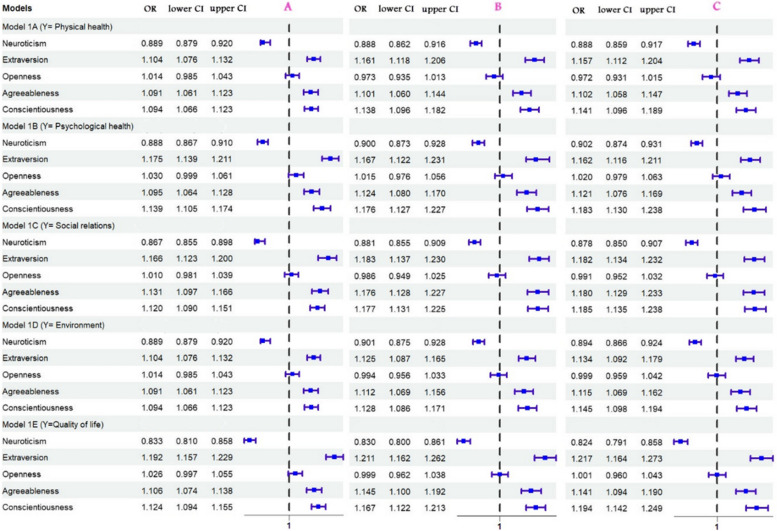
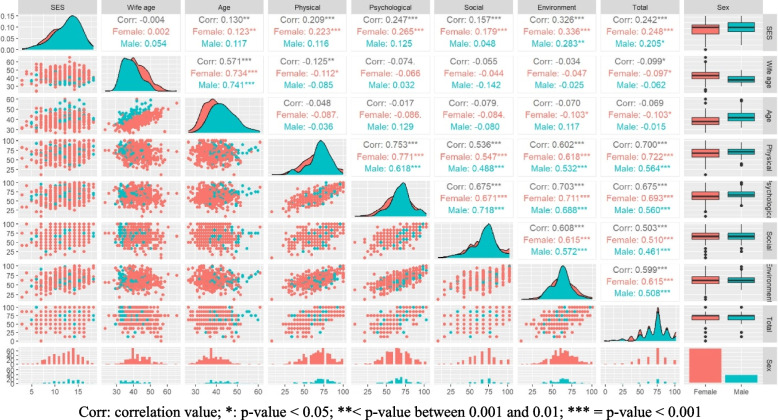
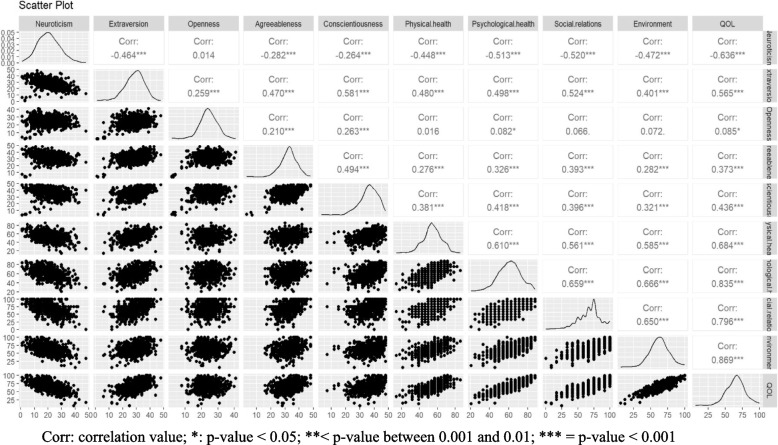
Results: Mean value of Psychological health [Mean difference = -4.34, P = 0.003], Physical health [mean difference = -3.93, P = 0.004], and total score of QoL [mean difference = -3.21, P = 0.049] were all significantly lower in women than men. Higher SES score was consistently associated with greater QoL scores (r > 0, P < 0.05). The physical domain and total QoL scores have been negatively correlated with the spouse's age (r < 0, P < 0.05). In crude and adjusted models, higher Neuroticism scores were inversly associated with higher scores of all QoL domains and total QoL (OR < 1, P < 0.05, for all models) while others personality traits except Openness showed a direct association (OR > 1, P < 0.05). Linear regression analysis also confirmed that higher Neuroticism scores were linked to poorer QoL scores (Betacoefficient < 0, P < 0.05), while all other traits, except Openness, showed a positive association (Betacoefficient > 0, P < 0.05).
Conclusion: This study provides robust evidence about the significant association of PT with QoL outcomes in middle aged people. This significant association highlights the importance of considering these traits in clinical applications, as tailored interventions based on personality profiles can effectively enhance the well-being of middle-aged individuals.
期刊介绍:
Health and Quality of Life Outcomes is an open access, peer-reviewed, journal offering high quality articles, rapid publication and wide diffusion in the public domain.
Health and Quality of Life Outcomes considers original manuscripts on the Health-Related Quality of Life (HRQOL) assessment for evaluation of medical and psychosocial interventions. It also considers approaches and studies on psychometric properties of HRQOL and patient reported outcome measures, including cultural validation of instruments if they provide information about the impact of interventions. The journal publishes study protocols and reviews summarising the present state of knowledge concerning a particular aspect of HRQOL and patient reported outcome measures. Reviews should generally follow systematic review methodology. Comments on articles and letters to the editor are welcome.




 京公网安备 11010802042870号
京ICP备2023020795号-1
京公网安备 11010802042870号
京ICP备2023020795号-1

 分享
分享
 求助内容:
求助内容: 应助结果提醒方式:
 扫码关注我们
