Ariana Naaseh, Steven Tohmasi, Carrie Stoll, Chongliang Luo, Lauren H Yaeger, Mark H Hoofnagle, Graham A Colditz, Marguerite W Spruce
{"title":"低钠血症与老年创伤后预后的关系:一项系统综述和荟萃分析。","authors":"Ariana Naaseh, Steven Tohmasi, Carrie Stoll, Chongliang Luo, Lauren H Yaeger, Mark H Hoofnagle, Graham A Colditz, Marguerite W Spruce","doi":"10.1136/tsaco-2024-001562","DOIUrl":null,"url":null,"abstract":"<p><strong>Background: </strong>Trauma is a major cause of mortality in the elderly population. Hyponatremia is the most common electrolyte imbalance in geriatric patients and has been demonstrated to be a risk factor for altered cognition, low bone density, falls, and death. We systematically and critically reviewed the literature to ascertain the association between hyponatremia and geriatric trauma outcomes.</p><p><strong>Methods: </strong>We searched seven databases for articles published from inception to October 2023. Studies included reported on geriatric trauma, hyponatremia, and clinical outcomes. Two investigators independently reviewed 6535 abstracts, 235 full-text articles, and critically appraised each study. Study details, patient characteristics, and outcomes were independently extracted by two reviewers. Data quality assessment was performed using the Grading of Recommendations Assessment, Development, and Evaluation approach. Publication bias was assessed using funnel plot-based methods. A meta-analysis of risk ratios (RR) was performed using the random effects method.</p><p><strong>Results: </strong>Four retrospective cohort studies involving 11 894 geriatric patients were included. Among these, 492 (21.4%) were classified as trauma patients due to a fall and 1806 (78.6%) were classified as a trauma patient due to the presence of a fracture. In total, 2298 (19.3%) patients were classified as hyponatremic (125-135 mmol/L) while 9596 (80.7%) were classified as normonatremic. The pooled RR for in-hospital mortality for hyponatremic patients was 2.23 (95% CI 1.51 to 3.74) with high heterogeneity across the studies (I<sup>2</sup>=82.17%).</p><p><strong>Conclusions: </strong>Geriatric trauma patients presenting with hyponatremia appear to have an increased risk of in-hospital mortality. Given this association, national trauma registries should consider collecting serum sodium values for geriatric patients and providers should work to address hyponatremia as a possible contribution to falls. Given the paucity of published literature on this topic, there is a need for prospective studies evaluating the association between hyponatremia and geriatric trauma outcomes.</p><p><strong>Level of evidence: </strong>Level III, systematic review with meta-analysis.</p>","PeriodicalId":23307,"journal":{"name":"Trauma Surgery & Acute Care Open","volume":"10 1","pages":"e001562"},"PeriodicalIF":2.5000,"publicationDate":"2025-02-16","publicationTypes":"Journal Article","fieldsOfStudy":null,"isOpenAccess":false,"openAccessPdf":"https://www.ncbi.nlm.nih.gov/pmc/articles/PMC11831274/pdf/","citationCount":"0","resultStr":"{\"title\":\"Association of hyponatremia with outcomes after geriatric trauma: a systematic review and meta-analysis.\",\"authors\":\"Ariana Naaseh, Steven Tohmasi, Carrie Stoll, Chongliang Luo, Lauren H Yaeger, Mark H Hoofnagle, Graham A Colditz, Marguerite W Spruce\",\"doi\":\"10.1136/tsaco-2024-001562\",\"DOIUrl\":null,\"url\":null,\"abstract\":\"<p><strong>Background: </strong>Trauma is a major cause of mortality in the elderly population. Hyponatremia is the most common electrolyte imbalance in geriatric patients and has been demonstrated to be a risk factor for altered cognition, low bone density, falls, and death. We systematically and critically reviewed the literature to ascertain the association between hyponatremia and geriatric trauma outcomes.</p><p><strong>Methods: </strong>We searched seven databases for articles published from inception to October 2023. Studies included reported on geriatric trauma, hyponatremia, and clinical outcomes. Two investigators independently reviewed 6535 abstracts, 235 full-text articles, and critically appraised each study. Study details, patient characteristics, and outcomes were independently extracted by two reviewers. Data quality assessment was performed using the Grading of Recommendations Assessment, Development, and Evaluation approach. Publication bias was assessed using funnel plot-based methods. A meta-analysis of risk ratios (RR) was performed using the random effects method.</p><p><strong>Results: </strong>Four retrospective cohort studies involving 11 894 geriatric patients were included. Among these, 492 (21.4%) were classified as trauma patients due to a fall and 1806 (78.6%) were classified as a trauma patient due to the presence of a fracture. In total, 2298 (19.3%) patients were classified as hyponatremic (125-135 mmol/L) while 9596 (80.7%) were classified as normonatremic. The pooled RR for in-hospital mortality for hyponatremic patients was 2.23 (95% CI 1.51 to 3.74) with high heterogeneity across the studies (I<sup>2</sup>=82.17%).</p><p><strong>Conclusions: </strong>Geriatric trauma patients presenting with hyponatremia appear to have an increased risk of in-hospital mortality. Given this association, national trauma registries should consider collecting serum sodium values for geriatric patients and providers should work to address hyponatremia as a possible contribution to falls. Given the paucity of published literature on this topic, there is a need for prospective studies evaluating the association between hyponatremia and geriatric trauma outcomes.</p><p><strong>Level of evidence: </strong>Level III, systematic review with meta-analysis.</p>\",\"PeriodicalId\":23307,\"journal\":{\"name\":\"Trauma Surgery & Acute Care Open\",\"volume\":\"10 1\",\"pages\":\"e001562\"},\"PeriodicalIF\":2.5000,\"publicationDate\":\"2025-02-16\",\"publicationTypes\":\"Journal Article\",\"fieldsOfStudy\":null,\"isOpenAccess\":false,\"openAccessPdf\":\"https://www.ncbi.nlm.nih.gov/pmc/articles/PMC11831274/pdf/\",\"citationCount\":\"0\",\"resultStr\":null,\"platform\":\"Semanticscholar\",\"paperid\":null,\"PeriodicalName\":\"Trauma Surgery & Acute Care Open\",\"FirstCategoryId\":\"1085\",\"ListUrlMain\":\"https://doi.org/10.1136/tsaco-2024-001562\",\"RegionNum\":0,\"RegionCategory\":null,\"ArticlePicture\":[],\"TitleCN\":null,\"AbstractTextCN\":null,\"PMCID\":null,\"EPubDate\":\"2025/1/1 0:00:00\",\"PubModel\":\"eCollection\",\"JCR\":\"Q3\",\"JCRName\":\"CRITICAL CARE MEDICINE\",\"Score\":null,\"Total\":0}","platform":"Semanticscholar","paperid":null,"PeriodicalName":"Trauma Surgery & Acute Care Open","FirstCategoryId":"1085","ListUrlMain":"https://doi.org/10.1136/tsaco-2024-001562","RegionNum":0,"RegionCategory":null,"ArticlePicture":[],"TitleCN":null,"AbstractTextCN":null,"PMCID":null,"EPubDate":"2025/1/1 0:00:00","PubModel":"eCollection","JCR":"Q3","JCRName":"CRITICAL CARE MEDICINE","Score":null,"Total":0}
引用次数: 0
摘要
背景:创伤是老年人死亡的主要原因。低钠血症是老年患者中最常见的电解质失衡,已被证明是认知改变、低骨密度、跌倒和死亡的危险因素。我们系统和批判性地回顾了文献,以确定低钠血症与老年创伤结果之间的关系。方法:我们检索了7个数据库中从建校到2023年10月发表的文章。研究包括关于老年创伤、低钠血症和临床结果的报道。两位研究者独立审查了6535篇摘要,235篇全文文章,并对每一项研究进行了批判性评价。研究细节、患者特征和结果由两位评论者独立提取。数据质量评估采用分级建议评估、发展和评估方法。采用基于漏斗图的方法评估发表偏倚。采用随机效应法对风险比(RR)进行meta分析。结果:纳入4项回顾性队列研究,涉及11894例老年患者。其中,492例(21.4%)因跌倒被归为创伤患者,1806例(78.6%)因骨折被归为创伤患者。其中2298例(19.3%)为低钠血症(125 ~ 135 mmol/L), 9596例(80.7%)为正常钠血症。低钠血症患者住院死亡率的综合RR为2.23 (95% CI 1.51 ~ 3.74),各研究间存在高度异质性(I2=82.17%)。结论:表现为低钠血症的老年创伤患者住院死亡的风险增加。鉴于这种关联,国家创伤登记处应考虑收集老年患者的血清钠值,提供者应努力解决低钠血症可能导致跌倒的问题。鉴于关于这一主题的已发表文献的缺乏,有必要进行前瞻性研究,评估低钠血症与老年创伤结果之间的关系。证据等级:III级,荟萃分析的系统评价。
Association of hyponatremia with outcomes after geriatric trauma: a systematic review and meta-analysis.
Background: Trauma is a major cause of mortality in the elderly population. Hyponatremia is the most common electrolyte imbalance in geriatric patients and has been demonstrated to be a risk factor for altered cognition, low bone density, falls, and death. We systematically and critically reviewed the literature to ascertain the association between hyponatremia and geriatric trauma outcomes.
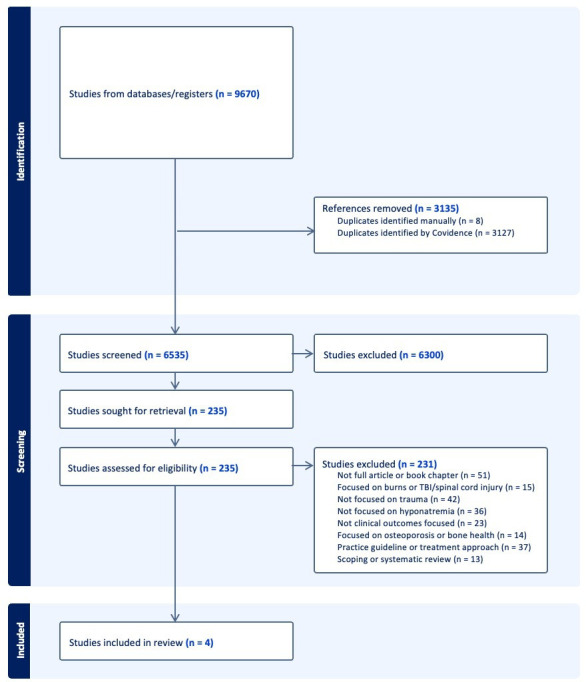
Methods: We searched seven databases for articles published from inception to October 2023. Studies included reported on geriatric trauma, hyponatremia, and clinical outcomes. Two investigators independently reviewed 6535 abstracts, 235 full-text articles, and critically appraised each study. Study details, patient characteristics, and outcomes were independently extracted by two reviewers. Data quality assessment was performed using the Grading of Recommendations Assessment, Development, and Evaluation approach. Publication bias was assessed using funnel plot-based methods. A meta-analysis of risk ratios (RR) was performed using the random effects method.
Results: Four retrospective cohort studies involving 11 894 geriatric patients were included. Among these, 492 (21.4%) were classified as trauma patients due to a fall and 1806 (78.6%) were classified as a trauma patient due to the presence of a fracture. In total, 2298 (19.3%) patients were classified as hyponatremic (125-135 mmol/L) while 9596 (80.7%) were classified as normonatremic. The pooled RR for in-hospital mortality for hyponatremic patients was 2.23 (95% CI 1.51 to 3.74) with high heterogeneity across the studies (I2=82.17%).
Conclusions: Geriatric trauma patients presenting with hyponatremia appear to have an increased risk of in-hospital mortality. Given this association, national trauma registries should consider collecting serum sodium values for geriatric patients and providers should work to address hyponatremia as a possible contribution to falls. Given the paucity of published literature on this topic, there is a need for prospective studies evaluating the association between hyponatremia and geriatric trauma outcomes.
Level of evidence: Level III, systematic review with meta-analysis.






 京公网安备 11010802042870号
京ICP备2023020795号-1
京公网安备 11010802042870号
京ICP备2023020795号-1

 分享
分享
 求助内容:
求助内容: 应助结果提醒方式:
 扫码关注我们
