Lili Niu, Sara Elizabeth Stinson, Louise Aas Holm, Morten Asp Vonsild Lund, Cilius Esmann Fonvig, Leonardo Cobuccio, Jonas Meisner, Helene Bæk Juel, Joao Fadista, Maja Thiele, Aleksander Krag, Jens-Christian Holm, Simon Rasmussen, Torben Hansen, Matthias Mann
{"title":"儿童和青少年血浆蛋白质组变异及其遗传决定因素","authors":"Lili Niu, Sara Elizabeth Stinson, Louise Aas Holm, Morten Asp Vonsild Lund, Cilius Esmann Fonvig, Leonardo Cobuccio, Jonas Meisner, Helene Bæk Juel, Joao Fadista, Maja Thiele, Aleksander Krag, Jens-Christian Holm, Simon Rasmussen, Torben Hansen, Matthias Mann","doi":"10.1038/s41588-025-02089-2","DOIUrl":null,"url":null,"abstract":"Our current understanding of the determinants of plasma proteome variation during pediatric development remains incomplete. Here, we show that genetic variants, age, sex and body mass index significantly influence this variation. Using a streamlined and highly quantitative mass spectrometry-based proteomics workflow, we analyzed plasma from 2,147 children and adolescents, identifying 1,216 proteins after quality control. Notably, the levels of 70% of these were associated with at least one of the aforementioned factors, with protein levels also being predictive. Quantitative trait loci (QTLs) regulated at least one-third of the proteins; between a few percent and up to 30-fold. Together with excellent replication in an additional 1,000 children and 558 adults, this reveals substantial genetic effects on plasma protein levels, persisting from childhood into adulthood. Through Mendelian randomization and colocalization analyses, we identified 41 causal genes for 33 cardiometabolic traits, emphasizing the value of protein QTLs in drug target identification and disease understanding. This mass spectrometry-based proteomic study profiles the plasma proteome in 2,147 children and adolescents and reveals its association with age, sex, puberty, body mass index and genetics.","PeriodicalId":18985,"journal":{"name":"Nature genetics","volume":"57 3","pages":"635-646"},"PeriodicalIF":29.0000,"publicationDate":"2025-02-19","publicationTypes":"Journal Article","fieldsOfStudy":null,"isOpenAccess":false,"openAccessPdf":"https://www.nature.com/articles/s41588-025-02089-2.pdf","citationCount":"0","resultStr":"{\"title\":\"Plasma proteome variation and its genetic determinants in children and adolescents\",\"authors\":\"Lili Niu, Sara Elizabeth Stinson, Louise Aas Holm, Morten Asp Vonsild Lund, Cilius Esmann Fonvig, Leonardo Cobuccio, Jonas Meisner, Helene Bæk Juel, Joao Fadista, Maja Thiele, Aleksander Krag, Jens-Christian Holm, Simon Rasmussen, Torben Hansen, Matthias Mann\",\"doi\":\"10.1038/s41588-025-02089-2\",\"DOIUrl\":null,\"url\":null,\"abstract\":\"Our current understanding of the determinants of plasma proteome variation during pediatric development remains incomplete. Here, we show that genetic variants, age, sex and body mass index significantly influence this variation. Using a streamlined and highly quantitative mass spectrometry-based proteomics workflow, we analyzed plasma from 2,147 children and adolescents, identifying 1,216 proteins after quality control. Notably, the levels of 70% of these were associated with at least one of the aforementioned factors, with protein levels also being predictive. Quantitative trait loci (QTLs) regulated at least one-third of the proteins; between a few percent and up to 30-fold. Together with excellent replication in an additional 1,000 children and 558 adults, this reveals substantial genetic effects on plasma protein levels, persisting from childhood into adulthood. Through Mendelian randomization and colocalization analyses, we identified 41 causal genes for 33 cardiometabolic traits, emphasizing the value of protein QTLs in drug target identification and disease understanding. This mass spectrometry-based proteomic study profiles the plasma proteome in 2,147 children and adolescents and reveals its association with age, sex, puberty, body mass index and genetics.\",\"PeriodicalId\":18985,\"journal\":{\"name\":\"Nature genetics\",\"volume\":\"57 3\",\"pages\":\"635-646\"},\"PeriodicalIF\":29.0000,\"publicationDate\":\"2025-02-19\",\"publicationTypes\":\"Journal Article\",\"fieldsOfStudy\":null,\"isOpenAccess\":false,\"openAccessPdf\":\"https://www.nature.com/articles/s41588-025-02089-2.pdf\",\"citationCount\":\"0\",\"resultStr\":null,\"platform\":\"Semanticscholar\",\"paperid\":null,\"PeriodicalName\":\"Nature genetics\",\"FirstCategoryId\":\"99\",\"ListUrlMain\":\"https://www.nature.com/articles/s41588-025-02089-2\",\"RegionNum\":1,\"RegionCategory\":\"生物学\",\"ArticlePicture\":[],\"TitleCN\":null,\"AbstractTextCN\":null,\"PMCID\":null,\"EPubDate\":\"\",\"PubModel\":\"\",\"JCR\":\"Q1\",\"JCRName\":\"GENETICS & HEREDITY\",\"Score\":null,\"Total\":0}","platform":"Semanticscholar","paperid":null,"PeriodicalName":"Nature genetics","FirstCategoryId":"99","ListUrlMain":"https://www.nature.com/articles/s41588-025-02089-2","RegionNum":1,"RegionCategory":"生物学","ArticlePicture":[],"TitleCN":null,"AbstractTextCN":null,"PMCID":null,"EPubDate":"","PubModel":"","JCR":"Q1","JCRName":"GENETICS & HEREDITY","Score":null,"Total":0}
Plasma proteome variation and its genetic determinants in children and adolescents
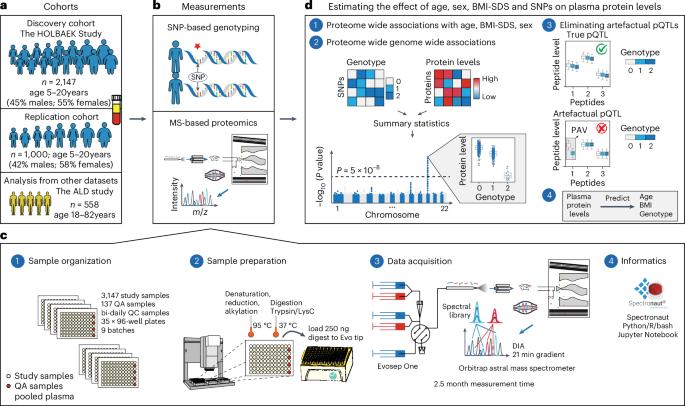
Our current understanding of the determinants of plasma proteome variation during pediatric development remains incomplete. Here, we show that genetic variants, age, sex and body mass index significantly influence this variation. Using a streamlined and highly quantitative mass spectrometry-based proteomics workflow, we analyzed plasma from 2,147 children and adolescents, identifying 1,216 proteins after quality control. Notably, the levels of 70% of these were associated with at least one of the aforementioned factors, with protein levels also being predictive. Quantitative trait loci (QTLs) regulated at least one-third of the proteins; between a few percent and up to 30-fold. Together with excellent replication in an additional 1,000 children and 558 adults, this reveals substantial genetic effects on plasma protein levels, persisting from childhood into adulthood. Through Mendelian randomization and colocalization analyses, we identified 41 causal genes for 33 cardiometabolic traits, emphasizing the value of protein QTLs in drug target identification and disease understanding. This mass spectrometry-based proteomic study profiles the plasma proteome in 2,147 children and adolescents and reveals its association with age, sex, puberty, body mass index and genetics.
期刊介绍:
Nature Genetics publishes the very highest quality research in genetics. It encompasses genetic and functional genomic studies on human and plant traits and on other model organisms. Current emphasis is on the genetic basis for common and complex diseases and on the functional mechanism, architecture and evolution of gene networks, studied by experimental perturbation.
Integrative genetic topics comprise, but are not limited to:
-Genes in the pathology of human disease
-Molecular analysis of simple and complex genetic traits
-Cancer genetics
-Agricultural genomics
-Developmental genetics
-Regulatory variation in gene expression
-Strategies and technologies for extracting function from genomic data
-Pharmacological genomics
-Genome evolution




 京公网安备 11010802042870号
京ICP备2023020795号-1
京公网安备 11010802042870号
京ICP备2023020795号-1

 分享
分享
 求助内容:
求助内容: 应助结果提醒方式:
 扫码关注我们
