{"title":"固体SEI膜Cu2+取代调控Na3V2(PO4)3具有优异的电化学性能","authors":"Zhenbo Peng, Bifen Chen, Shan Yu, Kaiyu Wu, Farao Zhang and Peng Gao","doi":"10.1039/D4DT03559C","DOIUrl":null,"url":null,"abstract":"<p >Na<small><sub>3</sub></small>V<small><sub>2</sub></small>(PO<small><sub>4</sub></small>)<small><sub>3</sub></small> (NVP) suffers from poor ionic and electronic conductivity. Herein, a dual-optimized design with Cu<small><sup>2+</sup></small> doping and wrapping in tubular carbon nanotubes (CNTs) is proposed for the first time. This strategy not only modifies the internal electronic structure but also regulates the morphological features of NVP material. Notably, Cu<small><sup>2+</sup></small> occupying V<small><sup>3+</sup></small> sites introduces favorable p-type doping effects. Consequently, newly generated holes can act as charge carriers to improve electronic conductivity. Meanwhile, to conserve the charge balance of the whole system, a series of distinctive Na<small><sub>3+<em>x</em></sub></small>V<small><sub>2−<em>x</em></sub></small>Cu<small><sub><em>x</em></sub></small>(PO<small><sub>4</sub></small>)<small><sub>3</sub></small> cathode materials are designed. The Na-rich scheme maintains charge integrity, as well as supplying more active Na<small><sup>+</sup></small> to take part in the reversible de-intercalation process. Due to the larger ionic radius of Cu<small><sup>2+</sup></small>, Cu<small><sup>2+</sup></small> doping plays a great role as a pillar to support the crystal skeleton and then expand the Na<small><sup>+</sup></small> migration channels, thus significantly elevating the ionic transport rate. Furthermore, moderate CNTs are wrapped around the active grains, functioning together with coated carbon layers to construct a highly conductive framework, enhancing electronic transfer. Meanwhile, the tubular CNTs and porous morphology effectively increase the contact areas between active particles and electrolyte, providing more active sites. Furthermore, <em>in situ</em> EIS measurement demonstrates that a stable SEI membrane covers the cycled Na<small><sub>3.07</sub></small>V<small><sub>1.93</sub></small>Cu<small><sub>0.07</sub></small>(PO<small><sub>4</sub></small>)<small><sub>3</sub></small>@CNTs grains to maintain electrode stability and prevent the occurrence of side-effects. Comprehensively, the Na<small><sub>3.07</sub></small>V<small><sub>1.93</sub></small>Cu<small><sub>0.07</sub></small>(PO<small><sub>4</sub></small>)<small><sub>3</sub></small>@CNTs sample releases 124.2 mA h g<small><sup>−1</sup></small> at 0.1 C. It releases 101.9 and 98.6 mA h g<small><sup>−1</sup></small> at 10 and 50 C, suggesting superior rate capability.</p>","PeriodicalId":71,"journal":{"name":"Dalton Transactions","volume":" 11","pages":" 4743-4754"},"PeriodicalIF":3.3000,"publicationDate":"2025-02-19","publicationTypes":"Journal Article","fieldsOfStudy":null,"isOpenAccess":false,"openAccessPdf":"","citationCount":"0","resultStr":"{\"title\":\"Cu2+ substitution regulating Na3V2(PO4)3 with solid SEI membrane for superior electrochemical performance†\",\"authors\":\"Zhenbo Peng, Bifen Chen, Shan Yu, Kaiyu Wu, Farao Zhang and Peng Gao\",\"doi\":\"10.1039/D4DT03559C\",\"DOIUrl\":null,\"url\":null,\"abstract\":\"<p >Na<small><sub>3</sub></small>V<small><sub>2</sub></small>(PO<small><sub>4</sub></small>)<small><sub>3</sub></small> (NVP) suffers from poor ionic and electronic conductivity. Herein, a dual-optimized design with Cu<small><sup>2+</sup></small> doping and wrapping in tubular carbon nanotubes (CNTs) is proposed for the first time. This strategy not only modifies the internal electronic structure but also regulates the morphological features of NVP material. Notably, Cu<small><sup>2+</sup></small> occupying V<small><sup>3+</sup></small> sites introduces favorable p-type doping effects. Consequently, newly generated holes can act as charge carriers to improve electronic conductivity. Meanwhile, to conserve the charge balance of the whole system, a series of distinctive Na<small><sub>3+<em>x</em></sub></small>V<small><sub>2−<em>x</em></sub></small>Cu<small><sub><em>x</em></sub></small>(PO<small><sub>4</sub></small>)<small><sub>3</sub></small> cathode materials are designed. The Na-rich scheme maintains charge integrity, as well as supplying more active Na<small><sup>+</sup></small> to take part in the reversible de-intercalation process. Due to the larger ionic radius of Cu<small><sup>2+</sup></small>, Cu<small><sup>2+</sup></small> doping plays a great role as a pillar to support the crystal skeleton and then expand the Na<small><sup>+</sup></small> migration channels, thus significantly elevating the ionic transport rate. Furthermore, moderate CNTs are wrapped around the active grains, functioning together with coated carbon layers to construct a highly conductive framework, enhancing electronic transfer. Meanwhile, the tubular CNTs and porous morphology effectively increase the contact areas between active particles and electrolyte, providing more active sites. Furthermore, <em>in situ</em> EIS measurement demonstrates that a stable SEI membrane covers the cycled Na<small><sub>3.07</sub></small>V<small><sub>1.93</sub></small>Cu<small><sub>0.07</sub></small>(PO<small><sub>4</sub></small>)<small><sub>3</sub></small>@CNTs grains to maintain electrode stability and prevent the occurrence of side-effects. Comprehensively, the Na<small><sub>3.07</sub></small>V<small><sub>1.93</sub></small>Cu<small><sub>0.07</sub></small>(PO<small><sub>4</sub></small>)<small><sub>3</sub></small>@CNTs sample releases 124.2 mA h g<small><sup>−1</sup></small> at 0.1 C. It releases 101.9 and 98.6 mA h g<small><sup>−1</sup></small> at 10 and 50 C, suggesting superior rate capability.</p>\",\"PeriodicalId\":71,\"journal\":{\"name\":\"Dalton Transactions\",\"volume\":\" 11\",\"pages\":\" 4743-4754\"},\"PeriodicalIF\":3.3000,\"publicationDate\":\"2025-02-19\",\"publicationTypes\":\"Journal Article\",\"fieldsOfStudy\":null,\"isOpenAccess\":false,\"openAccessPdf\":\"\",\"citationCount\":\"0\",\"resultStr\":null,\"platform\":\"Semanticscholar\",\"paperid\":null,\"PeriodicalName\":\"Dalton Transactions\",\"FirstCategoryId\":\"92\",\"ListUrlMain\":\"https://pubs.rsc.org/en/content/articlelanding/2025/dt/d4dt03559c\",\"RegionNum\":3,\"RegionCategory\":\"化学\",\"ArticlePicture\":[],\"TitleCN\":null,\"AbstractTextCN\":null,\"PMCID\":null,\"EPubDate\":\"\",\"PubModel\":\"\",\"JCR\":\"Q2\",\"JCRName\":\"CHEMISTRY, INORGANIC & NUCLEAR\",\"Score\":null,\"Total\":0}","platform":"Semanticscholar","paperid":null,"PeriodicalName":"Dalton Transactions","FirstCategoryId":"92","ListUrlMain":"https://pubs.rsc.org/en/content/articlelanding/2025/dt/d4dt03559c","RegionNum":3,"RegionCategory":"化学","ArticlePicture":[],"TitleCN":null,"AbstractTextCN":null,"PMCID":null,"EPubDate":"","PubModel":"","JCR":"Q2","JCRName":"CHEMISTRY, INORGANIC & NUCLEAR","Score":null,"Total":0}
引用次数: 0
摘要
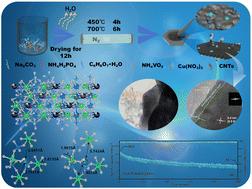
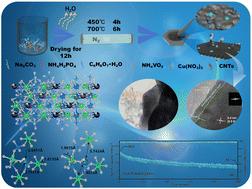
Na3V2(PO4)3 (NVP)具有较差的离子导电性和电子导电性。本文首次提出了在管状碳纳米管(CNTs)中掺杂Cu2+和包裹Cu2+的双重优化设计。这种策略不仅改变了NVP材料的内部电子结构,而且调节了NVP材料的形态特征。值得注意的是,Cu2+占据V3+位引入了有利的p型掺杂效应。因此,新生成的空穴可以作为载流子来提高电子导电性。同时,为了保持整个系统的电荷平衡,设计了一系列独特的Na3+xV2−xCux(PO4)3正极材料。富Na方案保持电荷完整性,并提供更多的活性Na+参与可逆脱嵌过程。由于Cu2+的离子半径较大,Cu2+掺杂起到了支撑晶体骨架的支柱作用,扩展了Na+的迁移通道,从而显著提高了离子输运速率。此外,适量的碳纳米管包裹在活性颗粒周围,与涂覆的碳层一起构建高导电性框架,增强电子转移。同时,管状CNTs和多孔形态有效地增加了活性颗粒与电解质的接触面积,提供了更多的活性位点。此外,原位EIS测量表明,稳定的SEI膜覆盖在循环的Na3.07V1.93Cu0.07(PO4)3@CNTs颗粒上,以保持电极的稳定性并防止副作用的发生。综合而言,Na3.07V1.93Cu0.07(PO4)3@CNTs样品在0.1℃下释放124.2 mA h g - 1,在10℃和50℃下释放101.9和98.6 mA h g - 1,显示出优越的速率能力。
Cu2+ substitution regulating Na3V2(PO4)3 with solid SEI membrane for superior electrochemical performance†
Na3V2(PO4)3 (NVP) suffers from poor ionic and electronic conductivity. Herein, a dual-optimized design with Cu2+ doping and wrapping in tubular carbon nanotubes (CNTs) is proposed for the first time. This strategy not only modifies the internal electronic structure but also regulates the morphological features of NVP material. Notably, Cu2+ occupying V3+ sites introduces favorable p-type doping effects. Consequently, newly generated holes can act as charge carriers to improve electronic conductivity. Meanwhile, to conserve the charge balance of the whole system, a series of distinctive Na3+xV2−xCux(PO4)3 cathode materials are designed. The Na-rich scheme maintains charge integrity, as well as supplying more active Na+ to take part in the reversible de-intercalation process. Due to the larger ionic radius of Cu2+, Cu2+ doping plays a great role as a pillar to support the crystal skeleton and then expand the Na+ migration channels, thus significantly elevating the ionic transport rate. Furthermore, moderate CNTs are wrapped around the active grains, functioning together with coated carbon layers to construct a highly conductive framework, enhancing electronic transfer. Meanwhile, the tubular CNTs and porous morphology effectively increase the contact areas between active particles and electrolyte, providing more active sites. Furthermore, in situ EIS measurement demonstrates that a stable SEI membrane covers the cycled Na3.07V1.93Cu0.07(PO4)3@CNTs grains to maintain electrode stability and prevent the occurrence of side-effects. Comprehensively, the Na3.07V1.93Cu0.07(PO4)3@CNTs sample releases 124.2 mA h g−1 at 0.1 C. It releases 101.9 and 98.6 mA h g−1 at 10 and 50 C, suggesting superior rate capability.
期刊介绍:
Dalton Transactions is a journal for all areas of inorganic chemistry, which encompasses the organometallic, bioinorganic and materials chemistry of the elements, with applications including synthesis, catalysis, energy conversion/storage, electrical devices and medicine. Dalton Transactions welcomes high-quality, original submissions in all of these areas and more, where the advancement of knowledge in inorganic chemistry is significant.




 京公网安备 11010802042870号
京ICP备2023020795号-1
京公网安备 11010802042870号
京ICP备2023020795号-1

 分享
分享
 求助内容:
求助内容: 应助结果提醒方式:
 扫码关注我们
