Qin Zhang, Xi Chen, Eng Liang Lim, Lei Shi and Zhanhua Wei
{"title":"推进全钙钛矿双端串联太阳能电池:宽窄带隙钙钛矿和互连层的优化","authors":"Qin Zhang, Xi Chen, Eng Liang Lim, Lei Shi and Zhanhua Wei","doi":"10.1039/D4EE06027J","DOIUrl":null,"url":null,"abstract":"<p >Perovskite solar cells (PSCs) have attracted tremendous attention due to their impressive power conversion efficiency (PCE). After extensive device engineering efforts, the PCE of single junction PSCs has reached 26.7% from the initial value of 3.8%. Owing to the unique characteristics of metal halide perovskites (MHPs), such as a tunable energy bandgap, bandgap complementary engineering can be applied to MHPs by pairing wide-bandgap (WBG) perovskite with narrow-bandgap (NBG) perovskite in series to form all-perovskite two-terminal tandem solar cells (all-Pe-2T-TSCs), which are expected to overcome the Shockley–Queisser limit. In a tandem architecture, the WBG perovskite and NBG perovskite act as the top and bottom absorbers, respectively, with the interconnecting layer (ICL) facilitating electron–hole recombination. Currently, (i) the huge <em>V</em><small><sub>OC</sub></small> deficit and severe photo-induced phase separation in WBG perovskite, (ii) the fast oxidation and uncontrollable crystallization of tin in NBG perovskite and (iii) the optical parasitic absorption losses in the ICL are the key challenges hindering the performance development of all-Pe-2T-TSCs. In this review, a thorough discussion is given to address the issues mentioned above through an analysis of previously published research. Finally, new viewpoints on boosting the PCE and stability of all-Pe-2T-TSCs are discussed, intending to guide readers in developing efficient and stable all-Pe-2T-TSCs.</p>","PeriodicalId":72,"journal":{"name":"Energy & Environmental Science","volume":" 7","pages":" 3060-3084"},"PeriodicalIF":30.8000,"publicationDate":"2025-02-19","publicationTypes":"Journal Article","fieldsOfStudy":null,"isOpenAccess":false,"openAccessPdf":"","citationCount":"0","resultStr":"{\"title\":\"Advancing all-perovskite two-terminal tandem solar cells: optimization of wide- and narrow-bandgap perovskites and interconnecting layers\",\"authors\":\"Qin Zhang, Xi Chen, Eng Liang Lim, Lei Shi and Zhanhua Wei\",\"doi\":\"10.1039/D4EE06027J\",\"DOIUrl\":null,\"url\":null,\"abstract\":\"<p >Perovskite solar cells (PSCs) have attracted tremendous attention due to their impressive power conversion efficiency (PCE). After extensive device engineering efforts, the PCE of single junction PSCs has reached 26.7% from the initial value of 3.8%. Owing to the unique characteristics of metal halide perovskites (MHPs), such as a tunable energy bandgap, bandgap complementary engineering can be applied to MHPs by pairing wide-bandgap (WBG) perovskite with narrow-bandgap (NBG) perovskite in series to form all-perovskite two-terminal tandem solar cells (all-Pe-2T-TSCs), which are expected to overcome the Shockley–Queisser limit. In a tandem architecture, the WBG perovskite and NBG perovskite act as the top and bottom absorbers, respectively, with the interconnecting layer (ICL) facilitating electron–hole recombination. Currently, (i) the huge <em>V</em><small><sub>OC</sub></small> deficit and severe photo-induced phase separation in WBG perovskite, (ii) the fast oxidation and uncontrollable crystallization of tin in NBG perovskite and (iii) the optical parasitic absorption losses in the ICL are the key challenges hindering the performance development of all-Pe-2T-TSCs. In this review, a thorough discussion is given to address the issues mentioned above through an analysis of previously published research. Finally, new viewpoints on boosting the PCE and stability of all-Pe-2T-TSCs are discussed, intending to guide readers in developing efficient and stable all-Pe-2T-TSCs.</p>\",\"PeriodicalId\":72,\"journal\":{\"name\":\"Energy & Environmental Science\",\"volume\":\" 7\",\"pages\":\" 3060-3084\"},\"PeriodicalIF\":30.8000,\"publicationDate\":\"2025-02-19\",\"publicationTypes\":\"Journal Article\",\"fieldsOfStudy\":null,\"isOpenAccess\":false,\"openAccessPdf\":\"\",\"citationCount\":\"0\",\"resultStr\":null,\"platform\":\"Semanticscholar\",\"paperid\":null,\"PeriodicalName\":\"Energy & Environmental Science\",\"FirstCategoryId\":\"88\",\"ListUrlMain\":\"https://pubs.rsc.org/en/content/articlelanding/2025/ee/d4ee06027j\",\"RegionNum\":1,\"RegionCategory\":\"材料科学\",\"ArticlePicture\":[],\"TitleCN\":null,\"AbstractTextCN\":null,\"PMCID\":null,\"EPubDate\":\"\",\"PubModel\":\"\",\"JCR\":\"Q1\",\"JCRName\":\"CHEMISTRY, MULTIDISCIPLINARY\",\"Score\":null,\"Total\":0}","platform":"Semanticscholar","paperid":null,"PeriodicalName":"Energy & Environmental Science","FirstCategoryId":"88","ListUrlMain":"https://pubs.rsc.org/en/content/articlelanding/2025/ee/d4ee06027j","RegionNum":1,"RegionCategory":"材料科学","ArticlePicture":[],"TitleCN":null,"AbstractTextCN":null,"PMCID":null,"EPubDate":"","PubModel":"","JCR":"Q1","JCRName":"CHEMISTRY, MULTIDISCIPLINARY","Score":null,"Total":0}
Advancing all-perovskite two-terminal tandem solar cells: optimization of wide- and narrow-bandgap perovskites and interconnecting layers
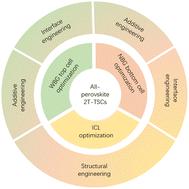
Perovskite solar cells (PSCs) have attracted tremendous attention due to their impressive power conversion efficiency (PCE). After extensive device engineering efforts, the PCE of single junction PSCs has reached 26.7% from the initial value of 3.8%. Owing to the unique characteristics of metal halide perovskites (MHPs), such as a tunable energy bandgap, bandgap complementary engineering can be applied to MHPs by pairing wide-bandgap (WBG) perovskite with narrow-bandgap (NBG) perovskite in series to form all-perovskite two-terminal tandem solar cells (all-Pe-2T-TSCs), which are expected to overcome the Shockley–Queisser limit. In a tandem architecture, the WBG perovskite and NBG perovskite act as the top and bottom absorbers, respectively, with the interconnecting layer (ICL) facilitating electron–hole recombination. Currently, (i) the huge VOC deficit and severe photo-induced phase separation in WBG perovskite, (ii) the fast oxidation and uncontrollable crystallization of tin in NBG perovskite and (iii) the optical parasitic absorption losses in the ICL are the key challenges hindering the performance development of all-Pe-2T-TSCs. In this review, a thorough discussion is given to address the issues mentioned above through an analysis of previously published research. Finally, new viewpoints on boosting the PCE and stability of all-Pe-2T-TSCs are discussed, intending to guide readers in developing efficient and stable all-Pe-2T-TSCs.
期刊介绍:
Energy & Environmental Science, a peer-reviewed scientific journal, publishes original research and review articles covering interdisciplinary topics in the (bio)chemical and (bio)physical sciences, as well as chemical engineering disciplines. Published monthly by the Royal Society of Chemistry (RSC), a not-for-profit publisher, Energy & Environmental Science is recognized as a leading journal. It boasts an impressive impact factor of 8.500 as of 2009, ranking 8th among 140 journals in the category "Chemistry, Multidisciplinary," second among 71 journals in "Energy & Fuels," second among 128 journals in "Engineering, Chemical," and first among 181 scientific journals in "Environmental Sciences."
Energy & Environmental Science publishes various types of articles, including Research Papers (original scientific work), Review Articles, Perspectives, and Minireviews (feature review-type articles of broad interest), Communications (original scientific work of an urgent nature), Opinions (personal, often speculative viewpoints or hypotheses on current topics), and Analysis Articles (in-depth examination of energy-related issues).




 京公网安备 11010802042870号
京ICP备2023020795号-1
京公网安备 11010802042870号
京ICP备2023020795号-1

 分享
分享
 求助内容:
求助内容: 应助结果提醒方式:
 扫码关注我们
