Chenxu Dong, Yongkun Yu, Changning Ma, Cheng Zhou, Jiajing Wang, Jiapei Gu, Juan Ji, Shubin Yang, Zunfeng Liu, Xu Xu and Liqiang Mai
{"title":"实现超长循环锌碘电池轨道耦合杂交的定制锌双原子双向催化剂","authors":"Chenxu Dong, Yongkun Yu, Changning Ma, Cheng Zhou, Jiajing Wang, Jiapei Gu, Juan Ji, Shubin Yang, Zunfeng Liu, Xu Xu and Liqiang Mai","doi":"10.1039/D4EE05767H","DOIUrl":null,"url":null,"abstract":"<p >Aqueous zinc–iodine (Zn–I<small><sub>2</sub></small>) batteries have become promising energy storage devices due to their high theoretical capacity, high safety, and low cost advantages. However, sluggish kinetics and the shuttle effect of polyiodides still limit the further development of Zn–I<small><sub>2</sub></small> batteries. Single-atom catalysts have been explored in Zn–I<small><sub>2</sub></small> batteries to address the above challenges, but single atom sites restrict the adsorption/desorption relationship of reactants and intermediates. Herein, honeycomb shaped Zn dual atom sites embedded in nitrogen doped carbon nanosheets were designed to not only enhance the confinement of I<small><sub>2</sub></small>, but also facilitate the bidirectional redox kinetics of polyiodides through orbital coupling and hybridization, thereby improving the capacity and cycle stability of Zn–I<small><sub>2</sub></small> batteries. Impressively, the batteries with I<small><sub>2</sub></small>@Zn<small><sub>2</sub></small>NC cathodes received the longest cycle of 100 000 cycles at 50C, retaining an ultra-low capacity fading of 0.0002% per cycle. Additionally, the batteries achieved 7000 cycles at 10C even at −20 °C, verifying good catalytic performance of Zn<small><sub>2</sub></small>NC at low temperature. This work reveals the mechanism of synergistic adsorption and catalytic conversion of polyiodides by dual single atom catalysts, providing guidance for the design of dual atom site structures to achieve state-of-the-art Zn–I<small><sub>2</sub></small> batteries.</p>","PeriodicalId":72,"journal":{"name":"Energy & Environmental Science","volume":" 6","pages":" 3014-3025"},"PeriodicalIF":30.5000,"publicationDate":"2025-02-19","publicationTypes":"Journal Article","fieldsOfStudy":null,"isOpenAccess":false,"openAccessPdf":"","citationCount":"0","resultStr":"{\"title\":\"Tailoring zinc diatomic bidirectional catalysts achieving orbital coupling–hybridization for ultralong-cycling zinc–iodine batteries†\",\"authors\":\"Chenxu Dong, Yongkun Yu, Changning Ma, Cheng Zhou, Jiajing Wang, Jiapei Gu, Juan Ji, Shubin Yang, Zunfeng Liu, Xu Xu and Liqiang Mai\",\"doi\":\"10.1039/D4EE05767H\",\"DOIUrl\":null,\"url\":null,\"abstract\":\"<p >Aqueous zinc–iodine (Zn–I<small><sub>2</sub></small>) batteries have become promising energy storage devices due to their high theoretical capacity, high safety, and low cost advantages. However, sluggish kinetics and the shuttle effect of polyiodides still limit the further development of Zn–I<small><sub>2</sub></small> batteries. Single-atom catalysts have been explored in Zn–I<small><sub>2</sub></small> batteries to address the above challenges, but single atom sites restrict the adsorption/desorption relationship of reactants and intermediates. Herein, honeycomb shaped Zn dual atom sites embedded in nitrogen doped carbon nanosheets were designed to not only enhance the confinement of I<small><sub>2</sub></small>, but also facilitate the bidirectional redox kinetics of polyiodides through orbital coupling and hybridization, thereby improving the capacity and cycle stability of Zn–I<small><sub>2</sub></small> batteries. Impressively, the batteries with I<small><sub>2</sub></small>@Zn<small><sub>2</sub></small>NC cathodes received the longest cycle of 100 000 cycles at 50C, retaining an ultra-low capacity fading of 0.0002% per cycle. Additionally, the batteries achieved 7000 cycles at 10C even at −20 °C, verifying good catalytic performance of Zn<small><sub>2</sub></small>NC at low temperature. This work reveals the mechanism of synergistic adsorption and catalytic conversion of polyiodides by dual single atom catalysts, providing guidance for the design of dual atom site structures to achieve state-of-the-art Zn–I<small><sub>2</sub></small> batteries.</p>\",\"PeriodicalId\":72,\"journal\":{\"name\":\"Energy & Environmental Science\",\"volume\":\" 6\",\"pages\":\" 3014-3025\"},\"PeriodicalIF\":30.5000,\"publicationDate\":\"2025-02-19\",\"publicationTypes\":\"Journal Article\",\"fieldsOfStudy\":null,\"isOpenAccess\":false,\"openAccessPdf\":\"\",\"citationCount\":\"0\",\"resultStr\":null,\"platform\":\"Semanticscholar\",\"paperid\":null,\"PeriodicalName\":\"Energy & Environmental Science\",\"FirstCategoryId\":\"88\",\"ListUrlMain\":\"https://pubs.rsc.org/en/content/articlelanding/2025/ee/d4ee05767h\",\"RegionNum\":1,\"RegionCategory\":\"材料科学\",\"ArticlePicture\":[],\"TitleCN\":null,\"AbstractTextCN\":null,\"PMCID\":null,\"EPubDate\":\"\",\"PubModel\":\"\",\"JCR\":\"Q1\",\"JCRName\":\"CHEMISTRY, MULTIDISCIPLINARY\",\"Score\":null,\"Total\":0}","platform":"Semanticscholar","paperid":null,"PeriodicalName":"Energy & Environmental Science","FirstCategoryId":"88","ListUrlMain":"https://pubs.rsc.org/en/content/articlelanding/2025/ee/d4ee05767h","RegionNum":1,"RegionCategory":"材料科学","ArticlePicture":[],"TitleCN":null,"AbstractTextCN":null,"PMCID":null,"EPubDate":"","PubModel":"","JCR":"Q1","JCRName":"CHEMISTRY, MULTIDISCIPLINARY","Score":null,"Total":0}
Tailoring zinc diatomic bidirectional catalysts achieving orbital coupling–hybridization for ultralong-cycling zinc–iodine batteries†
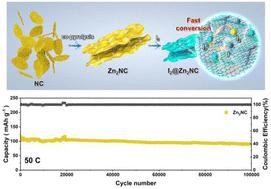
Aqueous zinc–iodine (Zn–I2) batteries have become promising energy storage devices due to their high theoretical capacity, high safety, and low cost advantages. However, sluggish kinetics and the shuttle effect of polyiodides still limit the further development of Zn–I2 batteries. Single-atom catalysts have been explored in Zn–I2 batteries to address the above challenges, but single atom sites restrict the adsorption/desorption relationship of reactants and intermediates. Herein, honeycomb shaped Zn dual atom sites embedded in nitrogen doped carbon nanosheets were designed to not only enhance the confinement of I2, but also facilitate the bidirectional redox kinetics of polyiodides through orbital coupling and hybridization, thereby improving the capacity and cycle stability of Zn–I2 batteries. Impressively, the batteries with I2@Zn2NC cathodes received the longest cycle of 100 000 cycles at 50C, retaining an ultra-low capacity fading of 0.0002% per cycle. Additionally, the batteries achieved 7000 cycles at 10C even at −20 °C, verifying good catalytic performance of Zn2NC at low temperature. This work reveals the mechanism of synergistic adsorption and catalytic conversion of polyiodides by dual single atom catalysts, providing guidance for the design of dual atom site structures to achieve state-of-the-art Zn–I2 batteries.
期刊介绍:
Energy & Environmental Science, a peer-reviewed scientific journal, publishes original research and review articles covering interdisciplinary topics in the (bio)chemical and (bio)physical sciences, as well as chemical engineering disciplines. Published monthly by the Royal Society of Chemistry (RSC), a not-for-profit publisher, Energy & Environmental Science is recognized as a leading journal. It boasts an impressive impact factor of 8.500 as of 2009, ranking 8th among 140 journals in the category "Chemistry, Multidisciplinary," second among 71 journals in "Energy & Fuels," second among 128 journals in "Engineering, Chemical," and first among 181 scientific journals in "Environmental Sciences."
Energy & Environmental Science publishes various types of articles, including Research Papers (original scientific work), Review Articles, Perspectives, and Minireviews (feature review-type articles of broad interest), Communications (original scientific work of an urgent nature), Opinions (personal, often speculative viewpoints or hypotheses on current topics), and Analysis Articles (in-depth examination of energy-related issues).





 京公网安备 11010802042870号
京ICP备2023020795号-1
京公网安备 11010802042870号
京ICP备2023020795号-1

 分享
分享
 求助内容:
求助内容: 应助结果提醒方式:
 扫码关注我们
