Sheng Fu, Nannan Sun, Hao Chen, You Li, Yunfei Li, Xiaotian Zhu, Bo Feng, Xueming Guo, Canglang Yao, Wenxiao Zhang, Xiaodong Li and Junfeng Fang
{"title":"通过播种-OH基团均匀化SAMs沉积用于钙钛矿太阳能电池的可扩展制造","authors":"Sheng Fu, Nannan Sun, Hao Chen, You Li, Yunfei Li, Xiaotian Zhu, Bo Feng, Xueming Guo, Canglang Yao, Wenxiao Zhang, Xiaodong Li and Junfeng Fang","doi":"10.1039/D5EE00350D","DOIUrl":null,"url":null,"abstract":"<p >Self-assembled monolayers (SAMs) play a significant role in the rapidly advancing inverted perovskite solar cells (PSCs). Additional metal oxide or molecular incorporations are widely adopted to ameliorate their incomplete and uneven deposition on substrates, where the underlying binding situations between SAMs and substrates are vital for further optimization but remain unclear. Here, we compared the bonding types between SAMs and metal oxides from a theoretical view and concluded that SAMs preferably form strong chemical bonds of –P–O–Sn by reacting with hydroxyl groups (–OH) on metal oxides for stable adsorption. We further proposed a simple yet effective strategy, named seeding –OH groups <em>via</em> hydrogen peroxide (H<small><sub>2</sub></small>O<small><sub>2</sub></small>)/ultraviolet bath, to strengthen and homogenize SAM deposition on substrates, yielding superior buried interface contact and high-quality perovskite films. Benefiting from the promotions, the resulted PSCs realized the champion efficiency of 26.19%, and 24.68% and 21.77% during their scalable fabrications with the areas of 1.21 and 13.8 cm<small><sup>2</sup></small> (minimodules, active area), surpassing the bare ones with inferior scalability. Moreover, the large-area device maintained over 90% of their initial efficiency after the ISOS-L-3 test for 1000 h.</p>","PeriodicalId":72,"journal":{"name":"Energy & Environmental Science","volume":" 7","pages":" 3305-3312"},"PeriodicalIF":30.8000,"publicationDate":"2025-02-19","publicationTypes":"Journal Article","fieldsOfStudy":null,"isOpenAccess":false,"openAccessPdf":"","citationCount":"0","resultStr":"{\"title\":\"Homogenizing SAM deposition via seeding –OH groups for scalable fabrication of perovskite solar cells†\",\"authors\":\"Sheng Fu, Nannan Sun, Hao Chen, You Li, Yunfei Li, Xiaotian Zhu, Bo Feng, Xueming Guo, Canglang Yao, Wenxiao Zhang, Xiaodong Li and Junfeng Fang\",\"doi\":\"10.1039/D5EE00350D\",\"DOIUrl\":null,\"url\":null,\"abstract\":\"<p >Self-assembled monolayers (SAMs) play a significant role in the rapidly advancing inverted perovskite solar cells (PSCs). Additional metal oxide or molecular incorporations are widely adopted to ameliorate their incomplete and uneven deposition on substrates, where the underlying binding situations between SAMs and substrates are vital for further optimization but remain unclear. Here, we compared the bonding types between SAMs and metal oxides from a theoretical view and concluded that SAMs preferably form strong chemical bonds of –P–O–Sn by reacting with hydroxyl groups (–OH) on metal oxides for stable adsorption. We further proposed a simple yet effective strategy, named seeding –OH groups <em>via</em> hydrogen peroxide (H<small><sub>2</sub></small>O<small><sub>2</sub></small>)/ultraviolet bath, to strengthen and homogenize SAM deposition on substrates, yielding superior buried interface contact and high-quality perovskite films. Benefiting from the promotions, the resulted PSCs realized the champion efficiency of 26.19%, and 24.68% and 21.77% during their scalable fabrications with the areas of 1.21 and 13.8 cm<small><sup>2</sup></small> (minimodules, active area), surpassing the bare ones with inferior scalability. Moreover, the large-area device maintained over 90% of their initial efficiency after the ISOS-L-3 test for 1000 h.</p>\",\"PeriodicalId\":72,\"journal\":{\"name\":\"Energy & Environmental Science\",\"volume\":\" 7\",\"pages\":\" 3305-3312\"},\"PeriodicalIF\":30.8000,\"publicationDate\":\"2025-02-19\",\"publicationTypes\":\"Journal Article\",\"fieldsOfStudy\":null,\"isOpenAccess\":false,\"openAccessPdf\":\"\",\"citationCount\":\"0\",\"resultStr\":null,\"platform\":\"Semanticscholar\",\"paperid\":null,\"PeriodicalName\":\"Energy & Environmental Science\",\"FirstCategoryId\":\"88\",\"ListUrlMain\":\"https://pubs.rsc.org/en/content/articlelanding/2025/ee/d5ee00350d\",\"RegionNum\":1,\"RegionCategory\":\"材料科学\",\"ArticlePicture\":[],\"TitleCN\":null,\"AbstractTextCN\":null,\"PMCID\":null,\"EPubDate\":\"\",\"PubModel\":\"\",\"JCR\":\"Q1\",\"JCRName\":\"CHEMISTRY, MULTIDISCIPLINARY\",\"Score\":null,\"Total\":0}","platform":"Semanticscholar","paperid":null,"PeriodicalName":"Energy & Environmental Science","FirstCategoryId":"88","ListUrlMain":"https://pubs.rsc.org/en/content/articlelanding/2025/ee/d5ee00350d","RegionNum":1,"RegionCategory":"材料科学","ArticlePicture":[],"TitleCN":null,"AbstractTextCN":null,"PMCID":null,"EPubDate":"","PubModel":"","JCR":"Q1","JCRName":"CHEMISTRY, MULTIDISCIPLINARY","Score":null,"Total":0}
引用次数: 0
摘要
自组装单层膜(sam)在快速发展的倒钙钛矿太阳能电池(PSCs)中起着重要的作用。额外的金属氧化物或分子掺入物被广泛采用,以改善其在底物上的不完整和不均匀沉积,其中SAMs与底物之间的潜在结合情况对进一步优化至关重要,但尚不清楚。本文从理论上比较了SAMs与金属氧化物之间的成键类型,并得出结论:SAMs通过与金属氧化物上的羟基(-OH)反应形成-P-O-Sn的强化学键。我们进一步提出了一种简单而有效的策略,即通过过氧化氢(H2O2)/紫外线浴来播种oh基团,以增强和均匀基底上的SAMs沉积,从而产生优越的埋藏界面接触和高质量的钙钛矿薄膜。综上所述,在面积为1.21 cm2和13.8 cm2(微模块,有源面积)的可扩展制造中,PSCs的冠军效率分别为26.19%、24.68%和21.77%,超过了可扩展性较差的裸PSCs。此外,在iso - l -3测试1000小时后,大面积器件的效率仍保持在初始效率的90%以上。
Homogenizing SAM deposition via seeding –OH groups for scalable fabrication of perovskite solar cells†
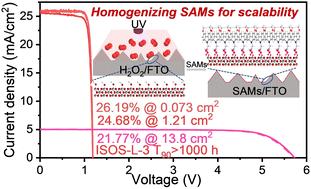
Self-assembled monolayers (SAMs) play a significant role in the rapidly advancing inverted perovskite solar cells (PSCs). Additional metal oxide or molecular incorporations are widely adopted to ameliorate their incomplete and uneven deposition on substrates, where the underlying binding situations between SAMs and substrates are vital for further optimization but remain unclear. Here, we compared the bonding types between SAMs and metal oxides from a theoretical view and concluded that SAMs preferably form strong chemical bonds of –P–O–Sn by reacting with hydroxyl groups (–OH) on metal oxides for stable adsorption. We further proposed a simple yet effective strategy, named seeding –OH groups via hydrogen peroxide (H2O2)/ultraviolet bath, to strengthen and homogenize SAM deposition on substrates, yielding superior buried interface contact and high-quality perovskite films. Benefiting from the promotions, the resulted PSCs realized the champion efficiency of 26.19%, and 24.68% and 21.77% during their scalable fabrications with the areas of 1.21 and 13.8 cm2 (minimodules, active area), surpassing the bare ones with inferior scalability. Moreover, the large-area device maintained over 90% of their initial efficiency after the ISOS-L-3 test for 1000 h.
期刊介绍:
Energy & Environmental Science, a peer-reviewed scientific journal, publishes original research and review articles covering interdisciplinary topics in the (bio)chemical and (bio)physical sciences, as well as chemical engineering disciplines. Published monthly by the Royal Society of Chemistry (RSC), a not-for-profit publisher, Energy & Environmental Science is recognized as a leading journal. It boasts an impressive impact factor of 8.500 as of 2009, ranking 8th among 140 journals in the category "Chemistry, Multidisciplinary," second among 71 journals in "Energy & Fuels," second among 128 journals in "Engineering, Chemical," and first among 181 scientific journals in "Environmental Sciences."
Energy & Environmental Science publishes various types of articles, including Research Papers (original scientific work), Review Articles, Perspectives, and Minireviews (feature review-type articles of broad interest), Communications (original scientific work of an urgent nature), Opinions (personal, often speculative viewpoints or hypotheses on current topics), and Analysis Articles (in-depth examination of energy-related issues).




 京公网安备 11010802042870号
京ICP备2023020795号-1
京公网安备 11010802042870号
京ICP备2023020795号-1

 分享
分享
 求助内容:
求助内容: 应助结果提醒方式:
 扫码关注我们
