Dibyajyoti D. Pradhan , A.P. Chakraverty , T. Badapanda , R. Nayak , U.K. Mohanty , M.R. Das
{"title":"辉光放电等离子体辐照增强玻璃/碳纤维复合材料的性能","authors":"Dibyajyoti D. Pradhan , A.P. Chakraverty , T. Badapanda , R. Nayak , U.K. Mohanty , M.R. Das","doi":"10.1016/j.compositesb.2025.112299","DOIUrl":null,"url":null,"abstract":"<div><div>Conventional FRP composite suffers various problems due to improper curing, interfacial residual stress and environmental degradation. Such problems can be compensated by adopting partial use of carbon fibre in glass fibre based FRP composite and exposing such composite to energetic radiation for post-curing strengthening. Keeping this in mind, FRP composite samples with alternative glass and carbon fibre layers were irradiated through glow discharge plasma up to 35 min with air and argon maintained with 10–50 Watt power. About 113 % and 135 % increase in inter laminar and flexural strengths, respectively, were found with respect to argon plasma ageing for 30 min at 50 Watt power. At this power, about 14.7 % and 35 % increase in T<sub>g</sub> was observed for the modified FRP with 15 min of air plasma and 30 min of argon plasma exposure, respectively. Maximum thermal activation energy was obtained through argon plasma irradiation. FTIR test revealed additional peaks at 1721 cm<sup>−1</sup> and 3060 cm<sup>−1</sup> for maximum power of argon-plasma treated FRP sample. Air and argon plasma at their optimized power and duration resulted increase in wettability with improved surface roughness. The failure modes of SEM fractographs indicated improved thermo-mechanical properties in plasma cured modified FRP.</div></div>","PeriodicalId":10660,"journal":{"name":"Composites Part B: Engineering","volume":"297 ","pages":"Article 112299"},"PeriodicalIF":14.2000,"publicationDate":"2025-05-15","publicationTypes":"Journal Article","fieldsOfStudy":null,"isOpenAccess":false,"openAccessPdf":"","citationCount":"0","resultStr":"{\"title\":\"Property enhancement of alternating glass/carbon fibre laminated FRP composite by glow discharge post-plasma irradiation\",\"authors\":\"Dibyajyoti D. Pradhan , A.P. Chakraverty , T. Badapanda , R. Nayak , U.K. Mohanty , M.R. Das\",\"doi\":\"10.1016/j.compositesb.2025.112299\",\"DOIUrl\":null,\"url\":null,\"abstract\":\"<div><div>Conventional FRP composite suffers various problems due to improper curing, interfacial residual stress and environmental degradation. Such problems can be compensated by adopting partial use of carbon fibre in glass fibre based FRP composite and exposing such composite to energetic radiation for post-curing strengthening. Keeping this in mind, FRP composite samples with alternative glass and carbon fibre layers were irradiated through glow discharge plasma up to 35 min with air and argon maintained with 10–50 Watt power. About 113 % and 135 % increase in inter laminar and flexural strengths, respectively, were found with respect to argon plasma ageing for 30 min at 50 Watt power. At this power, about 14.7 % and 35 % increase in T<sub>g</sub> was observed for the modified FRP with 15 min of air plasma and 30 min of argon plasma exposure, respectively. Maximum thermal activation energy was obtained through argon plasma irradiation. FTIR test revealed additional peaks at 1721 cm<sup>−1</sup> and 3060 cm<sup>−1</sup> for maximum power of argon-plasma treated FRP sample. Air and argon plasma at their optimized power and duration resulted increase in wettability with improved surface roughness. The failure modes of SEM fractographs indicated improved thermo-mechanical properties in plasma cured modified FRP.</div></div>\",\"PeriodicalId\":10660,\"journal\":{\"name\":\"Composites Part B: Engineering\",\"volume\":\"297 \",\"pages\":\"Article 112299\"},\"PeriodicalIF\":14.2000,\"publicationDate\":\"2025-05-15\",\"publicationTypes\":\"Journal Article\",\"fieldsOfStudy\":null,\"isOpenAccess\":false,\"openAccessPdf\":\"\",\"citationCount\":\"0\",\"resultStr\":null,\"platform\":\"Semanticscholar\",\"paperid\":null,\"PeriodicalName\":\"Composites Part B: Engineering\",\"FirstCategoryId\":\"5\",\"ListUrlMain\":\"https://www.sciencedirect.com/science/article/pii/S1359836825001891\",\"RegionNum\":1,\"RegionCategory\":\"材料科学\",\"ArticlePicture\":[],\"TitleCN\":null,\"AbstractTextCN\":null,\"PMCID\":null,\"EPubDate\":\"2025/2/17 0:00:00\",\"PubModel\":\"Epub\",\"JCR\":\"Q1\",\"JCRName\":\"ENGINEERING, MULTIDISCIPLINARY\",\"Score\":null,\"Total\":0}","platform":"Semanticscholar","paperid":null,"PeriodicalName":"Composites Part B: Engineering","FirstCategoryId":"5","ListUrlMain":"https://www.sciencedirect.com/science/article/pii/S1359836825001891","RegionNum":1,"RegionCategory":"材料科学","ArticlePicture":[],"TitleCN":null,"AbstractTextCN":null,"PMCID":null,"EPubDate":"2025/2/17 0:00:00","PubModel":"Epub","JCR":"Q1","JCRName":"ENGINEERING, MULTIDISCIPLINARY","Score":null,"Total":0}
引用次数: 0
摘要
传统的玻璃钢复合材料由于养护不当、界面残余应力和环境退化等原因存在各种问题。这些问题可以通过在玻璃纤维基FRP复合材料中部分使用碳纤维,并将这种复合材料暴露于高能辐射中进行固化后强化来弥补。考虑到这一点,通过辉光放电等离子体对具有替代玻璃和碳纤维层的FRP复合材料样品进行辐照,辐照时间长达35分钟,功率为10-50瓦。在50瓦功率下氩等离子体时效30 min,层间强度和抗弯强度分别提高了113%和135%。在此功率下,在空气等离子体暴露15分钟和氩气等离子体暴露30分钟后,改性玻璃钢的Tg分别增加了14.7%和35%。氩等离子体辐照获得了最大的热活化能。FTIR测试显示氩气等离子体处理FRP样品的最大功率在1721 cm - 1和3060 cm - 1处有额外的峰。在优化的功率和持续时间下,空气和氩等离子体的润湿性增加,表面粗糙度改善。SEM断口破坏模式表明,等离子体固化改性玻璃钢的热力学性能得到改善。
Property enhancement of alternating glass/carbon fibre laminated FRP composite by glow discharge post-plasma irradiation
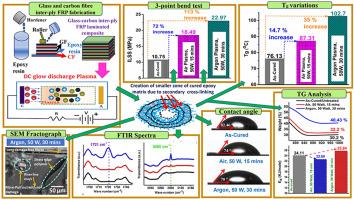
Conventional FRP composite suffers various problems due to improper curing, interfacial residual stress and environmental degradation. Such problems can be compensated by adopting partial use of carbon fibre in glass fibre based FRP composite and exposing such composite to energetic radiation for post-curing strengthening. Keeping this in mind, FRP composite samples with alternative glass and carbon fibre layers were irradiated through glow discharge plasma up to 35 min with air and argon maintained with 10–50 Watt power. About 113 % and 135 % increase in inter laminar and flexural strengths, respectively, were found with respect to argon plasma ageing for 30 min at 50 Watt power. At this power, about 14.7 % and 35 % increase in Tg was observed for the modified FRP with 15 min of air plasma and 30 min of argon plasma exposure, respectively. Maximum thermal activation energy was obtained through argon plasma irradiation. FTIR test revealed additional peaks at 1721 cm−1 and 3060 cm−1 for maximum power of argon-plasma treated FRP sample. Air and argon plasma at their optimized power and duration resulted increase in wettability with improved surface roughness. The failure modes of SEM fractographs indicated improved thermo-mechanical properties in plasma cured modified FRP.
期刊介绍:
Composites Part B: Engineering is a journal that publishes impactful research of high quality on composite materials. This research is supported by fundamental mechanics and materials science and engineering approaches. The targeted research can cover a wide range of length scales, ranging from nano to micro and meso, and even to the full product and structure level. The journal specifically focuses on engineering applications that involve high performance composites. These applications can range from low volume and high cost to high volume and low cost composite development.
The main goal of the journal is to provide a platform for the prompt publication of original and high quality research. The emphasis is on design, development, modeling, validation, and manufacturing of engineering details and concepts. The journal welcomes both basic research papers and proposals for review articles. Authors are encouraged to address challenges across various application areas. These areas include, but are not limited to, aerospace, automotive, and other surface transportation. The journal also covers energy-related applications, with a focus on renewable energy. Other application areas include infrastructure, off-shore and maritime projects, health care technology, and recreational products.




 京公网安备 11010802042870号
京ICP备2023020795号-1
京公网安备 11010802042870号
京ICP备2023020795号-1

 分享
分享
 求助内容:
求助内容: 应助结果提醒方式:
 扫码关注我们
