Sabuj Chandra Sutradhar, Wansu Bae, Subeen Song, Kijong Joo, Hyewon Na, Jiye Lee, Whangi Kim, Hohyoun Jang
{"title":"质子交换膜燃料电池用氟磺酰亚胺基聚苯甲酰二苯苯膜的合成与表征","authors":"Sabuj Chandra Sutradhar, Wansu Bae, Subeen Song, Kijong Joo, Hyewon Na, Jiye Lee, Whangi Kim, Hohyoun Jang","doi":"10.1016/j.fuel.2025.134741","DOIUrl":null,"url":null,"abstract":"<div><div>This study aims to enhance proton exchange membrane fuel cell (PEMFC) performance by synthesizing and characterizing sulfonyl imide-based poly(benzoyl diphenyl benzene) (SI-PBDPB) membranes. The objective is to develop ether-free SI-PBDPB polymers with dibenzoyl functionalities, using Ni/Zn catalysts, to improve conductivity, flexibility, chemical and mechanical integrity. These membranes exhibit superior ion exchange capacity (IEC) ranging from 0.98 to 1.78 meq/g and water uptake between 8.11 % and 48.48 %. Notably, the SI-PBDPB-40 membrane achieves exceptional proton conductivity of 118.61 mS/cm and a maximum power density of 0.63 W/cm2, outperforming Nafion 211® benchmarks of 104.5 mS/cm and 0.59 W/cm2. The sulfonyl imide groups enhance chemical resistance and facilitate efficient proton transport through distinct hydrophilic-hydrophobic phase separation. The thermal, mechanical, and chemical integrity of the SI-PBDPB membranes is confirmed by thermogravimetric analysis (TGA), tensile test, and Fenton’s reagent test, respectively. Atomic force microscopy (AFM) reveals well-defined ionic channels that contribute to their elevated proton conduction. These findings position SI-PBDPB membranes as promising candidates for next-generation PEMFCs.</div></div>","PeriodicalId":325,"journal":{"name":"Fuel","volume":"390 ","pages":"Article 134741"},"PeriodicalIF":7.8000,"publicationDate":"2025-06-15","publicationTypes":"Journal Article","fieldsOfStudy":null,"isOpenAccess":false,"openAccessPdf":"","citationCount":"0","resultStr":"{\"title\":\"Synthesis and characterization of fluoro sulfonyl imide-based poly(benzoyl diphenyl benzene) membranes for proton exchange membrane fuel cells\",\"authors\":\"Sabuj Chandra Sutradhar, Wansu Bae, Subeen Song, Kijong Joo, Hyewon Na, Jiye Lee, Whangi Kim, Hohyoun Jang\",\"doi\":\"10.1016/j.fuel.2025.134741\",\"DOIUrl\":null,\"url\":null,\"abstract\":\"<div><div>This study aims to enhance proton exchange membrane fuel cell (PEMFC) performance by synthesizing and characterizing sulfonyl imide-based poly(benzoyl diphenyl benzene) (SI-PBDPB) membranes. The objective is to develop ether-free SI-PBDPB polymers with dibenzoyl functionalities, using Ni/Zn catalysts, to improve conductivity, flexibility, chemical and mechanical integrity. These membranes exhibit superior ion exchange capacity (IEC) ranging from 0.98 to 1.78 meq/g and water uptake between 8.11 % and 48.48 %. Notably, the SI-PBDPB-40 membrane achieves exceptional proton conductivity of 118.61 mS/cm and a maximum power density of 0.63 W/cm2, outperforming Nafion 211® benchmarks of 104.5 mS/cm and 0.59 W/cm2. The sulfonyl imide groups enhance chemical resistance and facilitate efficient proton transport through distinct hydrophilic-hydrophobic phase separation. The thermal, mechanical, and chemical integrity of the SI-PBDPB membranes is confirmed by thermogravimetric analysis (TGA), tensile test, and Fenton’s reagent test, respectively. Atomic force microscopy (AFM) reveals well-defined ionic channels that contribute to their elevated proton conduction. These findings position SI-PBDPB membranes as promising candidates for next-generation PEMFCs.</div></div>\",\"PeriodicalId\":325,\"journal\":{\"name\":\"Fuel\",\"volume\":\"390 \",\"pages\":\"Article 134741\"},\"PeriodicalIF\":7.8000,\"publicationDate\":\"2025-06-15\",\"publicationTypes\":\"Journal Article\",\"fieldsOfStudy\":null,\"isOpenAccess\":false,\"openAccessPdf\":\"\",\"citationCount\":\"0\",\"resultStr\":null,\"platform\":\"Semanticscholar\",\"paperid\":null,\"PeriodicalName\":\"Fuel\",\"FirstCategoryId\":\"5\",\"ListUrlMain\":\"https://www.sciencedirect.com/science/article/pii/S001623612500465X\",\"RegionNum\":1,\"RegionCategory\":\"工程技术\",\"ArticlePicture\":[],\"TitleCN\":null,\"AbstractTextCN\":null,\"PMCID\":null,\"EPubDate\":\"2025/2/20 0:00:00\",\"PubModel\":\"Epub\",\"JCR\":\"Q2\",\"JCRName\":\"ENERGY & FUELS\",\"Score\":null,\"Total\":0}","platform":"Semanticscholar","paperid":null,"PeriodicalName":"Fuel","FirstCategoryId":"5","ListUrlMain":"https://www.sciencedirect.com/science/article/pii/S001623612500465X","RegionNum":1,"RegionCategory":"工程技术","ArticlePicture":[],"TitleCN":null,"AbstractTextCN":null,"PMCID":null,"EPubDate":"2025/2/20 0:00:00","PubModel":"Epub","JCR":"Q2","JCRName":"ENERGY & FUELS","Score":null,"Total":0}
Synthesis and characterization of fluoro sulfonyl imide-based poly(benzoyl diphenyl benzene) membranes for proton exchange membrane fuel cells
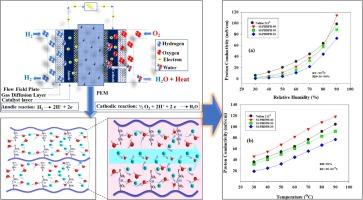
This study aims to enhance proton exchange membrane fuel cell (PEMFC) performance by synthesizing and characterizing sulfonyl imide-based poly(benzoyl diphenyl benzene) (SI-PBDPB) membranes. The objective is to develop ether-free SI-PBDPB polymers with dibenzoyl functionalities, using Ni/Zn catalysts, to improve conductivity, flexibility, chemical and mechanical integrity. These membranes exhibit superior ion exchange capacity (IEC) ranging from 0.98 to 1.78 meq/g and water uptake between 8.11 % and 48.48 %. Notably, the SI-PBDPB-40 membrane achieves exceptional proton conductivity of 118.61 mS/cm and a maximum power density of 0.63 W/cm2, outperforming Nafion 211® benchmarks of 104.5 mS/cm and 0.59 W/cm2. The sulfonyl imide groups enhance chemical resistance and facilitate efficient proton transport through distinct hydrophilic-hydrophobic phase separation. The thermal, mechanical, and chemical integrity of the SI-PBDPB membranes is confirmed by thermogravimetric analysis (TGA), tensile test, and Fenton’s reagent test, respectively. Atomic force microscopy (AFM) reveals well-defined ionic channels that contribute to their elevated proton conduction. These findings position SI-PBDPB membranes as promising candidates for next-generation PEMFCs.
期刊介绍:
The exploration of energy sources remains a critical matter of study. For the past nine decades, fuel has consistently held the forefront in primary research efforts within the field of energy science. This area of investigation encompasses a wide range of subjects, with a particular emphasis on emerging concerns like environmental factors and pollution.




 京公网安备 11010802042870号
京ICP备2023020795号-1
京公网安备 11010802042870号
京ICP备2023020795号-1

 分享
分享
 求助内容:
求助内容: 应助结果提醒方式:
 扫码关注我们
