Aida Zaabtia , Mohamedou Ba , Mahmoud Ben Amara , Salah Ammar
{"title":"Box-Behnken设计在不同太阳能阳极电fenton工艺余量加工条件优化中的应用","authors":"Aida Zaabtia , Mohamedou Ba , Mahmoud Ben Amara , Salah Ammar","doi":"10.1016/j.jpowsour.2025.236532","DOIUrl":null,"url":null,"abstract":"<div><div>This study focuses on the treatment of margin (olive mill wastewater) using the electro-Fenton process with different anodes powered by solar energy. Iron from pyrite is used as a catalyst, and hydrogen peroxide is produced <em>in situ</em> by bubbling air into the effluent. A three-factor Box-Behnken design is employed for optimization. The results show that a boron-doped diamond (BDD) anode achieves a chemical oxygen demand (COD) reduction rate of 98.71 % under the following conditions: current of 0.7 A, pyrite mass of 0.3 g, and electrolysis time of 90 min. Using a platinum anode, a COD reduction rate of 87.0 % is obtained with a current of 0.5 A, a pyrite mass of 0.3 g, and an electrolysis time of 75 min. Energy consumption is 10.35 kWh m<sup>−3</sup> for BDD and 6.25 kWh m<sup>−3</sup> for Pt, giving an operating cost of around 1.13 $ m<sup>−3</sup> and 0.682 $ m<sup>−3</sup> for the BDD and Pt respectively. This study demonstrates that the BDD electrode yields superior results compared to a flat platinum anode when using solar energy.</div></div>","PeriodicalId":377,"journal":{"name":"Journal of Power Sources","volume":"635 ","pages":"Article 236532"},"PeriodicalIF":8.4000,"publicationDate":"2025-04-15","publicationTypes":"Journal Article","fieldsOfStudy":null,"isOpenAccess":false,"openAccessPdf":"","citationCount":"0","resultStr":"{\"title\":\"Application of a Box-Behnken design to the optimization of margin processing conditions by the electro-Fenton process on different anodes using solar energy\",\"authors\":\"Aida Zaabtia , Mohamedou Ba , Mahmoud Ben Amara , Salah Ammar\",\"doi\":\"10.1016/j.jpowsour.2025.236532\",\"DOIUrl\":null,\"url\":null,\"abstract\":\"<div><div>This study focuses on the treatment of margin (olive mill wastewater) using the electro-Fenton process with different anodes powered by solar energy. Iron from pyrite is used as a catalyst, and hydrogen peroxide is produced <em>in situ</em> by bubbling air into the effluent. A three-factor Box-Behnken design is employed for optimization. The results show that a boron-doped diamond (BDD) anode achieves a chemical oxygen demand (COD) reduction rate of 98.71 % under the following conditions: current of 0.7 A, pyrite mass of 0.3 g, and electrolysis time of 90 min. Using a platinum anode, a COD reduction rate of 87.0 % is obtained with a current of 0.5 A, a pyrite mass of 0.3 g, and an electrolysis time of 75 min. Energy consumption is 10.35 kWh m<sup>−3</sup> for BDD and 6.25 kWh m<sup>−3</sup> for Pt, giving an operating cost of around 1.13 $ m<sup>−3</sup> and 0.682 $ m<sup>−3</sup> for the BDD and Pt respectively. This study demonstrates that the BDD electrode yields superior results compared to a flat platinum anode when using solar energy.</div></div>\",\"PeriodicalId\":377,\"journal\":{\"name\":\"Journal of Power Sources\",\"volume\":\"635 \",\"pages\":\"Article 236532\"},\"PeriodicalIF\":8.4000,\"publicationDate\":\"2025-04-15\",\"publicationTypes\":\"Journal Article\",\"fieldsOfStudy\":null,\"isOpenAccess\":false,\"openAccessPdf\":\"\",\"citationCount\":\"0\",\"resultStr\":null,\"platform\":\"Semanticscholar\",\"paperid\":null,\"PeriodicalName\":\"Journal of Power Sources\",\"FirstCategoryId\":\"5\",\"ListUrlMain\":\"https://www.sciencedirect.com/science/article/pii/S0378775325003684\",\"RegionNum\":2,\"RegionCategory\":\"工程技术\",\"ArticlePicture\":[],\"TitleCN\":null,\"AbstractTextCN\":null,\"PMCID\":null,\"EPubDate\":\"2025/2/19 0:00:00\",\"PubModel\":\"Epub\",\"JCR\":\"Q1\",\"JCRName\":\"CHEMISTRY, PHYSICAL\",\"Score\":null,\"Total\":0}","platform":"Semanticscholar","paperid":null,"PeriodicalName":"Journal of Power Sources","FirstCategoryId":"5","ListUrlMain":"https://www.sciencedirect.com/science/article/pii/S0378775325003684","RegionNum":2,"RegionCategory":"工程技术","ArticlePicture":[],"TitleCN":null,"AbstractTextCN":null,"PMCID":null,"EPubDate":"2025/2/19 0:00:00","PubModel":"Epub","JCR":"Q1","JCRName":"CHEMISTRY, PHYSICAL","Score":null,"Total":0}
Application of a Box-Behnken design to the optimization of margin processing conditions by the electro-Fenton process on different anodes using solar energy
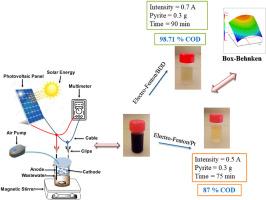
This study focuses on the treatment of margin (olive mill wastewater) using the electro-Fenton process with different anodes powered by solar energy. Iron from pyrite is used as a catalyst, and hydrogen peroxide is produced in situ by bubbling air into the effluent. A three-factor Box-Behnken design is employed for optimization. The results show that a boron-doped diamond (BDD) anode achieves a chemical oxygen demand (COD) reduction rate of 98.71 % under the following conditions: current of 0.7 A, pyrite mass of 0.3 g, and electrolysis time of 90 min. Using a platinum anode, a COD reduction rate of 87.0 % is obtained with a current of 0.5 A, a pyrite mass of 0.3 g, and an electrolysis time of 75 min. Energy consumption is 10.35 kWh m−3 for BDD and 6.25 kWh m−3 for Pt, giving an operating cost of around 1.13 $ m−3 and 0.682 $ m−3 for the BDD and Pt respectively. This study demonstrates that the BDD electrode yields superior results compared to a flat platinum anode when using solar energy.
期刊介绍:
The Journal of Power Sources is a publication catering to researchers and technologists interested in various aspects of the science, technology, and applications of electrochemical power sources. It covers original research and reviews on primary and secondary batteries, fuel cells, supercapacitors, and photo-electrochemical cells.
Topics considered include the research, development and applications of nanomaterials and novel componentry for these devices. Examples of applications of these electrochemical power sources include:
• Portable electronics
• Electric and Hybrid Electric Vehicles
• Uninterruptible Power Supply (UPS) systems
• Storage of renewable energy
• Satellites and deep space probes
• Boats and ships, drones and aircrafts
• Wearable energy storage systems




 京公网安备 11010802042870号
京ICP备2023020795号-1
京公网安备 11010802042870号
京ICP备2023020795号-1

 分享
分享
 求助内容:
求助内容: 应助结果提醒方式:
 扫码关注我们
