Sana Elbashir , Roushdey Salh , Britt M. Andersson
{"title":"Cu2+掺杂β-Ca3(PO4)2的结构和光谱特性新发现:Cu2+浓度与材料性能的相关性","authors":"Sana Elbashir , Roushdey Salh , Britt M. Andersson","doi":"10.1016/j.matdes.2025.113718","DOIUrl":null,"url":null,"abstract":"<div><div>Doping β-tricalcium phosphate (β-TCP) with copper (Cu<sup>2+</sup>) has great potential in various applications due to its rich chemistry. However, the doping characteristics are rarely studied in detail and are yet to be fully understood, creating a gap in the existing knowledge of these multifunctional materials. In this work, a series of Cu<sup>2+</sup> doped β-TCP (Cu<sub>x</sub>-TCPs) were prepared and comprehensively characterized to investigate the correlation between Cu<sup>2+</sup> doping and the material properties. Also, the synthesis of Cu<sub>x</sub>-TCPs was modeled using thermodynamic equilibrium calculations to investigate their formation pathways. The calculations predicted a possible inclusion of Cu<sup>2+</sup> in intermediate phosphate phases during the material synthesis, depending on the temperature. The structural analyses revealed lattice shrinkage due to the Cu<sup>2+</sup> doping and that Cu<sup>2+</sup> occupied Ca4 and Ca5 sites in the β-TCP crystal. The vibrational spectroscopy of the Cu<sub>x</sub>-TCPs showed noticeable deformation of ν<sub>1</sub> band of <span><math><msubsup><mrow><mi>P</mi><mi>O</mi></mrow><mrow><mn>4</mn></mrow><mrow><mn>3</mn><mo>-</mo></mrow></msubsup></math></span> ligand. The ultraviolet–visible absorption analysis revealed a reduction in the band gap energy induced by Cu<sup>2+</sup> doping. Photoluminescence spectroscopy demonstrated an enhanced emission tunability of Cu<sub>x</sub>-TCPs in the blue and orange–red regions depending on Cu<sup>2+</sup> concentration. These findings are a step toward a deeper understanding of the structure–property relationships of Cu<sup>2+</sup> doped β-TCPs and can play a significant role in their multidisciplinary applications.</div></div>","PeriodicalId":383,"journal":{"name":"Materials & Design","volume":"252 ","pages":"Article 113718"},"PeriodicalIF":8.2000,"publicationDate":"2025-04-01","publicationTypes":"Journal Article","fieldsOfStudy":null,"isOpenAccess":false,"openAccessPdf":"","citationCount":"0","resultStr":"{\"title\":\"New insights into structural and spectroscopic characteristics of Cu2+ doped β-Ca3(PO4)2: Correlation between Cu2+ concentration and material properties\",\"authors\":\"Sana Elbashir , Roushdey Salh , Britt M. Andersson\",\"doi\":\"10.1016/j.matdes.2025.113718\",\"DOIUrl\":null,\"url\":null,\"abstract\":\"<div><div>Doping β-tricalcium phosphate (β-TCP) with copper (Cu<sup>2+</sup>) has great potential in various applications due to its rich chemistry. However, the doping characteristics are rarely studied in detail and are yet to be fully understood, creating a gap in the existing knowledge of these multifunctional materials. In this work, a series of Cu<sup>2+</sup> doped β-TCP (Cu<sub>x</sub>-TCPs) were prepared and comprehensively characterized to investigate the correlation between Cu<sup>2+</sup> doping and the material properties. Also, the synthesis of Cu<sub>x</sub>-TCPs was modeled using thermodynamic equilibrium calculations to investigate their formation pathways. The calculations predicted a possible inclusion of Cu<sup>2+</sup> in intermediate phosphate phases during the material synthesis, depending on the temperature. The structural analyses revealed lattice shrinkage due to the Cu<sup>2+</sup> doping and that Cu<sup>2+</sup> occupied Ca4 and Ca5 sites in the β-TCP crystal. The vibrational spectroscopy of the Cu<sub>x</sub>-TCPs showed noticeable deformation of ν<sub>1</sub> band of <span><math><msubsup><mrow><mi>P</mi><mi>O</mi></mrow><mrow><mn>4</mn></mrow><mrow><mn>3</mn><mo>-</mo></mrow></msubsup></math></span> ligand. The ultraviolet–visible absorption analysis revealed a reduction in the band gap energy induced by Cu<sup>2+</sup> doping. Photoluminescence spectroscopy demonstrated an enhanced emission tunability of Cu<sub>x</sub>-TCPs in the blue and orange–red regions depending on Cu<sup>2+</sup> concentration. These findings are a step toward a deeper understanding of the structure–property relationships of Cu<sup>2+</sup> doped β-TCPs and can play a significant role in their multidisciplinary applications.</div></div>\",\"PeriodicalId\":383,\"journal\":{\"name\":\"Materials & Design\",\"volume\":\"252 \",\"pages\":\"Article 113718\"},\"PeriodicalIF\":8.2000,\"publicationDate\":\"2025-04-01\",\"publicationTypes\":\"Journal Article\",\"fieldsOfStudy\":null,\"isOpenAccess\":false,\"openAccessPdf\":\"\",\"citationCount\":\"0\",\"resultStr\":null,\"platform\":\"Semanticscholar\",\"paperid\":null,\"PeriodicalName\":\"Materials & Design\",\"FirstCategoryId\":\"88\",\"ListUrlMain\":\"https://www.sciencedirect.com/science/article/pii/S0264127525001388\",\"RegionNum\":2,\"RegionCategory\":\"材料科学\",\"ArticlePicture\":[],\"TitleCN\":null,\"AbstractTextCN\":null,\"PMCID\":null,\"EPubDate\":\"2025/2/12 0:00:00\",\"PubModel\":\"Epub\",\"JCR\":\"Q1\",\"JCRName\":\"MATERIALS SCIENCE, MULTIDISCIPLINARY\",\"Score\":null,\"Total\":0}","platform":"Semanticscholar","paperid":null,"PeriodicalName":"Materials & Design","FirstCategoryId":"88","ListUrlMain":"https://www.sciencedirect.com/science/article/pii/S0264127525001388","RegionNum":2,"RegionCategory":"材料科学","ArticlePicture":[],"TitleCN":null,"AbstractTextCN":null,"PMCID":null,"EPubDate":"2025/2/12 0:00:00","PubModel":"Epub","JCR":"Q1","JCRName":"MATERIALS SCIENCE, MULTIDISCIPLINARY","Score":null,"Total":0}
New insights into structural and spectroscopic characteristics of Cu2+ doped β-Ca3(PO4)2: Correlation between Cu2+ concentration and material properties
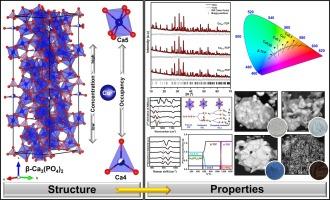
Doping β-tricalcium phosphate (β-TCP) with copper (Cu2+) has great potential in various applications due to its rich chemistry. However, the doping characteristics are rarely studied in detail and are yet to be fully understood, creating a gap in the existing knowledge of these multifunctional materials. In this work, a series of Cu2+ doped β-TCP (Cux-TCPs) were prepared and comprehensively characterized to investigate the correlation between Cu2+ doping and the material properties. Also, the synthesis of Cux-TCPs was modeled using thermodynamic equilibrium calculations to investigate their formation pathways. The calculations predicted a possible inclusion of Cu2+ in intermediate phosphate phases during the material synthesis, depending on the temperature. The structural analyses revealed lattice shrinkage due to the Cu2+ doping and that Cu2+ occupied Ca4 and Ca5 sites in the β-TCP crystal. The vibrational spectroscopy of the Cux-TCPs showed noticeable deformation of ν1 band of ligand. The ultraviolet–visible absorption analysis revealed a reduction in the band gap energy induced by Cu2+ doping. Photoluminescence spectroscopy demonstrated an enhanced emission tunability of Cux-TCPs in the blue and orange–red regions depending on Cu2+ concentration. These findings are a step toward a deeper understanding of the structure–property relationships of Cu2+ doped β-TCPs and can play a significant role in their multidisciplinary applications.
期刊介绍:
Materials and Design is a multi-disciplinary journal that publishes original research reports, review articles, and express communications. The journal focuses on studying the structure and properties of inorganic and organic materials, advancements in synthesis, processing, characterization, and testing, the design of materials and engineering systems, and their applications in technology. It aims to bring together various aspects of materials science, engineering, physics, and chemistry.
The journal explores themes ranging from materials to design and aims to reveal the connections between natural and artificial materials, as well as experiment and modeling. Manuscripts submitted to Materials and Design should contain elements of discovery and surprise, as they often contribute new insights into the architecture and function of matter.




 京公网安备 11010802042870号
京ICP备2023020795号-1
京公网安备 11010802042870号
京ICP备2023020795号-1

 分享
分享
 求助内容:
求助内容: 应助结果提醒方式:
 扫码关注我们
