Unhyok Yun, Zhaoyang Fan, Chung Song Ho, Jianfei Peng, Lin Wu, Lei Yang, Hongjun Mao
{"title":"考虑载重因子功率和船体形状的改进船舶排放模型:对中国港口集群的启示","authors":"Unhyok Yun, Zhaoyang Fan, Chung Song Ho, Jianfei Peng, Lin Wu, Lei Yang, Hongjun Mao","doi":"10.1029/2024JD042005","DOIUrl":null,"url":null,"abstract":"<p>Shipping emissions are a major source of atmospheric pollutants globally. Accurate ship emission inventories are the key for developing pollution control strategies, but simulating the operating power of a ship under different navigational conditions is a challenge in ship emission estimation. Here, to improve the accuracy of the traditional power model and to establish framework for ship emissions in the port area, an improved load factor-based power model considering the impact of hull shape on the ship's resistance was proposed and applied to estimate the ship pollutant emissions. A series of data preprocessing methods were constructed based on automated identification system (AIS) high-precision measured data, including filling gaps and outliers, identifying vessel's operating mode with geofencing, and assigning fuel information by navigation area. The proposed power model and the AIS data preprocessing method were applied to estimate the ship pollutant emissions within Qingdao Port, China, in 2020. The total ship emissions were 1.27 × 10<sup>4</sup>, 6.33 × 10<sup>4</sup>, 1.91 × 10<sup>3</sup>, 1.76 × 10<sup>3</sup>, 3.11 × 10<sup>3</sup>, and 7.52 × 10<sup>3</sup> tone for SO<sub>2</sub>, NO<sub>X</sub>, PM<sub>10</sub>, PM<sub>2.5</sub>, HC, and CO, respectively. As for emissions from ocean-going vessels, the proposed power model estimation was 3.9% lower than the propeller law power model and 2.4% higher than the admiralty law power model. We highlight that the proposed power model could be of large benefit in accurately evaluating regional ship emissions in the future, which can provide scientific assurance for ship emission inventory construction and green port development.</p>","PeriodicalId":15986,"journal":{"name":"Journal of Geophysical Research: Atmospheres","volume":"130 4","pages":""},"PeriodicalIF":3.8000,"publicationDate":"2025-02-19","publicationTypes":"Journal Article","fieldsOfStudy":null,"isOpenAccess":false,"openAccessPdf":"","citationCount":"0","resultStr":"{\"title\":\"Improved Ship Emission Model Considering Load Factor-Based Power and Hull Shape: Implication in a Chinese Port Cluster\",\"authors\":\"Unhyok Yun, Zhaoyang Fan, Chung Song Ho, Jianfei Peng, Lin Wu, Lei Yang, Hongjun Mao\",\"doi\":\"10.1029/2024JD042005\",\"DOIUrl\":null,\"url\":null,\"abstract\":\"<p>Shipping emissions are a major source of atmospheric pollutants globally. Accurate ship emission inventories are the key for developing pollution control strategies, but simulating the operating power of a ship under different navigational conditions is a challenge in ship emission estimation. Here, to improve the accuracy of the traditional power model and to establish framework for ship emissions in the port area, an improved load factor-based power model considering the impact of hull shape on the ship's resistance was proposed and applied to estimate the ship pollutant emissions. A series of data preprocessing methods were constructed based on automated identification system (AIS) high-precision measured data, including filling gaps and outliers, identifying vessel's operating mode with geofencing, and assigning fuel information by navigation area. The proposed power model and the AIS data preprocessing method were applied to estimate the ship pollutant emissions within Qingdao Port, China, in 2020. The total ship emissions were 1.27 × 10<sup>4</sup>, 6.33 × 10<sup>4</sup>, 1.91 × 10<sup>3</sup>, 1.76 × 10<sup>3</sup>, 3.11 × 10<sup>3</sup>, and 7.52 × 10<sup>3</sup> tone for SO<sub>2</sub>, NO<sub>X</sub>, PM<sub>10</sub>, PM<sub>2.5</sub>, HC, and CO, respectively. As for emissions from ocean-going vessels, the proposed power model estimation was 3.9% lower than the propeller law power model and 2.4% higher than the admiralty law power model. We highlight that the proposed power model could be of large benefit in accurately evaluating regional ship emissions in the future, which can provide scientific assurance for ship emission inventory construction and green port development.</p>\",\"PeriodicalId\":15986,\"journal\":{\"name\":\"Journal of Geophysical Research: Atmospheres\",\"volume\":\"130 4\",\"pages\":\"\"},\"PeriodicalIF\":3.8000,\"publicationDate\":\"2025-02-19\",\"publicationTypes\":\"Journal Article\",\"fieldsOfStudy\":null,\"isOpenAccess\":false,\"openAccessPdf\":\"\",\"citationCount\":\"0\",\"resultStr\":null,\"platform\":\"Semanticscholar\",\"paperid\":null,\"PeriodicalName\":\"Journal of Geophysical Research: Atmospheres\",\"FirstCategoryId\":\"89\",\"ListUrlMain\":\"https://agupubs.onlinelibrary.wiley.com/doi/10.1029/2024JD042005\",\"RegionNum\":2,\"RegionCategory\":\"地球科学\",\"ArticlePicture\":[],\"TitleCN\":null,\"AbstractTextCN\":null,\"PMCID\":null,\"EPubDate\":\"\",\"PubModel\":\"\",\"JCR\":\"Q2\",\"JCRName\":\"METEOROLOGY & ATMOSPHERIC SCIENCES\",\"Score\":null,\"Total\":0}","platform":"Semanticscholar","paperid":null,"PeriodicalName":"Journal of Geophysical Research: Atmospheres","FirstCategoryId":"89","ListUrlMain":"https://agupubs.onlinelibrary.wiley.com/doi/10.1029/2024JD042005","RegionNum":2,"RegionCategory":"地球科学","ArticlePicture":[],"TitleCN":null,"AbstractTextCN":null,"PMCID":null,"EPubDate":"","PubModel":"","JCR":"Q2","JCRName":"METEOROLOGY & ATMOSPHERIC SCIENCES","Score":null,"Total":0}
Improved Ship Emission Model Considering Load Factor-Based Power and Hull Shape: Implication in a Chinese Port Cluster
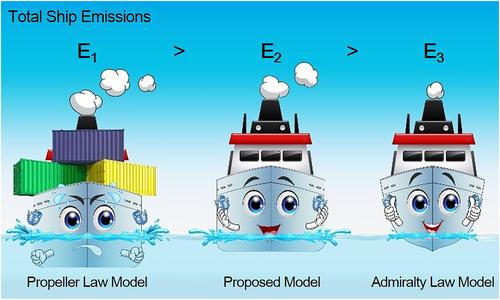
Shipping emissions are a major source of atmospheric pollutants globally. Accurate ship emission inventories are the key for developing pollution control strategies, but simulating the operating power of a ship under different navigational conditions is a challenge in ship emission estimation. Here, to improve the accuracy of the traditional power model and to establish framework for ship emissions in the port area, an improved load factor-based power model considering the impact of hull shape on the ship's resistance was proposed and applied to estimate the ship pollutant emissions. A series of data preprocessing methods were constructed based on automated identification system (AIS) high-precision measured data, including filling gaps and outliers, identifying vessel's operating mode with geofencing, and assigning fuel information by navigation area. The proposed power model and the AIS data preprocessing method were applied to estimate the ship pollutant emissions within Qingdao Port, China, in 2020. The total ship emissions were 1.27 × 10⁴, 6.33 × 10⁴, 1.91 × 10³, 1.76 × 10³, 3.11 × 10³, and 7.52 × 10³ tone for SO2, NOX, PM10, PM2.5, HC, and CO, respectively. As for emissions from ocean-going vessels, the proposed power model estimation was 3.9% lower than the propeller law power model and 2.4% higher than the admiralty law power model. We highlight that the proposed power model could be of large benefit in accurately evaluating regional ship emissions in the future, which can provide scientific assurance for ship emission inventory construction and green port development.
期刊介绍:
JGR: Atmospheres publishes articles that advance and improve understanding of atmospheric properties and processes, including the interaction of the atmosphere with other components of the Earth system.






 京公网安备 11010802042870号
京ICP备2023020795号-1
京公网安备 11010802042870号
京ICP备2023020795号-1

 分享
分享
 求助内容:
求助内容: 应助结果提醒方式:
 扫码关注我们
