Hu Yang, Yufei Liu, Tainã M. L. Pinho, Xiaoxu Shi, Yi Zhong, Qingsong Liu, Gerrit Lohmann, Jiping Liu, Jingyu Zhang, Xufeng Zheng, Dake Chen
{"title":"改变地球-太阳距离漂移全球环流模式","authors":"Hu Yang, Yufei Liu, Tainã M. L. Pinho, Xiaoxu Shi, Yi Zhong, Qingsong Liu, Gerrit Lohmann, Jiping Liu, Jingyu Zhang, Xufeng Zheng, Dake Chen","doi":"10.1029/2024GL113066","DOIUrl":null,"url":null,"abstract":"<p>Modern observations reveal that large-scale ocean-atmosphere circulation (OAC) is drifting toward higher latitudes under global warming. Paleoclimate proxies indicate that similar OAC drifts occurred on orbital timescale as well. However, the characteristics and underlying mechanisms remain unclear. Here, by conducting simulations with different Earth's orbits, we investigate how changes in Earth-Sun distance affect the OAC. We find that a closer Earth-Sun distance (perihelion) causes a poleward drift of OAC. This drift in circulation is dynamically consistent with displacement of meridional temperature gradient. Precession alters the perihelion season on orbital timescales, leading to a seasonal poleward drift in OAC. This drift is amplified during the hemispheric summer, reaching magnitudes of <span></span><math>\n <semantics>\n <mrow>\n <mo>∼</mo>\n </mrow>\n <annotation> ${\\sim} $</annotation>\n </semantics></math>10° under high eccentricity. The identified OAC drifts reshape the seasonality of precipitation and temperature over land, as well as ocean upwelling and downwelling, ultimately affecting the distribution of Earth's terrestrial and marine ecosystems.</p>","PeriodicalId":12523,"journal":{"name":"Geophysical Research Letters","volume":"52 4","pages":""},"PeriodicalIF":5.0000,"publicationDate":"2025-02-20","publicationTypes":"Journal Article","fieldsOfStudy":null,"isOpenAccess":false,"openAccessPdf":"https://onlinelibrary.wiley.com/doi/epdf/10.1029/2024GL113066","citationCount":"0","resultStr":"{\"title\":\"Changing Earth-Sun Distance Drifts Global Circulation Patterns\",\"authors\":\"Hu Yang, Yufei Liu, Tainã M. L. Pinho, Xiaoxu Shi, Yi Zhong, Qingsong Liu, Gerrit Lohmann, Jiping Liu, Jingyu Zhang, Xufeng Zheng, Dake Chen\",\"doi\":\"10.1029/2024GL113066\",\"DOIUrl\":null,\"url\":null,\"abstract\":\"<p>Modern observations reveal that large-scale ocean-atmosphere circulation (OAC) is drifting toward higher latitudes under global warming. Paleoclimate proxies indicate that similar OAC drifts occurred on orbital timescale as well. However, the characteristics and underlying mechanisms remain unclear. Here, by conducting simulations with different Earth's orbits, we investigate how changes in Earth-Sun distance affect the OAC. We find that a closer Earth-Sun distance (perihelion) causes a poleward drift of OAC. This drift in circulation is dynamically consistent with displacement of meridional temperature gradient. Precession alters the perihelion season on orbital timescales, leading to a seasonal poleward drift in OAC. This drift is amplified during the hemispheric summer, reaching magnitudes of <span></span><math>\\n <semantics>\\n <mrow>\\n <mo>∼</mo>\\n </mrow>\\n <annotation> ${\\\\sim} $</annotation>\\n </semantics></math>10° under high eccentricity. The identified OAC drifts reshape the seasonality of precipitation and temperature over land, as well as ocean upwelling and downwelling, ultimately affecting the distribution of Earth's terrestrial and marine ecosystems.</p>\",\"PeriodicalId\":12523,\"journal\":{\"name\":\"Geophysical Research Letters\",\"volume\":\"52 4\",\"pages\":\"\"},\"PeriodicalIF\":5.0000,\"publicationDate\":\"2025-02-20\",\"publicationTypes\":\"Journal Article\",\"fieldsOfStudy\":null,\"isOpenAccess\":false,\"openAccessPdf\":\"https://onlinelibrary.wiley.com/doi/epdf/10.1029/2024GL113066\",\"citationCount\":\"0\",\"resultStr\":null,\"platform\":\"Semanticscholar\",\"paperid\":null,\"PeriodicalName\":\"Geophysical Research Letters\",\"FirstCategoryId\":\"89\",\"ListUrlMain\":\"https://agupubs.onlinelibrary.wiley.com/doi/10.1029/2024GL113066\",\"RegionNum\":1,\"RegionCategory\":\"地球科学\",\"ArticlePicture\":[],\"TitleCN\":null,\"AbstractTextCN\":null,\"PMCID\":null,\"EPubDate\":\"\",\"PubModel\":\"\",\"JCR\":\"Q1\",\"JCRName\":\"GEOSCIENCES, MULTIDISCIPLINARY\",\"Score\":null,\"Total\":0}","platform":"Semanticscholar","paperid":null,"PeriodicalName":"Geophysical Research Letters","FirstCategoryId":"89","ListUrlMain":"https://agupubs.onlinelibrary.wiley.com/doi/10.1029/2024GL113066","RegionNum":1,"RegionCategory":"地球科学","ArticlePicture":[],"TitleCN":null,"AbstractTextCN":null,"PMCID":null,"EPubDate":"","PubModel":"","JCR":"Q1","JCRName":"GEOSCIENCES, MULTIDISCIPLINARY","Score":null,"Total":0}
Changing Earth-Sun Distance Drifts Global Circulation Patterns
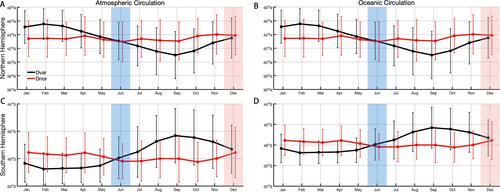
Modern observations reveal that large-scale ocean-atmosphere circulation (OAC) is drifting toward higher latitudes under global warming. Paleoclimate proxies indicate that similar OAC drifts occurred on orbital timescale as well. However, the characteristics and underlying mechanisms remain unclear. Here, by conducting simulations with different Earth's orbits, we investigate how changes in Earth-Sun distance affect the OAC. We find that a closer Earth-Sun distance (perihelion) causes a poleward drift of OAC. This drift in circulation is dynamically consistent with displacement of meridional temperature gradient. Precession alters the perihelion season on orbital timescales, leading to a seasonal poleward drift in OAC. This drift is amplified during the hemispheric summer, reaching magnitudes of 10° under high eccentricity. The identified OAC drifts reshape the seasonality of precipitation and temperature over land, as well as ocean upwelling and downwelling, ultimately affecting the distribution of Earth's terrestrial and marine ecosystems.
期刊介绍:
Geophysical Research Letters (GRL) publishes high-impact, innovative, and timely research on major scientific advances in all the major geoscience disciplines. Papers are communications-length articles and should have broad and immediate implications in their discipline or across the geosciences. GRLmaintains the fastest turn-around of all high-impact publications in the geosciences and works closely with authors to ensure broad visibility of top papers.






 京公网安备 11010802042870号
京ICP备2023020795号-1
京公网安备 11010802042870号
京ICP备2023020795号-1

 分享
分享
 求助内容:
求助内容: 应助结果提醒方式:
 扫码关注我们
