{"title":"通过提高高效太阳能电池的相纯度来降低锑基钙钛矿的激子结合能。","authors":"Tengyu Xu, Xian Zhang, Fangzhou Liu, Huichao Guo, Jiaqi Zhang, Shaogeng Cai, Deao Li, Yangyang Zhang, Yan Guan, Wenjin Yu, Dechun Zou, Lixin Xiao and Cuncun Wu","doi":"10.1039/D5MH00003C","DOIUrl":null,"url":null,"abstract":"<p >Antimony-based halide perovskites have attracted significant attention owing to their unique optoelectronic properties and low toxicity. However, the distinct defect physics and high exciton binding energy of antimony-based perovskites compared with their lead-based analogues significantly hinder the photovoltaic performance of antimony-based perovskite solar cells (PSCs). In this work, a feasible strategy by regulating the precursor composition is introduced to mitigate the defects and impurity phases of Cs<small><sub>3</sub></small>Sb<small><sub>2</sub></small>Cl<small><sub><em>x</em></sub></small>I<small><sub>9−<em>x</em></sub></small> films. An optimized content of excess SbI<small><sub>3</sub></small> in the precursor composition was found to effectively suppress the CsI impurity phases in the obtained Cs<small><sub>3</sub></small>Sb<small><sub>2</sub></small>Cl<small><sub><em>x</em></sub></small>I<small><sub>9−<em>x</em></sub></small> films, leading to enhanced crystallinity and reduced defects. Furthermore, the obtained Cs<small><sub>3</sub></small>Sb<small><sub>2</sub></small>Cl<small><sub><em>x</em></sub></small>I<small><sub>9−<em>x</em></sub></small> films exhibited an increased dielectric response and reduced exciton binding energy, which are conducive to exciton dissociation and carrier transport. A champion efficiency of 3.42% was achieved with the optimized solar cell devices, which is one of the highest efficiencies reported for all-inorganic antimony-based PSCs. These findings provide new perspectives for exploring high-efficiency antimony-based PSCs.</p>","PeriodicalId":87,"journal":{"name":"Materials Horizons","volume":" 10","pages":" 3436-3443"},"PeriodicalIF":10.7000,"publicationDate":"2025-02-07","publicationTypes":"Journal Article","fieldsOfStudy":null,"isOpenAccess":false,"openAccessPdf":"","citationCount":"0","resultStr":"{\"title\":\"Reducing exciton binding energy of antimony-based perovskites by improving the phase purity for efficient solar cells†\",\"authors\":\"Tengyu Xu, Xian Zhang, Fangzhou Liu, Huichao Guo, Jiaqi Zhang, Shaogeng Cai, Deao Li, Yangyang Zhang, Yan Guan, Wenjin Yu, Dechun Zou, Lixin Xiao and Cuncun Wu\",\"doi\":\"10.1039/D5MH00003C\",\"DOIUrl\":null,\"url\":null,\"abstract\":\"<p >Antimony-based halide perovskites have attracted significant attention owing to their unique optoelectronic properties and low toxicity. However, the distinct defect physics and high exciton binding energy of antimony-based perovskites compared with their lead-based analogues significantly hinder the photovoltaic performance of antimony-based perovskite solar cells (PSCs). In this work, a feasible strategy by regulating the precursor composition is introduced to mitigate the defects and impurity phases of Cs<small><sub>3</sub></small>Sb<small><sub>2</sub></small>Cl<small><sub><em>x</em></sub></small>I<small><sub>9−<em>x</em></sub></small> films. An optimized content of excess SbI<small><sub>3</sub></small> in the precursor composition was found to effectively suppress the CsI impurity phases in the obtained Cs<small><sub>3</sub></small>Sb<small><sub>2</sub></small>Cl<small><sub><em>x</em></sub></small>I<small><sub>9−<em>x</em></sub></small> films, leading to enhanced crystallinity and reduced defects. Furthermore, the obtained Cs<small><sub>3</sub></small>Sb<small><sub>2</sub></small>Cl<small><sub><em>x</em></sub></small>I<small><sub>9−<em>x</em></sub></small> films exhibited an increased dielectric response and reduced exciton binding energy, which are conducive to exciton dissociation and carrier transport. A champion efficiency of 3.42% was achieved with the optimized solar cell devices, which is one of the highest efficiencies reported for all-inorganic antimony-based PSCs. These findings provide new perspectives for exploring high-efficiency antimony-based PSCs.</p>\",\"PeriodicalId\":87,\"journal\":{\"name\":\"Materials Horizons\",\"volume\":\" 10\",\"pages\":\" 3436-3443\"},\"PeriodicalIF\":10.7000,\"publicationDate\":\"2025-02-07\",\"publicationTypes\":\"Journal Article\",\"fieldsOfStudy\":null,\"isOpenAccess\":false,\"openAccessPdf\":\"\",\"citationCount\":\"0\",\"resultStr\":null,\"platform\":\"Semanticscholar\",\"paperid\":null,\"PeriodicalName\":\"Materials Horizons\",\"FirstCategoryId\":\"88\",\"ListUrlMain\":\"https://pubs.rsc.org/en/content/articlelanding/2025/mh/d5mh00003c\",\"RegionNum\":2,\"RegionCategory\":\"材料科学\",\"ArticlePicture\":[],\"TitleCN\":null,\"AbstractTextCN\":null,\"PMCID\":null,\"EPubDate\":\"\",\"PubModel\":\"\",\"JCR\":\"Q1\",\"JCRName\":\"CHEMISTRY, MULTIDISCIPLINARY\",\"Score\":null,\"Total\":0}","platform":"Semanticscholar","paperid":null,"PeriodicalName":"Materials Horizons","FirstCategoryId":"88","ListUrlMain":"https://pubs.rsc.org/en/content/articlelanding/2025/mh/d5mh00003c","RegionNum":2,"RegionCategory":"材料科学","ArticlePicture":[],"TitleCN":null,"AbstractTextCN":null,"PMCID":null,"EPubDate":"","PubModel":"","JCR":"Q1","JCRName":"CHEMISTRY, MULTIDISCIPLINARY","Score":null,"Total":0}
Reducing exciton binding energy of antimony-based perovskites by improving the phase purity for efficient solar cells†
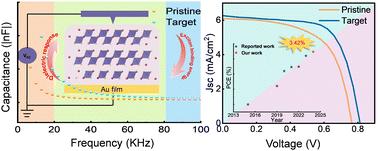
Antimony-based halide perovskites have attracted significant attention owing to their unique optoelectronic properties and low toxicity. However, the distinct defect physics and high exciton binding energy of antimony-based perovskites compared with their lead-based analogues significantly hinder the photovoltaic performance of antimony-based perovskite solar cells (PSCs). In this work, a feasible strategy by regulating the precursor composition is introduced to mitigate the defects and impurity phases of Cs3Sb2ClxI9−x films. An optimized content of excess SbI3 in the precursor composition was found to effectively suppress the CsI impurity phases in the obtained Cs3Sb2ClxI9−x films, leading to enhanced crystallinity and reduced defects. Furthermore, the obtained Cs3Sb2ClxI9−x films exhibited an increased dielectric response and reduced exciton binding energy, which are conducive to exciton dissociation and carrier transport. A champion efficiency of 3.42% was achieved with the optimized solar cell devices, which is one of the highest efficiencies reported for all-inorganic antimony-based PSCs. These findings provide new perspectives for exploring high-efficiency antimony-based PSCs.



 京公网安备 11010802042870号
京ICP备2023020795号-1
京公网安备 11010802042870号
京ICP备2023020795号-1

 分享
分享
 求助内容:
求助内容: 应助结果提醒方式:
 扫码关注我们
