{"title":"可解释机器学习中具有优越热电性能的高度可变形范德华硫属化合物。","authors":"Qi Ren, Bonan Zhu, Gang Tang, Jiawang Hong","doi":"10.1002/smll.202412745","DOIUrl":null,"url":null,"abstract":"<p>Van der Waals (vdW) chalcogenide-based flexible thermoelectric devices hold great promise for wearable electronics. However, intrinsic vdW chalcogenides that combine high flexibility with superior thermoelectric figures of merit (ZT) remain extremely rare. Consequently, there is an urgent need to develop methods capable of high-throughput screening to identify potential vdW chalcogenides with both robust flexibility and favorable ZT value. In this study, over 1000 vdW chalcogenides are high-throughput screened for their flexibility and ZT values. Flexibility is evaluated using the previously developed deformability factor, while ZT values are predicted using a machine learning model. Several candidates with large deformability and high ZT are successfully identified. Among these, NbSe<sub>2</sub>Br<sub>2</sub> emerges as the top-performing material. Further first-principles calculations reveal that it achieves a maximum ZT value of 1.35 at 1000 K, the highest reported so far among flexible inorganic thermoelectric materials. Its power factor value of 8.1 µW cm<sup>−1</sup>K<sup>−2</sup> at 300 K also surpasses most organic and inorganic flexible thermoelectric materials. The high ZT<sub>max</sub> is mainly contributed by the extremely low thermal conductivity and the high Seebeck coefficient along the out-of-plane direction at high temperatures. The study offers new material options for the development and application of flexible thermoelectric devices based on layered chalcogenides.</p>","PeriodicalId":228,"journal":{"name":"Small","volume":"21 12","pages":""},"PeriodicalIF":11.8000,"publicationDate":"2025-02-18","publicationTypes":"Journal Article","fieldsOfStudy":null,"isOpenAccess":false,"openAccessPdf":"","citationCount":"0","resultStr":"{\"title\":\"Highly Deformable Van der Waals Chalcogenides with Superior Thermoelectric Performance from Interpretable Machine Learning\",\"authors\":\"Qi Ren, Bonan Zhu, Gang Tang, Jiawang Hong\",\"doi\":\"10.1002/smll.202412745\",\"DOIUrl\":null,\"url\":null,\"abstract\":\"<p>Van der Waals (vdW) chalcogenide-based flexible thermoelectric devices hold great promise for wearable electronics. However, intrinsic vdW chalcogenides that combine high flexibility with superior thermoelectric figures of merit (ZT) remain extremely rare. Consequently, there is an urgent need to develop methods capable of high-throughput screening to identify potential vdW chalcogenides with both robust flexibility and favorable ZT value. In this study, over 1000 vdW chalcogenides are high-throughput screened for their flexibility and ZT values. Flexibility is evaluated using the previously developed deformability factor, while ZT values are predicted using a machine learning model. Several candidates with large deformability and high ZT are successfully identified. Among these, NbSe<sub>2</sub>Br<sub>2</sub> emerges as the top-performing material. Further first-principles calculations reveal that it achieves a maximum ZT value of 1.35 at 1000 K, the highest reported so far among flexible inorganic thermoelectric materials. Its power factor value of 8.1 µW cm<sup>−1</sup>K<sup>−2</sup> at 300 K also surpasses most organic and inorganic flexible thermoelectric materials. The high ZT<sub>max</sub> is mainly contributed by the extremely low thermal conductivity and the high Seebeck coefficient along the out-of-plane direction at high temperatures. The study offers new material options for the development and application of flexible thermoelectric devices based on layered chalcogenides.</p>\",\"PeriodicalId\":228,\"journal\":{\"name\":\"Small\",\"volume\":\"21 12\",\"pages\":\"\"},\"PeriodicalIF\":11.8000,\"publicationDate\":\"2025-02-18\",\"publicationTypes\":\"Journal Article\",\"fieldsOfStudy\":null,\"isOpenAccess\":false,\"openAccessPdf\":\"\",\"citationCount\":\"0\",\"resultStr\":null,\"platform\":\"Semanticscholar\",\"paperid\":null,\"PeriodicalName\":\"Small\",\"FirstCategoryId\":\"88\",\"ListUrlMain\":\"https://onlinelibrary.wiley.com/doi/10.1002/smll.202412745\",\"RegionNum\":2,\"RegionCategory\":\"材料科学\",\"ArticlePicture\":[],\"TitleCN\":null,\"AbstractTextCN\":null,\"PMCID\":null,\"EPubDate\":\"\",\"PubModel\":\"\",\"JCR\":\"Q1\",\"JCRName\":\"CHEMISTRY, MULTIDISCIPLINARY\",\"Score\":null,\"Total\":0}","platform":"Semanticscholar","paperid":null,"PeriodicalName":"Small","FirstCategoryId":"88","ListUrlMain":"https://onlinelibrary.wiley.com/doi/10.1002/smll.202412745","RegionNum":2,"RegionCategory":"材料科学","ArticlePicture":[],"TitleCN":null,"AbstractTextCN":null,"PMCID":null,"EPubDate":"","PubModel":"","JCR":"Q1","JCRName":"CHEMISTRY, MULTIDISCIPLINARY","Score":null,"Total":0}
引用次数: 0
摘要
范德华(vdW)基于硫族的柔性热电器件在可穿戴电子产品中具有很大的前景。然而,结合高灵活性和优异热电性能(ZT)的内在vdW硫族化合物仍然非常罕见。因此,迫切需要开发能够高通量筛选的方法来鉴定具有强大灵活性和有利ZT值的潜在vdW硫属化合物。在这项研究中,超过1000个vdW的硫属化合物因其灵活性和ZT值而被高通量筛选。使用先前开发的可变形性因子评估灵活性,而使用机器学习模型预测ZT值。成功地确定了几个具有大变形能力和高ZT的候选材料。其中,NbSe2Br2是性能最好的材料。进一步的第一性原理计算表明,它在1000 K时达到了1.35的最大ZT值,这是迄今为止报道的柔性无机热电材料中的最高ZT值。在300 K时,其功率因数值为8.1 μ W cm- K-2,也超过了大多数有机和无机柔性热电材料。高ZTmax主要是由于在高温下极低的导热系数和沿面外方向的高塞贝克系数。该研究为基于层状硫族化合物的柔性热电器件的开发和应用提供了新的材料选择。
Highly Deformable Van der Waals Chalcogenides with Superior Thermoelectric Performance from Interpretable Machine Learning
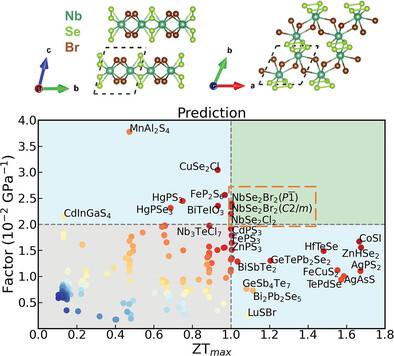
Van der Waals (vdW) chalcogenide-based flexible thermoelectric devices hold great promise for wearable electronics. However, intrinsic vdW chalcogenides that combine high flexibility with superior thermoelectric figures of merit (ZT) remain extremely rare. Consequently, there is an urgent need to develop methods capable of high-throughput screening to identify potential vdW chalcogenides with both robust flexibility and favorable ZT value. In this study, over 1000 vdW chalcogenides are high-throughput screened for their flexibility and ZT values. Flexibility is evaluated using the previously developed deformability factor, while ZT values are predicted using a machine learning model. Several candidates with large deformability and high ZT are successfully identified. Among these, NbSe2Br2 emerges as the top-performing material. Further first-principles calculations reveal that it achieves a maximum ZT value of 1.35 at 1000 K, the highest reported so far among flexible inorganic thermoelectric materials. Its power factor value of 8.1 µW cm−1K−2 at 300 K also surpasses most organic and inorganic flexible thermoelectric materials. The high ZTmax is mainly contributed by the extremely low thermal conductivity and the high Seebeck coefficient along the out-of-plane direction at high temperatures. The study offers new material options for the development and application of flexible thermoelectric devices based on layered chalcogenides.
期刊介绍:
Small serves as an exceptional platform for both experimental and theoretical studies in fundamental and applied interdisciplinary research at the nano- and microscale. The journal offers a compelling mix of peer-reviewed Research Articles, Reviews, Perspectives, and Comments.
With a remarkable 2022 Journal Impact Factor of 13.3 (Journal Citation Reports from Clarivate Analytics, 2023), Small remains among the top multidisciplinary journals, covering a wide range of topics at the interface of materials science, chemistry, physics, engineering, medicine, and biology.
Small's readership includes biochemists, biologists, biomedical scientists, chemists, engineers, information technologists, materials scientists, physicists, and theoreticians alike.





 京公网安备 11010802042870号
京ICP备2023020795号-1
京公网安备 11010802042870号
京ICP备2023020795号-1

 分享
分享
 求助内容:
求助内容: 应助结果提醒方式:
 扫码关注我们
