Weitao Wang, Haitao Wu, Xuan Zhang, Yang Hong, Shi Tao, Xiangjing Cao, Shipeng Wang, Lisha Zha, Zhengbao Zha
{"title":"全组分抗原纳米疫苗联合aTIGIT增强先天和适应性抗肿瘤免疫。","authors":"Weitao Wang, Haitao Wu, Xuan Zhang, Yang Hong, Shi Tao, Xiangjing Cao, Shipeng Wang, Lisha Zha, Zhengbao Zha","doi":"10.1002/smll.202412800","DOIUrl":null,"url":null,"abstract":"<p>Using entire tumor cells or tissues that display both common and patient-specific antigens can potentially trigger a comprehensive and long-lasting anti-tumor immune response. However, the limited immunogenicity, low uptake efficiency, and susceptibility to degradation of whole-component antigens present significant challenges. In this study, we employed tumor lysates (TLs) as whole-component antigens, in conjunction with MgAl-layered double hydroxide (MA) as nanoadjuvants and Mn<sup>2+</sup> as immunostimulants, to create personalized MMAT (Mn<sup>2+</sup>-MA-TLs) nanovaccines. After subcutaneous injection of MMAT nanovaccines, the high local concentrations of TLs and Mn<sup>2+</sup> facilitated the recruitment and activation of antigen-presenting cells (APCs), thereby inducing a robust adaptive immune response. Remarkably, MMAT nanovaccines enabled lysosomal escape, enhanced antigen cross-presentation, and activated the cyclic GMP-AMP synthase (cGAS)-stimulator of interferon genes (STING) pathway in APCs. Furthermore, MMAT nanovaccines, when combined with the anti-TIGIT monoclonal antibody (aTIGIT), an immune checkpoint inhibitor, not only stimulated T-cell-based adaptive anti-tumor immune responses but also activated the NK-cell-based innate anti-tumor immunity, effectively suppressing tumor growth, recurrence, and metastasis. Thus, the ternary MMAT nanovaccines developed here introduced a pioneered paradigm for the rapid preparation of whole-component tumor antigens with nanoadjuvants and immunostimulants into nanovaccines, offering new prospects for clinical immunotherapies.</p>","PeriodicalId":228,"journal":{"name":"Small","volume":"21 12","pages":""},"PeriodicalIF":12.1000,"publicationDate":"2025-02-18","publicationTypes":"Journal Article","fieldsOfStudy":null,"isOpenAccess":false,"openAccessPdf":"","citationCount":"0","resultStr":"{\"title\":\"Whole-Component Antigen Nanovaccines Combined With aTIGIT for Enhanced Innate and Adaptive Anti-tumor Immunity\",\"authors\":\"Weitao Wang, Haitao Wu, Xuan Zhang, Yang Hong, Shi Tao, Xiangjing Cao, Shipeng Wang, Lisha Zha, Zhengbao Zha\",\"doi\":\"10.1002/smll.202412800\",\"DOIUrl\":null,\"url\":null,\"abstract\":\"<p>Using entire tumor cells or tissues that display both common and patient-specific antigens can potentially trigger a comprehensive and long-lasting anti-tumor immune response. However, the limited immunogenicity, low uptake efficiency, and susceptibility to degradation of whole-component antigens present significant challenges. In this study, we employed tumor lysates (TLs) as whole-component antigens, in conjunction with MgAl-layered double hydroxide (MA) as nanoadjuvants and Mn<sup>2+</sup> as immunostimulants, to create personalized MMAT (Mn<sup>2+</sup>-MA-TLs) nanovaccines. After subcutaneous injection of MMAT nanovaccines, the high local concentrations of TLs and Mn<sup>2+</sup> facilitated the recruitment and activation of antigen-presenting cells (APCs), thereby inducing a robust adaptive immune response. Remarkably, MMAT nanovaccines enabled lysosomal escape, enhanced antigen cross-presentation, and activated the cyclic GMP-AMP synthase (cGAS)-stimulator of interferon genes (STING) pathway in APCs. Furthermore, MMAT nanovaccines, when combined with the anti-TIGIT monoclonal antibody (aTIGIT), an immune checkpoint inhibitor, not only stimulated T-cell-based adaptive anti-tumor immune responses but also activated the NK-cell-based innate anti-tumor immunity, effectively suppressing tumor growth, recurrence, and metastasis. Thus, the ternary MMAT nanovaccines developed here introduced a pioneered paradigm for the rapid preparation of whole-component tumor antigens with nanoadjuvants and immunostimulants into nanovaccines, offering new prospects for clinical immunotherapies.</p>\",\"PeriodicalId\":228,\"journal\":{\"name\":\"Small\",\"volume\":\"21 12\",\"pages\":\"\"},\"PeriodicalIF\":12.1000,\"publicationDate\":\"2025-02-18\",\"publicationTypes\":\"Journal Article\",\"fieldsOfStudy\":null,\"isOpenAccess\":false,\"openAccessPdf\":\"\",\"citationCount\":\"0\",\"resultStr\":null,\"platform\":\"Semanticscholar\",\"paperid\":null,\"PeriodicalName\":\"Small\",\"FirstCategoryId\":\"88\",\"ListUrlMain\":\"https://onlinelibrary.wiley.com/doi/10.1002/smll.202412800\",\"RegionNum\":2,\"RegionCategory\":\"材料科学\",\"ArticlePicture\":[],\"TitleCN\":null,\"AbstractTextCN\":null,\"PMCID\":null,\"EPubDate\":\"\",\"PubModel\":\"\",\"JCR\":\"Q1\",\"JCRName\":\"CHEMISTRY, MULTIDISCIPLINARY\",\"Score\":null,\"Total\":0}","platform":"Semanticscholar","paperid":null,"PeriodicalName":"Small","FirstCategoryId":"88","ListUrlMain":"https://onlinelibrary.wiley.com/doi/10.1002/smll.202412800","RegionNum":2,"RegionCategory":"材料科学","ArticlePicture":[],"TitleCN":null,"AbstractTextCN":null,"PMCID":null,"EPubDate":"","PubModel":"","JCR":"Q1","JCRName":"CHEMISTRY, MULTIDISCIPLINARY","Score":null,"Total":0}
Whole-Component Antigen Nanovaccines Combined With aTIGIT for Enhanced Innate and Adaptive Anti-tumor Immunity
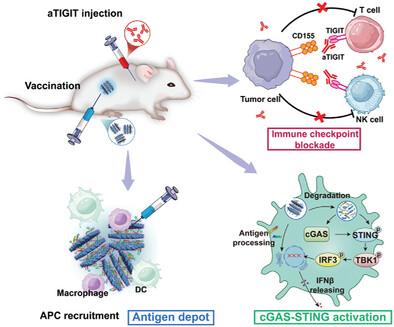
Using entire tumor cells or tissues that display both common and patient-specific antigens can potentially trigger a comprehensive and long-lasting anti-tumor immune response. However, the limited immunogenicity, low uptake efficiency, and susceptibility to degradation of whole-component antigens present significant challenges. In this study, we employed tumor lysates (TLs) as whole-component antigens, in conjunction with MgAl-layered double hydroxide (MA) as nanoadjuvants and Mn2+ as immunostimulants, to create personalized MMAT (Mn2+-MA-TLs) nanovaccines. After subcutaneous injection of MMAT nanovaccines, the high local concentrations of TLs and Mn2+ facilitated the recruitment and activation of antigen-presenting cells (APCs), thereby inducing a robust adaptive immune response. Remarkably, MMAT nanovaccines enabled lysosomal escape, enhanced antigen cross-presentation, and activated the cyclic GMP-AMP synthase (cGAS)-stimulator of interferon genes (STING) pathway in APCs. Furthermore, MMAT nanovaccines, when combined with the anti-TIGIT monoclonal antibody (aTIGIT), an immune checkpoint inhibitor, not only stimulated T-cell-based adaptive anti-tumor immune responses but also activated the NK-cell-based innate anti-tumor immunity, effectively suppressing tumor growth, recurrence, and metastasis. Thus, the ternary MMAT nanovaccines developed here introduced a pioneered paradigm for the rapid preparation of whole-component tumor antigens with nanoadjuvants and immunostimulants into nanovaccines, offering new prospects for clinical immunotherapies.
期刊介绍:
Small serves as an exceptional platform for both experimental and theoretical studies in fundamental and applied interdisciplinary research at the nano- and microscale. The journal offers a compelling mix of peer-reviewed Research Articles, Reviews, Perspectives, and Comments.
With a remarkable 2022 Journal Impact Factor of 13.3 (Journal Citation Reports from Clarivate Analytics, 2023), Small remains among the top multidisciplinary journals, covering a wide range of topics at the interface of materials science, chemistry, physics, engineering, medicine, and biology.
Small's readership includes biochemists, biologists, biomedical scientists, chemists, engineers, information technologists, materials scientists, physicists, and theoreticians alike.





 京公网安备 11010802042870号
京ICP备2023020795号-1
京公网安备 11010802042870号
京ICP备2023020795号-1

 分享
分享
 求助内容:
求助内容: 应助结果提醒方式:
 扫码关注我们
