Esther N Dekker, David van Klaveren, Eva M M Verkolf, Roeland F de Wilde, Marc G Besselink, Eileen M O'Reilly, Alessandro Paniccia, Matthew H G Katz, Ching-Wei D Tzeng, Alice C Wei, Amer H Zureikat, Bas Groot Koerkamp
{"title":"局部晚期胰腺癌诱导FOLFIRINOX后碳水化合物抗原19-9 (CA19-9)反应确定可能受益于手术探查的患者:多中心,观察性队列研究","authors":"Esther N Dekker, David van Klaveren, Eva M M Verkolf, Roeland F de Wilde, Marc G Besselink, Eileen M O'Reilly, Alessandro Paniccia, Matthew H G Katz, Ching-Wei D Tzeng, Alice C Wei, Amer H Zureikat, Bas Groot Koerkamp","doi":"10.1093/bjs/znaf011","DOIUrl":null,"url":null,"abstract":"<p><strong>Background: </strong>Which patients with locally advanced pancreatic cancer may benefit from surgical exploration after induction treatment remains debated. The aim of this retrospective cohort study was to identify independent factors for overall survival after surgical exploration for locally advanced pancreatic cancer, which are available at restaging after induction therapy.</p><p><strong>Methods: </strong>Consecutive patients with locally advanced pancreatic cancer from the Trans-Atlantic Pancreatic Surgery cohort who underwent surgical exploration after FOLFIRINOX as induction chemotherapy were included. Multivariable Cox proportional hazards analyses with contour plots were used for the predicted 3-year overall survival in patients who underwent surgical exploration.</p><p><strong>Results: </strong>Overall, 958 patients with locally advanced pancreatic cancer were treated with FOLFIRINOX as induction therapy. At restaging, 221 patients (23.1%) had metastatic disease (M1) and 724 patients (75.6%) did not have metastatic disease (M0)-234 patients (24.4%) with M0 disease underwent surgical exploration and 490 patients (51.1%) with M0 disease did not undergo surgical exploration; restaging information was not available for 13 patients (1%). The surgical exploration cohort included 213 patients with locally advanced pancreatic cancer, after excluding 21 carbohydrate antigen 19-9 non-producers. The independent prognostic factors for overall survival after surgical exploration were post-induction carbohydrate antigen 19-9 level (HR 1.14 (95% c.i. 1.01 to 1.29)), carbohydrate antigen 19-9 decrease (HR 0.89 (95% c.i. 0.79 to 0.99)), and a WHO performance status of greater than or equal to one (HR 1.71 (95% c.i. 1.21 to 2.42)). Baseline carbohydrate antigen 19-9 was not prognostic for overall survival after surgical exploration (HR 0.98 (95% c.i. 0.90 to 1.07)). The best predicted 3-year overall survival was achieved with a greater than 80% decrease in carbohydrate antigen 19-9 and a post-induction carbohydrate antigen 19-9 less than 50 U/ml.</p><p><strong>Conclusion: </strong>Carbohydrate antigen 19-9 after induction therapy, carbohydrate antigen 19-9 decrease, and performance status are independent prognostic factors for overall survival after surgical exploration for locally advanced pancreatic cancer. Three-year overall survival is best in patients with a performance status of zero, a greater than 80% decrease in carbohydrate antigen 19-9, and a post-induction carbohydrate antigen 19-9 level less than 50 U/ml.</p>","PeriodicalId":136,"journal":{"name":"British Journal of Surgery","volume":"112 2","pages":""},"PeriodicalIF":9.4000,"publicationDate":"2025-02-01","publicationTypes":"Journal Article","fieldsOfStudy":null,"isOpenAccess":false,"openAccessPdf":"https://www.ncbi.nlm.nih.gov/pmc/articles/PMC11836430/pdf/","citationCount":"0","resultStr":"{\"title\":\"Carbohydrate antigen 19-9 (CA19-9) response after induction FOLFIRINOX for locally advanced pancreatic cancer identifies patients who may benefit from surgical exploration: multicentre, observational cohort study.\",\"authors\":\"Esther N Dekker, David van Klaveren, Eva M M Verkolf, Roeland F de Wilde, Marc G Besselink, Eileen M O'Reilly, Alessandro Paniccia, Matthew H G Katz, Ching-Wei D Tzeng, Alice C Wei, Amer H Zureikat, Bas Groot Koerkamp\",\"doi\":\"10.1093/bjs/znaf011\",\"DOIUrl\":null,\"url\":null,\"abstract\":\"<p><strong>Background: </strong>Which patients with locally advanced pancreatic cancer may benefit from surgical exploration after induction treatment remains debated. The aim of this retrospective cohort study was to identify independent factors for overall survival after surgical exploration for locally advanced pancreatic cancer, which are available at restaging after induction therapy.</p><p><strong>Methods: </strong>Consecutive patients with locally advanced pancreatic cancer from the Trans-Atlantic Pancreatic Surgery cohort who underwent surgical exploration after FOLFIRINOX as induction chemotherapy were included. Multivariable Cox proportional hazards analyses with contour plots were used for the predicted 3-year overall survival in patients who underwent surgical exploration.</p><p><strong>Results: </strong>Overall, 958 patients with locally advanced pancreatic cancer were treated with FOLFIRINOX as induction therapy. At restaging, 221 patients (23.1%) had metastatic disease (M1) and 724 patients (75.6%) did not have metastatic disease (M0)-234 patients (24.4%) with M0 disease underwent surgical exploration and 490 patients (51.1%) with M0 disease did not undergo surgical exploration; restaging information was not available for 13 patients (1%). The surgical exploration cohort included 213 patients with locally advanced pancreatic cancer, after excluding 21 carbohydrate antigen 19-9 non-producers. The independent prognostic factors for overall survival after surgical exploration were post-induction carbohydrate antigen 19-9 level (HR 1.14 (95% c.i. 1.01 to 1.29)), carbohydrate antigen 19-9 decrease (HR 0.89 (95% c.i. 0.79 to 0.99)), and a WHO performance status of greater than or equal to one (HR 1.71 (95% c.i. 1.21 to 2.42)). Baseline carbohydrate antigen 19-9 was not prognostic for overall survival after surgical exploration (HR 0.98 (95% c.i. 0.90 to 1.07)). The best predicted 3-year overall survival was achieved with a greater than 80% decrease in carbohydrate antigen 19-9 and a post-induction carbohydrate antigen 19-9 less than 50 U/ml.</p><p><strong>Conclusion: </strong>Carbohydrate antigen 19-9 after induction therapy, carbohydrate antigen 19-9 decrease, and performance status are independent prognostic factors for overall survival after surgical exploration for locally advanced pancreatic cancer. Three-year overall survival is best in patients with a performance status of zero, a greater than 80% decrease in carbohydrate antigen 19-9, and a post-induction carbohydrate antigen 19-9 level less than 50 U/ml.</p>\",\"PeriodicalId\":136,\"journal\":{\"name\":\"British Journal of Surgery\",\"volume\":\"112 2\",\"pages\":\"\"},\"PeriodicalIF\":9.4000,\"publicationDate\":\"2025-02-01\",\"publicationTypes\":\"Journal Article\",\"fieldsOfStudy\":null,\"isOpenAccess\":false,\"openAccessPdf\":\"https://www.ncbi.nlm.nih.gov/pmc/articles/PMC11836430/pdf/\",\"citationCount\":\"0\",\"resultStr\":null,\"platform\":\"Semanticscholar\",\"paperid\":null,\"PeriodicalName\":\"British Journal of Surgery\",\"FirstCategoryId\":\"3\",\"ListUrlMain\":\"https://doi.org/10.1093/bjs/znaf011\",\"RegionNum\":1,\"RegionCategory\":\"医学\",\"ArticlePicture\":[],\"TitleCN\":null,\"AbstractTextCN\":null,\"PMCID\":null,\"EPubDate\":\"\",\"PubModel\":\"\",\"JCR\":\"Q1\",\"JCRName\":\"SURGERY\",\"Score\":null,\"Total\":0}","platform":"Semanticscholar","paperid":null,"PeriodicalName":"British Journal of Surgery","FirstCategoryId":"3","ListUrlMain":"https://doi.org/10.1093/bjs/znaf011","RegionNum":1,"RegionCategory":"医学","ArticlePicture":[],"TitleCN":null,"AbstractTextCN":null,"PMCID":null,"EPubDate":"","PubModel":"","JCR":"Q1","JCRName":"SURGERY","Score":null,"Total":0}
引用次数: 0
摘要
背景:哪些局部晚期胰腺癌患者在诱导治疗后可以从手术探查中获益仍然存在争议。本回顾性队列研究的目的是确定局部晚期胰腺癌手术探查后总生存率的独立因素,这些因素可用于诱导治疗后的再分期。方法:纳入来自跨大西洋胰腺手术队列的连续局部晚期胰腺癌患者,这些患者在FOLFIRINOX诱导化疗后接受了手术探查。采用等高线图进行多变量Cox比例风险分析,预测手术探查患者的3年总生存率。结果:总体而言,958例局部晚期胰腺癌患者接受了FOLFIRINOX诱导治疗。再分期时,221例(23.1%)患者有转移性疾病(M1), 724例(75.6%)患者没有转移性疾病(M0)——234例(24.4%)M0患者进行了手术探查,490例(51.1%)M0患者未进行手术探查;13例(1%)患者无法获得再贮藏信息。手术探查队列包括213例局部晚期胰腺癌患者,排除21例碳水化合物抗原19-9非产生者。手术探查后总体生存的独立预后因素为诱导后碳水化合物抗原19-9水平(HR 1.14 (95% ci . 1.01 ~ 1.29))、碳水化合物抗原19-9降低(HR 0.89 (95% ci . 0.79 ~ 0.99))和WHO表现状态大于或等于1 (HR 1.71 (95% ci . 1.21 ~ 2.42))。基线碳水化合物抗原19-9不能预测手术探查后的总生存(风险比0.98 (95% ci 0.90 ~ 1.07))。当碳水化合物抗原19-9降低80%以上,诱导后碳水化合物抗原19-9低于50 U/ml时,预测3年总生存率最高。结论:诱导治疗后碳水化合物抗原19-9、碳水化合物抗原19-9的降低和运动状态是局部晚期胰腺癌手术探查后总生存的独立预后因素。表现状态为零、碳水化合物抗原19-9下降大于80%、诱导后碳水化合物抗原19-9水平小于50 U/ml的患者3年总生存率最佳。
Carbohydrate antigen 19-9 (CA19-9) response after induction FOLFIRINOX for locally advanced pancreatic cancer identifies patients who may benefit from surgical exploration: multicentre, observational cohort study.
Background: Which patients with locally advanced pancreatic cancer may benefit from surgical exploration after induction treatment remains debated. The aim of this retrospective cohort study was to identify independent factors for overall survival after surgical exploration for locally advanced pancreatic cancer, which are available at restaging after induction therapy.
Methods: Consecutive patients with locally advanced pancreatic cancer from the Trans-Atlantic Pancreatic Surgery cohort who underwent surgical exploration after FOLFIRINOX as induction chemotherapy were included. Multivariable Cox proportional hazards analyses with contour plots were used for the predicted 3-year overall survival in patients who underwent surgical exploration.
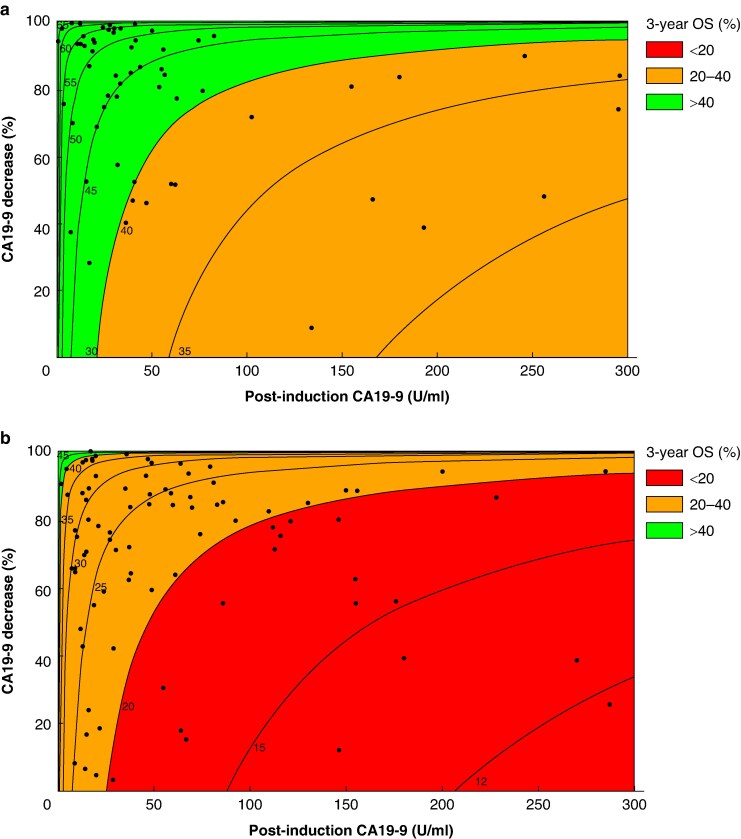
Results: Overall, 958 patients with locally advanced pancreatic cancer were treated with FOLFIRINOX as induction therapy. At restaging, 221 patients (23.1%) had metastatic disease (M1) and 724 patients (75.6%) did not have metastatic disease (M0)-234 patients (24.4%) with M0 disease underwent surgical exploration and 490 patients (51.1%) with M0 disease did not undergo surgical exploration; restaging information was not available for 13 patients (1%). The surgical exploration cohort included 213 patients with locally advanced pancreatic cancer, after excluding 21 carbohydrate antigen 19-9 non-producers. The independent prognostic factors for overall survival after surgical exploration were post-induction carbohydrate antigen 19-9 level (HR 1.14 (95% c.i. 1.01 to 1.29)), carbohydrate antigen 19-9 decrease (HR 0.89 (95% c.i. 0.79 to 0.99)), and a WHO performance status of greater than or equal to one (HR 1.71 (95% c.i. 1.21 to 2.42)). Baseline carbohydrate antigen 19-9 was not prognostic for overall survival after surgical exploration (HR 0.98 (95% c.i. 0.90 to 1.07)). The best predicted 3-year overall survival was achieved with a greater than 80% decrease in carbohydrate antigen 19-9 and a post-induction carbohydrate antigen 19-9 less than 50 U/ml.
Conclusion: Carbohydrate antigen 19-9 after induction therapy, carbohydrate antigen 19-9 decrease, and performance status are independent prognostic factors for overall survival after surgical exploration for locally advanced pancreatic cancer. Three-year overall survival is best in patients with a performance status of zero, a greater than 80% decrease in carbohydrate antigen 19-9, and a post-induction carbohydrate antigen 19-9 level less than 50 U/ml.
期刊介绍:
The British Journal of Surgery (BJS), incorporating the European Journal of Surgery, stands as Europe's leading peer-reviewed surgical journal. It serves as an invaluable platform for presenting high-quality clinical and laboratory-based research across a wide range of surgical topics. In addition to providing a comprehensive coverage of traditional surgical practices, BJS also showcases emerging areas in the field, such as minimally invasive therapy and interventional radiology.
While the journal appeals to general surgeons, it also holds relevance for specialty surgeons and professionals working in closely related fields. By presenting cutting-edge research and advancements, BJS aims to revolutionize the way surgical knowledge is shared and contribute to the ongoing progress of the surgical community.






 京公网安备 11010802042870号
京ICP备2023020795号-1
京公网安备 11010802042870号
京ICP备2023020795号-1

 分享
分享
 求助内容:
求助内容: 应助结果提醒方式:
 扫码关注我们
