Tae-Sung Kim, Jinhoo Seok, Haewon Roh, Wonki Yoon, Taek-Hyun Kwon, Hyunjun Jo
{"title":"经股动脉与经桡动脉脑血管造影的程序动力学:一项回顾性研究。","authors":"Tae-Sung Kim, Jinhoo Seok, Haewon Roh, Wonki Yoon, Taek-Hyun Kwon, Hyunjun Jo","doi":"10.12659/MSM.947603","DOIUrl":null,"url":null,"abstract":"<p><p>BACKGROUND Cerebral angiography, although invasive, remains the most accurate diagnostic tool for neurovascular diseases. While transfemoral cerebral angiography (TFCA) is the conventional approach, transradial cerebral angiography (TRCA) has gained interest due to potential benefits, such as reduced hematoma risk and shorter recovery times. However, procedure times and influencing factors remain debated. This retrospective study from a single center aimed to compare procedure time in 100 patients undergoing conventional TFCA and 93 undergoing TRCA. MATERIAL AND METHODS This single-center retrospective study included 193 patients who underwent 4-vessel cerebral angiography from January to December 2023. TFCA and TRCA were performed by experienced neurosurgeons. TRCA involved radial artery access with collateral circulation assessment (modified Allen's and Barbeau's tests), and TFCA used femoral artery access with standard techniques. Clinical data, including puncture times and radiation exposure, were collected. Logistic regression identified factors influencing prolonged procedure times (>20 minutes). RESULTS Procedure times for TFCA and TRCA were similar (median: 20.00 minutes vs 24.50 minutes, p=0.139), though TRCA showed longer puncture times (median: 10.00 vs 10.00 minutes, p=0.001). Radiation exposure was comparable (421.00 milliGray (mGy) vs 418.50 mGy, p=0.530). Hypertension (OR: 2.255, p=0.011) and aortic arch tortuosity (OR: 3.881, p=0.002) significantly influenced prolonged procedures. CONCLUSIONS TRCA offers a safe and effective alternative to TFCA for diagnostic cerebral angiography, with comparable procedure times and radiation exposure. While patient-specific factors, such as hypertension and aortic arch tortuosity, influence procedure duration, TRCA provides benefits in patient comfort and recovery. These findings support the broader use of TRCA in diagnostic settings.</p>","PeriodicalId":48888,"journal":{"name":"Medical Science Monitor","volume":"31 ","pages":"e947603"},"PeriodicalIF":2.1000,"publicationDate":"2025-02-19","publicationTypes":"Journal Article","fieldsOfStudy":null,"isOpenAccess":false,"openAccessPdf":"https://www.ncbi.nlm.nih.gov/pmc/articles/PMC11849229/pdf/","citationCount":"0","resultStr":"{\"title\":\"Procedure Dynamics in Transfemoral vs Transradial Cerebral Angiography: A Retrospective Study.\",\"authors\":\"Tae-Sung Kim, Jinhoo Seok, Haewon Roh, Wonki Yoon, Taek-Hyun Kwon, Hyunjun Jo\",\"doi\":\"10.12659/MSM.947603\",\"DOIUrl\":null,\"url\":null,\"abstract\":\"<p><p>BACKGROUND Cerebral angiography, although invasive, remains the most accurate diagnostic tool for neurovascular diseases. While transfemoral cerebral angiography (TFCA) is the conventional approach, transradial cerebral angiography (TRCA) has gained interest due to potential benefits, such as reduced hematoma risk and shorter recovery times. However, procedure times and influencing factors remain debated. This retrospective study from a single center aimed to compare procedure time in 100 patients undergoing conventional TFCA and 93 undergoing TRCA. MATERIAL AND METHODS This single-center retrospective study included 193 patients who underwent 4-vessel cerebral angiography from January to December 2023. TFCA and TRCA were performed by experienced neurosurgeons. TRCA involved radial artery access with collateral circulation assessment (modified Allen's and Barbeau's tests), and TFCA used femoral artery access with standard techniques. Clinical data, including puncture times and radiation exposure, were collected. Logistic regression identified factors influencing prolonged procedure times (>20 minutes). RESULTS Procedure times for TFCA and TRCA were similar (median: 20.00 minutes vs 24.50 minutes, p=0.139), though TRCA showed longer puncture times (median: 10.00 vs 10.00 minutes, p=0.001). Radiation exposure was comparable (421.00 milliGray (mGy) vs 418.50 mGy, p=0.530). Hypertension (OR: 2.255, p=0.011) and aortic arch tortuosity (OR: 3.881, p=0.002) significantly influenced prolonged procedures. CONCLUSIONS TRCA offers a safe and effective alternative to TFCA for diagnostic cerebral angiography, with comparable procedure times and radiation exposure. While patient-specific factors, such as hypertension and aortic arch tortuosity, influence procedure duration, TRCA provides benefits in patient comfort and recovery. These findings support the broader use of TRCA in diagnostic settings.</p>\",\"PeriodicalId\":48888,\"journal\":{\"name\":\"Medical Science Monitor\",\"volume\":\"31 \",\"pages\":\"e947603\"},\"PeriodicalIF\":2.1000,\"publicationDate\":\"2025-02-19\",\"publicationTypes\":\"Journal Article\",\"fieldsOfStudy\":null,\"isOpenAccess\":false,\"openAccessPdf\":\"https://www.ncbi.nlm.nih.gov/pmc/articles/PMC11849229/pdf/\",\"citationCount\":\"0\",\"resultStr\":null,\"platform\":\"Semanticscholar\",\"paperid\":null,\"PeriodicalName\":\"Medical Science Monitor\",\"FirstCategoryId\":\"3\",\"ListUrlMain\":\"https://doi.org/10.12659/MSM.947603\",\"RegionNum\":4,\"RegionCategory\":\"医学\",\"ArticlePicture\":[],\"TitleCN\":null,\"AbstractTextCN\":null,\"PMCID\":null,\"EPubDate\":\"\",\"PubModel\":\"\",\"JCR\":\"Q1\",\"JCRName\":\"Medicine\",\"Score\":null,\"Total\":0}","platform":"Semanticscholar","paperid":null,"PeriodicalName":"Medical Science Monitor","FirstCategoryId":"3","ListUrlMain":"https://doi.org/10.12659/MSM.947603","RegionNum":4,"RegionCategory":"医学","ArticlePicture":[],"TitleCN":null,"AbstractTextCN":null,"PMCID":null,"EPubDate":"","PubModel":"","JCR":"Q1","JCRName":"Medicine","Score":null,"Total":0}
Procedure Dynamics in Transfemoral vs Transradial Cerebral Angiography: A Retrospective Study.
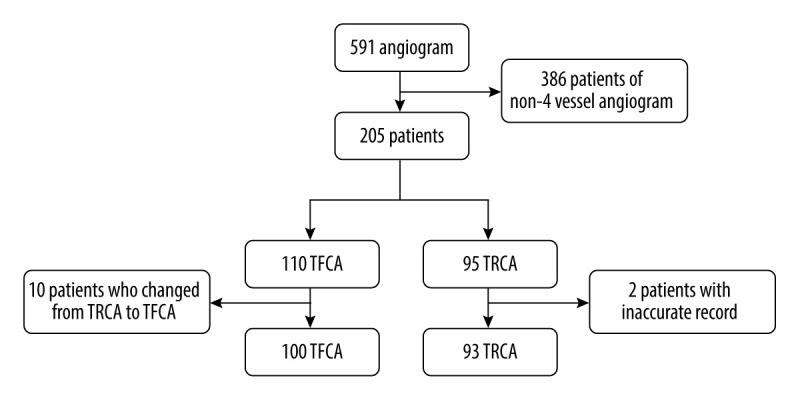
BACKGROUND Cerebral angiography, although invasive, remains the most accurate diagnostic tool for neurovascular diseases. While transfemoral cerebral angiography (TFCA) is the conventional approach, transradial cerebral angiography (TRCA) has gained interest due to potential benefits, such as reduced hematoma risk and shorter recovery times. However, procedure times and influencing factors remain debated. This retrospective study from a single center aimed to compare procedure time in 100 patients undergoing conventional TFCA and 93 undergoing TRCA. MATERIAL AND METHODS This single-center retrospective study included 193 patients who underwent 4-vessel cerebral angiography from January to December 2023. TFCA and TRCA were performed by experienced neurosurgeons. TRCA involved radial artery access with collateral circulation assessment (modified Allen's and Barbeau's tests), and TFCA used femoral artery access with standard techniques. Clinical data, including puncture times and radiation exposure, were collected. Logistic regression identified factors influencing prolonged procedure times (>20 minutes). RESULTS Procedure times for TFCA and TRCA were similar (median: 20.00 minutes vs 24.50 minutes, p=0.139), though TRCA showed longer puncture times (median: 10.00 vs 10.00 minutes, p=0.001). Radiation exposure was comparable (421.00 milliGray (mGy) vs 418.50 mGy, p=0.530). Hypertension (OR: 2.255, p=0.011) and aortic arch tortuosity (OR: 3.881, p=0.002) significantly influenced prolonged procedures. CONCLUSIONS TRCA offers a safe and effective alternative to TFCA for diagnostic cerebral angiography, with comparable procedure times and radiation exposure. While patient-specific factors, such as hypertension and aortic arch tortuosity, influence procedure duration, TRCA provides benefits in patient comfort and recovery. These findings support the broader use of TRCA in diagnostic settings.
期刊介绍:
Medical Science Monitor (MSM) established in 1995 is an international, peer-reviewed scientific journal which publishes original articles in Clinical Medicine and related disciplines such as Epidemiology and Population Studies, Product Investigations, Development of Laboratory Techniques :: Diagnostics and Medical Technology which enable presentation of research or review works in overlapping areas of medicine and technology such us (but not limited to): medical diagnostics, medical imaging systems, computer simulation of health and disease processes, new medical devices, etc. Reviews and Special Reports - papers may be accepted on the basis that they provide a systematic, critical and up-to-date overview of literature pertaining to research or clinical topics. Meta-analyses are considered as reviews. A special attention will be paid to a teaching value of a review paper.
Medical Science Monitor is internationally indexed in Thomson-Reuters Web of Science, Journals Citation Report (JCR), Science Citation Index Expanded (SCI), Index Medicus MEDLINE, PubMed, PMC, EMBASE/Excerpta Medica, Chemical Abstracts CAS and Index Copernicus.






 京公网安备 11010802042870号
京ICP备2023020795号-1
京公网安备 11010802042870号
京ICP备2023020795号-1

 分享
分享
 求助内容:
求助内容: 应助结果提醒方式:
 扫码关注我们
