Hongmei Du , Yinru Li , Fei Zhao , Jingjing Xu , Yifei Su , Jinsheng Zhao , Konggang Qu , Xianxi Zhang
{"title":"C3N4固载Fe(Ni)Se2/Se纳米颗粒作为析氧反应和液态锌空气电池的高活性电催化剂","authors":"Hongmei Du , Yinru Li , Fei Zhao , Jingjing Xu , Yifei Su , Jinsheng Zhao , Konggang Qu , Xianxi Zhang","doi":"10.1016/j.apsusc.2025.162696","DOIUrl":null,"url":null,"abstract":"<div><div>Finding catalysts with a high concentration of active sites and superior intrinsic activity is critical in boosting electrocatalytic efficiency. In this paper, Fe(Ni)Se<sub>2</sub>/Se-C<sub>3</sub>N<sub>4</sub> is prepared through a hydrothermal and subsequent selenization method. The prepared Fe(Ni)Se<sub>2</sub>/Se-C<sub>3</sub>N<sub>4</sub> catalyst exhibits outstanding OER performance, with a 225 mV overpotential at a current density of 10 mA cm<sup>−2</sup>. It also shows strong catalytic stability. After 856 h of testing at a current density of 2 mA cm<sup>−2</sup>, there is comparatively little current deterioration. The zinc-air battery assembled using Fe(Ni)Se<sub>2</sub>/Se-C<sub>3</sub>N<sub>4</sub> as the catalyst shows a maximum specific capacity of 699.0 mAh g<sup>−1</sup>. At a current density of 273.1 mA cm<sup>−2</sup>, the power density increases to a maximum of 157.1 mW cm<sup>−2</sup>. The internal electron transport between Fe(Ni)Se<sub>2</sub>/Se and C<sub>3</sub>N<sub>4</sub> modulates the electronic structure and subsequently enhances the catalytic performance, as demonstrated by synchronized radiation and theoretical calculations. The catalyst’s large specific surface area and abundance of active sites contribute to the improvement of catalytic activity. This work provides useful recommendations for the synthesis and design of efficient bifunctional catalysts in the future, facilitating the commercialization of electrocatalysis.</div></div>","PeriodicalId":247,"journal":{"name":"Applied Surface Science","volume":"692 ","pages":"Article 162696"},"PeriodicalIF":6.9000,"publicationDate":"2025-05-30","publicationTypes":"Journal Article","fieldsOfStudy":null,"isOpenAccess":false,"openAccessPdf":"","citationCount":"0","resultStr":"{\"title\":\"Fe(Ni)Se2/Se nanoparticles anchored on C3N4 as highly active electrocatalysts in oxygen evolution reaction and liquid Zn-air batteries\",\"authors\":\"Hongmei Du , Yinru Li , Fei Zhao , Jingjing Xu , Yifei Su , Jinsheng Zhao , Konggang Qu , Xianxi Zhang\",\"doi\":\"10.1016/j.apsusc.2025.162696\",\"DOIUrl\":null,\"url\":null,\"abstract\":\"<div><div>Finding catalysts with a high concentration of active sites and superior intrinsic activity is critical in boosting electrocatalytic efficiency. In this paper, Fe(Ni)Se<sub>2</sub>/Se-C<sub>3</sub>N<sub>4</sub> is prepared through a hydrothermal and subsequent selenization method. The prepared Fe(Ni)Se<sub>2</sub>/Se-C<sub>3</sub>N<sub>4</sub> catalyst exhibits outstanding OER performance, with a 225 mV overpotential at a current density of 10 mA cm<sup>−2</sup>. It also shows strong catalytic stability. After 856 h of testing at a current density of 2 mA cm<sup>−2</sup>, there is comparatively little current deterioration. The zinc-air battery assembled using Fe(Ni)Se<sub>2</sub>/Se-C<sub>3</sub>N<sub>4</sub> as the catalyst shows a maximum specific capacity of 699.0 mAh g<sup>−1</sup>. At a current density of 273.1 mA cm<sup>−2</sup>, the power density increases to a maximum of 157.1 mW cm<sup>−2</sup>. The internal electron transport between Fe(Ni)Se<sub>2</sub>/Se and C<sub>3</sub>N<sub>4</sub> modulates the electronic structure and subsequently enhances the catalytic performance, as demonstrated by synchronized radiation and theoretical calculations. The catalyst’s large specific surface area and abundance of active sites contribute to the improvement of catalytic activity. This work provides useful recommendations for the synthesis and design of efficient bifunctional catalysts in the future, facilitating the commercialization of electrocatalysis.</div></div>\",\"PeriodicalId\":247,\"journal\":{\"name\":\"Applied Surface Science\",\"volume\":\"692 \",\"pages\":\"Article 162696\"},\"PeriodicalIF\":6.9000,\"publicationDate\":\"2025-05-30\",\"publicationTypes\":\"Journal Article\",\"fieldsOfStudy\":null,\"isOpenAccess\":false,\"openAccessPdf\":\"\",\"citationCount\":\"0\",\"resultStr\":null,\"platform\":\"Semanticscholar\",\"paperid\":null,\"PeriodicalName\":\"Applied Surface Science\",\"FirstCategoryId\":\"88\",\"ListUrlMain\":\"https://www.sciencedirect.com/science/article/pii/S0169433225004106\",\"RegionNum\":2,\"RegionCategory\":\"材料科学\",\"ArticlePicture\":[],\"TitleCN\":null,\"AbstractTextCN\":null,\"PMCID\":null,\"EPubDate\":\"2025/2/19 0:00:00\",\"PubModel\":\"Epub\",\"JCR\":\"Q2\",\"JCRName\":\"CHEMISTRY, PHYSICAL\",\"Score\":null,\"Total\":0}","platform":"Semanticscholar","paperid":null,"PeriodicalName":"Applied Surface Science","FirstCategoryId":"88","ListUrlMain":"https://www.sciencedirect.com/science/article/pii/S0169433225004106","RegionNum":2,"RegionCategory":"材料科学","ArticlePicture":[],"TitleCN":null,"AbstractTextCN":null,"PMCID":null,"EPubDate":"2025/2/19 0:00:00","PubModel":"Epub","JCR":"Q2","JCRName":"CHEMISTRY, PHYSICAL","Score":null,"Total":0}
引用次数: 0
摘要
寻找具有高浓度活性位点和优异本征活性的催化剂是提高电催化效率的关键。本文采用水热和后续硒化法制备了Fe(Ni)Se2/Se-C3N4。制备的Fe(Ni)Se2/Se-C3N4催化剂在电流密度为10 mA cm−2时的过电位为225 mV,表现出优异的OER性能。并表现出较强的催化稳定性。在2 mA cm−2的电流密度下测试856 h后,电流劣化相对较小。以Fe(Ni)Se2/Se-C3N4为催化剂组装的锌空气电池的最大比容量为699.0 mAh g−1。当电流密度为273.1 mA cm−2时,功率密度增加到最大值157.1 mW cm−2。同步辐射和理论计算表明,Fe(Ni)Se2/Se和C3N4之间的内部电子传递调节了电子结构,从而提高了催化性能。催化剂的大比表面积和丰富的活性位点有助于提高催化活性。本研究为今后高效双功能催化剂的合成和设计提供了有益的建议,促进了电催化的商业化。
Fe(Ni)Se2/Se nanoparticles anchored on C3N4 as highly active electrocatalysts in oxygen evolution reaction and liquid Zn-air batteries
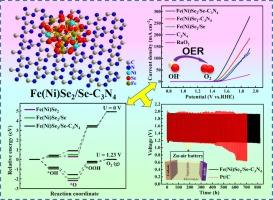
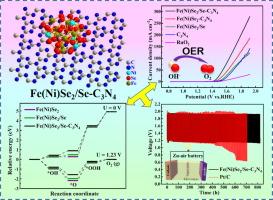
Finding catalysts with a high concentration of active sites and superior intrinsic activity is critical in boosting electrocatalytic efficiency. In this paper, Fe(Ni)Se2/Se-C3N4 is prepared through a hydrothermal and subsequent selenization method. The prepared Fe(Ni)Se2/Se-C3N4 catalyst exhibits outstanding OER performance, with a 225 mV overpotential at a current density of 10 mA cm−2. It also shows strong catalytic stability. After 856 h of testing at a current density of 2 mA cm−2, there is comparatively little current deterioration. The zinc-air battery assembled using Fe(Ni)Se2/Se-C3N4 as the catalyst shows a maximum specific capacity of 699.0 mAh g−1. At a current density of 273.1 mA cm−2, the power density increases to a maximum of 157.1 mW cm−2. The internal electron transport between Fe(Ni)Se2/Se and C3N4 modulates the electronic structure and subsequently enhances the catalytic performance, as demonstrated by synchronized radiation and theoretical calculations. The catalyst’s large specific surface area and abundance of active sites contribute to the improvement of catalytic activity. This work provides useful recommendations for the synthesis and design of efficient bifunctional catalysts in the future, facilitating the commercialization of electrocatalysis.
期刊介绍:
Applied Surface Science covers topics contributing to a better understanding of surfaces, interfaces, nanostructures and their applications. The journal is concerned with scientific research on the atomic and molecular level of material properties determined with specific surface analytical techniques and/or computational methods, as well as the processing of such structures.




 京公网安备 11010802042870号
京ICP备2023020795号-1
京公网安备 11010802042870号
京ICP备2023020795号-1

 分享
分享
 求助内容:
求助内容: 应助结果提醒方式:
 扫码关注我们
