Gizem Guzelsoy, Setiembre D. Elorza, Manon Ros, Logan T. Schachtner, Makiko Hayashi, Spencer Hobson-Gutierrez, Parker Rundstrom, Julia S. Brunner, Ray Pillai, William E. Walkowicz, Lydia W. S. Finley, Maxime Deforet, Thales Papagiannakopoulos, Carlos Carmona-Fontaine
{"title":"协同营养清除是癌症的进化优势","authors":"Gizem Guzelsoy, Setiembre D. Elorza, Manon Ros, Logan T. Schachtner, Makiko Hayashi, Spencer Hobson-Gutierrez, Parker Rundstrom, Julia S. Brunner, Ray Pillai, William E. Walkowicz, Lydia W. S. Finley, Maxime Deforet, Thales Papagiannakopoulos, Carlos Carmona-Fontaine","doi":"10.1038/s41586-025-08588-w","DOIUrl":null,"url":null,"abstract":"The survival of malignant cells within tumours is often seen as depending on ruthless competition for nutrients and other resources1,2. Although competition is certainly critical for tumour evolution and cancer progression, cooperative interactions within tumours are also important, albeit poorly understood3,4. Cooperative populations at all levels of biological organization risk extinction if their population size falls below a critical tipping point5,6. Here we examined whether cooperation among tumour cells may be a potential therapeutic target. We identified a cooperative mechanism that enables tumour cells to proliferate under the amino acid-deprived conditions found in the tumour microenvironment. Disruption of this mechanism drove cultured tumour populations to the critical extinction point and resulted in a marked reduction in tumour growth in vivo. Mechanistically, we show that tumour cells collectively digest extracellular oligopeptides through the secretion of aminopeptidases. The resulting free amino acids benefit both aminopeptidase-secreting cells and neighbouring cells. We identified CNDP2 as the key enzyme that hydrolyses these peptides extracellularly, and loss of this aminopeptidase prevents tumour growth in vitro and in vivo. These data show that cooperative scavenging of nutrients is key to survival in the tumour microenvironment and reveal a targetable cancer vulnerability. Nutrient-starved tumour cells cooperate by secreting aminopeptidases that digest oligopeptides in the microenvironment, creating a shared pool of free amino acids.","PeriodicalId":18787,"journal":{"name":"Nature","volume":"640 8058","pages":"534-542"},"PeriodicalIF":48.5000,"publicationDate":"2025-02-19","publicationTypes":"Journal Article","fieldsOfStudy":null,"isOpenAccess":false,"openAccessPdf":"https://www.nature.com/articles/s41586-025-08588-w.pdf","citationCount":"0","resultStr":"{\"title\":\"Cooperative nutrient scavenging is an evolutionary advantage in cancer\",\"authors\":\"Gizem Guzelsoy, Setiembre D. Elorza, Manon Ros, Logan T. Schachtner, Makiko Hayashi, Spencer Hobson-Gutierrez, Parker Rundstrom, Julia S. Brunner, Ray Pillai, William E. Walkowicz, Lydia W. S. Finley, Maxime Deforet, Thales Papagiannakopoulos, Carlos Carmona-Fontaine\",\"doi\":\"10.1038/s41586-025-08588-w\",\"DOIUrl\":null,\"url\":null,\"abstract\":\"The survival of malignant cells within tumours is often seen as depending on ruthless competition for nutrients and other resources1,2. Although competition is certainly critical for tumour evolution and cancer progression, cooperative interactions within tumours are also important, albeit poorly understood3,4. Cooperative populations at all levels of biological organization risk extinction if their population size falls below a critical tipping point5,6. Here we examined whether cooperation among tumour cells may be a potential therapeutic target. We identified a cooperative mechanism that enables tumour cells to proliferate under the amino acid-deprived conditions found in the tumour microenvironment. Disruption of this mechanism drove cultured tumour populations to the critical extinction point and resulted in a marked reduction in tumour growth in vivo. Mechanistically, we show that tumour cells collectively digest extracellular oligopeptides through the secretion of aminopeptidases. The resulting free amino acids benefit both aminopeptidase-secreting cells and neighbouring cells. We identified CNDP2 as the key enzyme that hydrolyses these peptides extracellularly, and loss of this aminopeptidase prevents tumour growth in vitro and in vivo. These data show that cooperative scavenging of nutrients is key to survival in the tumour microenvironment and reveal a targetable cancer vulnerability. Nutrient-starved tumour cells cooperate by secreting aminopeptidases that digest oligopeptides in the microenvironment, creating a shared pool of free amino acids.\",\"PeriodicalId\":18787,\"journal\":{\"name\":\"Nature\",\"volume\":\"640 8058\",\"pages\":\"534-542\"},\"PeriodicalIF\":48.5000,\"publicationDate\":\"2025-02-19\",\"publicationTypes\":\"Journal Article\",\"fieldsOfStudy\":null,\"isOpenAccess\":false,\"openAccessPdf\":\"https://www.nature.com/articles/s41586-025-08588-w.pdf\",\"citationCount\":\"0\",\"resultStr\":null,\"platform\":\"Semanticscholar\",\"paperid\":null,\"PeriodicalName\":\"Nature\",\"FirstCategoryId\":\"103\",\"ListUrlMain\":\"https://www.nature.com/articles/s41586-025-08588-w\",\"RegionNum\":1,\"RegionCategory\":\"综合性期刊\",\"ArticlePicture\":[],\"TitleCN\":null,\"AbstractTextCN\":null,\"PMCID\":null,\"EPubDate\":\"\",\"PubModel\":\"\",\"JCR\":\"Q1\",\"JCRName\":\"MULTIDISCIPLINARY SCIENCES\",\"Score\":null,\"Total\":0}","platform":"Semanticscholar","paperid":null,"PeriodicalName":"Nature","FirstCategoryId":"103","ListUrlMain":"https://www.nature.com/articles/s41586-025-08588-w","RegionNum":1,"RegionCategory":"综合性期刊","ArticlePicture":[],"TitleCN":null,"AbstractTextCN":null,"PMCID":null,"EPubDate":"","PubModel":"","JCR":"Q1","JCRName":"MULTIDISCIPLINARY SCIENCES","Score":null,"Total":0}
Cooperative nutrient scavenging is an evolutionary advantage in cancer
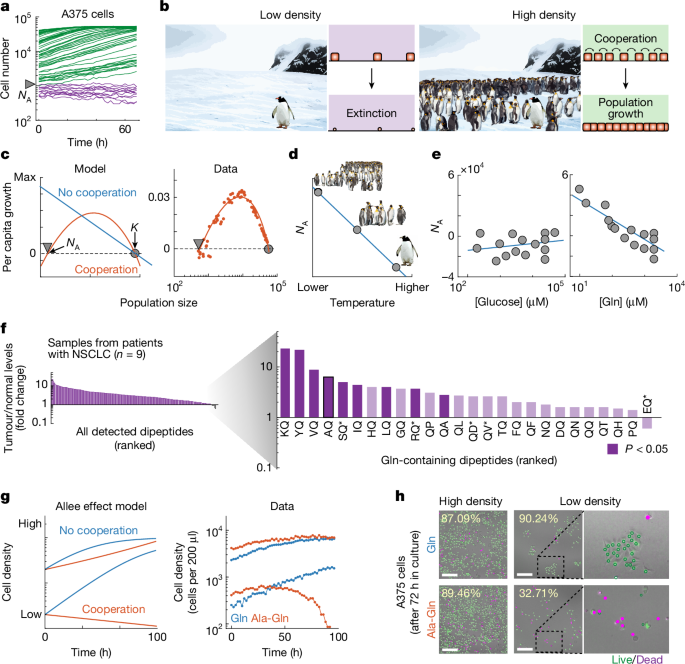
The survival of malignant cells within tumours is often seen as depending on ruthless competition for nutrients and other resources1,2. Although competition is certainly critical for tumour evolution and cancer progression, cooperative interactions within tumours are also important, albeit poorly understood3,4. Cooperative populations at all levels of biological organization risk extinction if their population size falls below a critical tipping point5,6. Here we examined whether cooperation among tumour cells may be a potential therapeutic target. We identified a cooperative mechanism that enables tumour cells to proliferate under the amino acid-deprived conditions found in the tumour microenvironment. Disruption of this mechanism drove cultured tumour populations to the critical extinction point and resulted in a marked reduction in tumour growth in vivo. Mechanistically, we show that tumour cells collectively digest extracellular oligopeptides through the secretion of aminopeptidases. The resulting free amino acids benefit both aminopeptidase-secreting cells and neighbouring cells. We identified CNDP2 as the key enzyme that hydrolyses these peptides extracellularly, and loss of this aminopeptidase prevents tumour growth in vitro and in vivo. These data show that cooperative scavenging of nutrients is key to survival in the tumour microenvironment and reveal a targetable cancer vulnerability. Nutrient-starved tumour cells cooperate by secreting aminopeptidases that digest oligopeptides in the microenvironment, creating a shared pool of free amino acids.
期刊介绍:
Nature is a prestigious international journal that publishes peer-reviewed research in various scientific and technological fields. The selection of articles is based on criteria such as originality, importance, interdisciplinary relevance, timeliness, accessibility, elegance, and surprising conclusions. In addition to showcasing significant scientific advances, Nature delivers rapid, authoritative, insightful news, and interpretation of current and upcoming trends impacting science, scientists, and the broader public. The journal serves a dual purpose: firstly, to promptly share noteworthy scientific advances and foster discussions among scientists, and secondly, to ensure the swift dissemination of scientific results globally, emphasizing their significance for knowledge, culture, and daily life.





 京公网安备 11010802042870号
京ICP备2023020795号-1
京公网安备 11010802042870号
京ICP备2023020795号-1

 分享
分享
 求助内容:
求助内容: 应助结果提醒方式:
 扫码关注我们
