Hanqing Dong, Hongwei Xie, Qiushi Song and Zhiqiang Ning
{"title":"锂离子电池用Fe2O3氧化硅钙合金制备多层SiOx","authors":"Hanqing Dong, Hongwei Xie, Qiushi Song and Zhiqiang Ning","doi":"10.1039/D4DT03439B","DOIUrl":null,"url":null,"abstract":"<p >SiO<small><sub><em>x</em></sub></small> is deemed a promising candidate for lithium-ion batteries owing to its high specific capacity and relatively low volume expansion. However, its low rate performance is a bottleneck for its application. Two-dimensional SiO<small><sub><em>x</em></sub></small> with short lithium-ion pathways and large layer intervals has been a hot research topic for improving the electrochemical performance of lithium-ion batteries. Herein, a solid exfoliation method was designed to synthesize a multilayer SiO<small><sub><em>x</em></sub></small> using CaSi<small><sub>2</sub></small> and Fe<small><sub>2</sub></small>O<small><sub>3</sub></small>. This multilayer SiO<small><sub><em>x</em></sub></small> exhibited large layer intervals after the by-products were removed by HCl. The void space provided extra space for volume expansion, which prevented pulverization, and the thin monolayer shortened the Li<small><sup>+</sup></small> pathways. Therefore, ML-SiO<small><sub><em>x</em></sub></small>–Fe<small><sub>2</sub></small>O<small><sub>3</sub></small> exhibited an excellent reversible capacity of 697.8 mA h g<small><sup>−1</sup></small> after 200 cycles at 0.5 A g<small><sup>−1</sup></small> with a capacity retention of 94.2%. Meanwhile, ML-SiO<small><sub><em>x</em></sub></small>–Fe<small><sub>2</sub></small>O<small><sub>3</sub></small> anode delivered a rate performance of 432.7 mA h g<small><sup>−1</sup></small> at 3 A g<small><sup>−1</sup></small>, and it could be recovered to 1157.1 mA h g<small><sup>−1</sup></small> when the current density was converted to 0.1 A g<small><sup>−1</sup></small>. This work opens up a new method for synthesizing multilayer SiO<small><sub><em>x</em></sub></small> using metal oxides to exfoliate CaSi<small><sub>2</sub></small>.</p>","PeriodicalId":71,"journal":{"name":"Dalton Transactions","volume":" 11","pages":" 4755-4760"},"PeriodicalIF":3.3000,"publicationDate":"2025-02-20","publicationTypes":"Journal Article","fieldsOfStudy":null,"isOpenAccess":false,"openAccessPdf":"","citationCount":"0","resultStr":"{\"title\":\"Multilayer SiOx derived from Si–Ca alloy via Fe2O3 oxidization for Li-ion batteries†\",\"authors\":\"Hanqing Dong, Hongwei Xie, Qiushi Song and Zhiqiang Ning\",\"doi\":\"10.1039/D4DT03439B\",\"DOIUrl\":null,\"url\":null,\"abstract\":\"<p >SiO<small><sub><em>x</em></sub></small> is deemed a promising candidate for lithium-ion batteries owing to its high specific capacity and relatively low volume expansion. However, its low rate performance is a bottleneck for its application. Two-dimensional SiO<small><sub><em>x</em></sub></small> with short lithium-ion pathways and large layer intervals has been a hot research topic for improving the electrochemical performance of lithium-ion batteries. Herein, a solid exfoliation method was designed to synthesize a multilayer SiO<small><sub><em>x</em></sub></small> using CaSi<small><sub>2</sub></small> and Fe<small><sub>2</sub></small>O<small><sub>3</sub></small>. This multilayer SiO<small><sub><em>x</em></sub></small> exhibited large layer intervals after the by-products were removed by HCl. The void space provided extra space for volume expansion, which prevented pulverization, and the thin monolayer shortened the Li<small><sup>+</sup></small> pathways. Therefore, ML-SiO<small><sub><em>x</em></sub></small>–Fe<small><sub>2</sub></small>O<small><sub>3</sub></small> exhibited an excellent reversible capacity of 697.8 mA h g<small><sup>−1</sup></small> after 200 cycles at 0.5 A g<small><sup>−1</sup></small> with a capacity retention of 94.2%. Meanwhile, ML-SiO<small><sub><em>x</em></sub></small>–Fe<small><sub>2</sub></small>O<small><sub>3</sub></small> anode delivered a rate performance of 432.7 mA h g<small><sup>−1</sup></small> at 3 A g<small><sup>−1</sup></small>, and it could be recovered to 1157.1 mA h g<small><sup>−1</sup></small> when the current density was converted to 0.1 A g<small><sup>−1</sup></small>. This work opens up a new method for synthesizing multilayer SiO<small><sub><em>x</em></sub></small> using metal oxides to exfoliate CaSi<small><sub>2</sub></small>.</p>\",\"PeriodicalId\":71,\"journal\":{\"name\":\"Dalton Transactions\",\"volume\":\" 11\",\"pages\":\" 4755-4760\"},\"PeriodicalIF\":3.3000,\"publicationDate\":\"2025-02-20\",\"publicationTypes\":\"Journal Article\",\"fieldsOfStudy\":null,\"isOpenAccess\":false,\"openAccessPdf\":\"\",\"citationCount\":\"0\",\"resultStr\":null,\"platform\":\"Semanticscholar\",\"paperid\":null,\"PeriodicalName\":\"Dalton Transactions\",\"FirstCategoryId\":\"92\",\"ListUrlMain\":\"https://pubs.rsc.org/en/content/articlelanding/2025/dt/d4dt03439b\",\"RegionNum\":3,\"RegionCategory\":\"化学\",\"ArticlePicture\":[],\"TitleCN\":null,\"AbstractTextCN\":null,\"PMCID\":null,\"EPubDate\":\"\",\"PubModel\":\"\",\"JCR\":\"Q2\",\"JCRName\":\"CHEMISTRY, INORGANIC & NUCLEAR\",\"Score\":null,\"Total\":0}","platform":"Semanticscholar","paperid":null,"PeriodicalName":"Dalton Transactions","FirstCategoryId":"92","ListUrlMain":"https://pubs.rsc.org/en/content/articlelanding/2025/dt/d4dt03439b","RegionNum":3,"RegionCategory":"化学","ArticlePicture":[],"TitleCN":null,"AbstractTextCN":null,"PMCID":null,"EPubDate":"","PubModel":"","JCR":"Q2","JCRName":"CHEMISTRY, INORGANIC & NUCLEAR","Score":null,"Total":0}
引用次数: 0
摘要
SiOx因其高比容量和相对较小的体积膨胀而被认为是锂离子电池的有前途的候选者。然而,它的低速率性能是其应用的瓶颈。具有短锂离子路径和大层间距的二维SiOx已成为提高锂离子电池电化学性能的研究热点。本文设计了一种固体剥离法,以CaSi2和Fe2O3为原料合成多层SiOx。副产物被HCl去除后,多层SiOx表现出较大的层间距。孔隙空间为体积膨胀提供了额外的空间,防止了粉碎,薄的单层缩短了Li+路径。因此,ML-SiOx-Fe2O3在0.5 A g−1下循环200次后表现出优异的可逆容量为697.8 mA h g−1,容量保持率为94.2%。同时,ML-SiOx-Fe2O3阳极在3 a g−1时的速率性能为432.7 mA h g−1,当电流密度转换为0.1 a g−1时,速率性能可恢复到1157.1 mA h g−1。本工作开辟了一种利用金属氧化物剥离CaSi2合成多层SiOx的新方法。
Multilayer SiOx derived from Si–Ca alloy via Fe2O3 oxidization for Li-ion batteries†
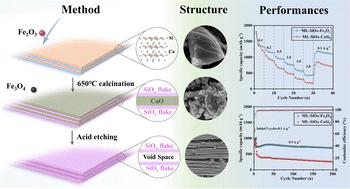
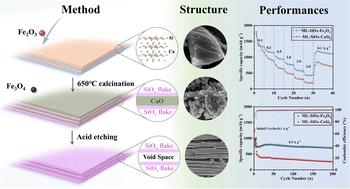
SiOx is deemed a promising candidate for lithium-ion batteries owing to its high specific capacity and relatively low volume expansion. However, its low rate performance is a bottleneck for its application. Two-dimensional SiOx with short lithium-ion pathways and large layer intervals has been a hot research topic for improving the electrochemical performance of lithium-ion batteries. Herein, a solid exfoliation method was designed to synthesize a multilayer SiOx using CaSi2 and Fe2O3. This multilayer SiOx exhibited large layer intervals after the by-products were removed by HCl. The void space provided extra space for volume expansion, which prevented pulverization, and the thin monolayer shortened the Li+ pathways. Therefore, ML-SiOx–Fe2O3 exhibited an excellent reversible capacity of 697.8 mA h g−1 after 200 cycles at 0.5 A g−1 with a capacity retention of 94.2%. Meanwhile, ML-SiOx–Fe2O3 anode delivered a rate performance of 432.7 mA h g−1 at 3 A g−1, and it could be recovered to 1157.1 mA h g−1 when the current density was converted to 0.1 A g−1. This work opens up a new method for synthesizing multilayer SiOx using metal oxides to exfoliate CaSi2.
期刊介绍:
Dalton Transactions is a journal for all areas of inorganic chemistry, which encompasses the organometallic, bioinorganic and materials chemistry of the elements, with applications including synthesis, catalysis, energy conversion/storage, electrical devices and medicine. Dalton Transactions welcomes high-quality, original submissions in all of these areas and more, where the advancement of knowledge in inorganic chemistry is significant.




 京公网安备 11010802042870号
京ICP备2023020795号-1
京公网安备 11010802042870号
京ICP备2023020795号-1

 分享
分享
 求助内容:
求助内容: 应助结果提醒方式:
 扫码关注我们
