Muhammad Bagus Arif , Evi Yulianti , Qolby Sabrina , Sudaryanto Sudaryanto , Sun Theo C.L. Ndruru , Muhammad Ghozali
{"title":"羧甲基纤维素和壳聚糖制备生物聚电解质复合膜作为锌离子电池的选择性隔膜","authors":"Muhammad Bagus Arif , Evi Yulianti , Qolby Sabrina , Sudaryanto Sudaryanto , Sun Theo C.L. Ndruru , Muhammad Ghozali","doi":"10.1016/j.polymer.2025.128181","DOIUrl":null,"url":null,"abstract":"<div><div>Zinc-ion batteries (ZIBs) are gaining recognition as eco-friendly and easy-to-process energy storage solutions. Separators, which are crucial for performance, have received less attention. Separators play a vital role in facilitating efficient zinc-ion transfer and ensuring uniform ion distribution to minimize dendrite formation. Polyelectrolyte complexes (PECs), with their charged functional groups, show promise as separators. This study developed bio-polyelectrolyte complex (b-PEC) membranes using carboxymethylcellulose (CMC) and chitosan through the hot-press method. Adding NaCl during preparation activated functional groups and enhancing structural integrity. Without chemical crosslinking, the b-PEC membranes retained the original properties of the constituent polyelectrolytes. Chitosan functional groups reduced Zn<sup>2+</sup> diffusion and immobilized SO<sub>4</sub><sup>2−</sup>, while CMC facilitated Zn<sup>2+</sup> transport, promoting uniform ion distribution and reducing dendrite formation. The optimized b-PEC (0.5)-ZnSO<sub>4</sub> membrane achieved an ionic conductivity of 9.29 × 10<sup>−3</sup> S cm<sup>−1</sup> and a zinc-ion transference number of 0.68, highlighting its potential as a ZIB separator.</div></div>","PeriodicalId":405,"journal":{"name":"Polymer","volume":"323 ","pages":"Article 128181"},"PeriodicalIF":5.1000,"publicationDate":"2025-04-10","publicationTypes":"Journal Article","fieldsOfStudy":null,"isOpenAccess":false,"openAccessPdf":"","citationCount":"0","resultStr":"{\"title\":\"Preparation of bio-polyelectrolyte complex membrane from carboxymethylcellulose and chitosan as a selective alternative zinc-ion battery separator\",\"authors\":\"Muhammad Bagus Arif , Evi Yulianti , Qolby Sabrina , Sudaryanto Sudaryanto , Sun Theo C.L. Ndruru , Muhammad Ghozali\",\"doi\":\"10.1016/j.polymer.2025.128181\",\"DOIUrl\":null,\"url\":null,\"abstract\":\"<div><div>Zinc-ion batteries (ZIBs) are gaining recognition as eco-friendly and easy-to-process energy storage solutions. Separators, which are crucial for performance, have received less attention. Separators play a vital role in facilitating efficient zinc-ion transfer and ensuring uniform ion distribution to minimize dendrite formation. Polyelectrolyte complexes (PECs), with their charged functional groups, show promise as separators. This study developed bio-polyelectrolyte complex (b-PEC) membranes using carboxymethylcellulose (CMC) and chitosan through the hot-press method. Adding NaCl during preparation activated functional groups and enhancing structural integrity. Without chemical crosslinking, the b-PEC membranes retained the original properties of the constituent polyelectrolytes. Chitosan functional groups reduced Zn<sup>2+</sup> diffusion and immobilized SO<sub>4</sub><sup>2−</sup>, while CMC facilitated Zn<sup>2+</sup> transport, promoting uniform ion distribution and reducing dendrite formation. The optimized b-PEC (0.5)-ZnSO<sub>4</sub> membrane achieved an ionic conductivity of 9.29 × 10<sup>−3</sup> S cm<sup>−1</sup> and a zinc-ion transference number of 0.68, highlighting its potential as a ZIB separator.</div></div>\",\"PeriodicalId\":405,\"journal\":{\"name\":\"Polymer\",\"volume\":\"323 \",\"pages\":\"Article 128181\"},\"PeriodicalIF\":5.1000,\"publicationDate\":\"2025-04-10\",\"publicationTypes\":\"Journal Article\",\"fieldsOfStudy\":null,\"isOpenAccess\":false,\"openAccessPdf\":\"\",\"citationCount\":\"0\",\"resultStr\":null,\"platform\":\"Semanticscholar\",\"paperid\":null,\"PeriodicalName\":\"Polymer\",\"FirstCategoryId\":\"92\",\"ListUrlMain\":\"https://www.sciencedirect.com/science/article/pii/S0032386125001673\",\"RegionNum\":2,\"RegionCategory\":\"化学\",\"ArticlePicture\":[],\"TitleCN\":null,\"AbstractTextCN\":null,\"PMCID\":null,\"EPubDate\":\"2025/2/19 0:00:00\",\"PubModel\":\"Epub\",\"JCR\":\"Q2\",\"JCRName\":\"POLYMER SCIENCE\",\"Score\":null,\"Total\":0}","platform":"Semanticscholar","paperid":null,"PeriodicalName":"Polymer","FirstCategoryId":"92","ListUrlMain":"https://www.sciencedirect.com/science/article/pii/S0032386125001673","RegionNum":2,"RegionCategory":"化学","ArticlePicture":[],"TitleCN":null,"AbstractTextCN":null,"PMCID":null,"EPubDate":"2025/2/19 0:00:00","PubModel":"Epub","JCR":"Q2","JCRName":"POLYMER SCIENCE","Score":null,"Total":0}
引用次数: 0
摘要
锌离子电池(zib)作为环保和易于处理的能源存储解决方案正在获得认可。对性能至关重要的分离器受到的关注较少。分离器在促进锌离子高效转移和确保离子均匀分布以减少枝晶形成方面起着至关重要的作用。聚电解质配合物(PECs)及其带电荷官能团,是一种很有前途的分离材料。以羧甲基纤维素(CMC)和壳聚糖为原料,采用热压法制备生物聚电解质复合物(b-PEC)膜。在制备过程中加入NaCl活化了官能团,增强了结构的完整性。在没有化学交联的情况下,b-PEC膜保留了组成聚电解质的原始性质。壳聚糖官能团减少了Zn2+的扩散,固定了SO42-, CMC促进了Zn2+的运输,促进了离子的均匀分布,减少了枝晶的形成。优化后的b-PEC (0.5)-ZnSO4膜离子电导率为9.29 × 10⁻³ S cm-1,锌离子转移数为0.68,具有作为ZIB分离器的潜力。
Preparation of bio-polyelectrolyte complex membrane from carboxymethylcellulose and chitosan as a selective alternative zinc-ion battery separator
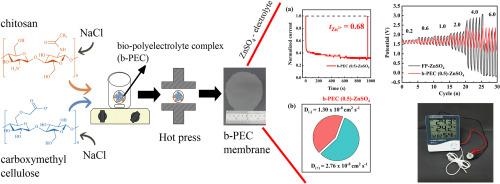
Zinc-ion batteries (ZIBs) are gaining recognition as eco-friendly and easy-to-process energy storage solutions. Separators, which are crucial for performance, have received less attention. Separators play a vital role in facilitating efficient zinc-ion transfer and ensuring uniform ion distribution to minimize dendrite formation. Polyelectrolyte complexes (PECs), with their charged functional groups, show promise as separators. This study developed bio-polyelectrolyte complex (b-PEC) membranes using carboxymethylcellulose (CMC) and chitosan through the hot-press method. Adding NaCl during preparation activated functional groups and enhancing structural integrity. Without chemical crosslinking, the b-PEC membranes retained the original properties of the constituent polyelectrolytes. Chitosan functional groups reduced Zn2+ diffusion and immobilized SO42−, while CMC facilitated Zn2+ transport, promoting uniform ion distribution and reducing dendrite formation. The optimized b-PEC (0.5)-ZnSO4 membrane achieved an ionic conductivity of 9.29 × 10⁻³ S cm−1 and a zinc-ion transference number of 0.68, highlighting its potential as a ZIB separator.
期刊介绍:
Polymer is an interdisciplinary journal dedicated to publishing innovative and significant advances in Polymer Physics, Chemistry and Technology. We welcome submissions on polymer hybrids, nanocomposites, characterisation and self-assembly. Polymer also publishes work on the technological application of polymers in energy and optoelectronics.
The main scope is covered but not limited to the following core areas:
Polymer Materials
Nanocomposites and hybrid nanomaterials
Polymer blends, films, fibres, networks and porous materials
Physical Characterization
Characterisation, modelling and simulation* of molecular and materials properties in bulk, solution, and thin films
Polymer Engineering
Advanced multiscale processing methods
Polymer Synthesis, Modification and Self-assembly
Including designer polymer architectures, mechanisms and kinetics, and supramolecular polymerization
Technological Applications
Polymers for energy generation and storage
Polymer membranes for separation technology
Polymers for opto- and microelectronics.





 京公网安备 11010802042870号
京ICP备2023020795号-1
京公网安备 11010802042870号
京ICP备2023020795号-1

 分享
分享
 求助内容:
求助内容: 应助结果提醒方式:
 扫码关注我们
