{"title":"装有t形多孔区的微型管式燃烧室火焰稳定性优化设计","authors":"Guangyao Yang, Aiwu Fan","doi":"10.1016/j.fuel.2025.134610","DOIUrl":null,"url":null,"abstract":"<div><div>There exist urgent demands for miniature combustion-based power devices due to their high energy densities. We recently integrated a T-shaped porous zone into a meso-scale combustor with an inner radius (<em>R</em>) of 3 mm. Numerical simulation demonstrated that this new configuration harvested a maximum flame blow-off limit of 1.05 m/s for stoichiometric C<sub>4</sub>H<sub>10</sub>/air mixtures, which is almost twice of the counterpart (0.55 m/s) of original combustor with cylindrical porous media. In the present study, further optimization of this combustor was performed by varying the protruding part radius (<em>r</em>) of the T-shaped porous zone. The findings indicate that as <em>r</em> rises from 0.5 to 2.0 mm, flame blow-off limit keeps increasing to 1.65 m/s, whereas flame cannot be stabilized in the combustor when <em>r</em> = 2.5 mm. Analysis demonstrates that when <em>r</em> = 2.5 mm, flow resistance in the annular space increases drastically and the portion of gaseous mixture that passes through the protruding part increased sharply. Consequently, the low-velocity zone cannot be formed any longer and flame cannot be anchored. Moreover, the heat recirculation efficiency still increases with an increasing <em>r</em>. Therefore, the largest blow-off limit is achieved at <em>r</em> = 2.0 mm.</div></div>","PeriodicalId":325,"journal":{"name":"Fuel","volume":"391 ","pages":"Article 134610"},"PeriodicalIF":7.8000,"publicationDate":"2025-07-01","publicationTypes":"Journal Article","fieldsOfStudy":null,"isOpenAccess":false,"openAccessPdf":"","citationCount":"0","resultStr":"{\"title\":\"Optimization of a miniature tubular combustor filled with a T-shaped porous zone for flame stability enhancement\",\"authors\":\"Guangyao Yang, Aiwu Fan\",\"doi\":\"10.1016/j.fuel.2025.134610\",\"DOIUrl\":null,\"url\":null,\"abstract\":\"<div><div>There exist urgent demands for miniature combustion-based power devices due to their high energy densities. We recently integrated a T-shaped porous zone into a meso-scale combustor with an inner radius (<em>R</em>) of 3 mm. Numerical simulation demonstrated that this new configuration harvested a maximum flame blow-off limit of 1.05 m/s for stoichiometric C<sub>4</sub>H<sub>10</sub>/air mixtures, which is almost twice of the counterpart (0.55 m/s) of original combustor with cylindrical porous media. In the present study, further optimization of this combustor was performed by varying the protruding part radius (<em>r</em>) of the T-shaped porous zone. The findings indicate that as <em>r</em> rises from 0.5 to 2.0 mm, flame blow-off limit keeps increasing to 1.65 m/s, whereas flame cannot be stabilized in the combustor when <em>r</em> = 2.5 mm. Analysis demonstrates that when <em>r</em> = 2.5 mm, flow resistance in the annular space increases drastically and the portion of gaseous mixture that passes through the protruding part increased sharply. Consequently, the low-velocity zone cannot be formed any longer and flame cannot be anchored. Moreover, the heat recirculation efficiency still increases with an increasing <em>r</em>. Therefore, the largest blow-off limit is achieved at <em>r</em> = 2.0 mm.</div></div>\",\"PeriodicalId\":325,\"journal\":{\"name\":\"Fuel\",\"volume\":\"391 \",\"pages\":\"Article 134610\"},\"PeriodicalIF\":7.8000,\"publicationDate\":\"2025-07-01\",\"publicationTypes\":\"Journal Article\",\"fieldsOfStudy\":null,\"isOpenAccess\":false,\"openAccessPdf\":\"\",\"citationCount\":\"0\",\"resultStr\":null,\"platform\":\"Semanticscholar\",\"paperid\":null,\"PeriodicalName\":\"Fuel\",\"FirstCategoryId\":\"5\",\"ListUrlMain\":\"https://www.sciencedirect.com/science/article/pii/S0016236125003345\",\"RegionNum\":1,\"RegionCategory\":\"工程技术\",\"ArticlePicture\":[],\"TitleCN\":null,\"AbstractTextCN\":null,\"PMCID\":null,\"EPubDate\":\"2025/2/20 0:00:00\",\"PubModel\":\"Epub\",\"JCR\":\"Q2\",\"JCRName\":\"ENERGY & FUELS\",\"Score\":null,\"Total\":0}","platform":"Semanticscholar","paperid":null,"PeriodicalName":"Fuel","FirstCategoryId":"5","ListUrlMain":"https://www.sciencedirect.com/science/article/pii/S0016236125003345","RegionNum":1,"RegionCategory":"工程技术","ArticlePicture":[],"TitleCN":null,"AbstractTextCN":null,"PMCID":null,"EPubDate":"2025/2/20 0:00:00","PubModel":"Epub","JCR":"Q2","JCRName":"ENERGY & FUELS","Score":null,"Total":0}
Optimization of a miniature tubular combustor filled with a T-shaped porous zone for flame stability enhancement
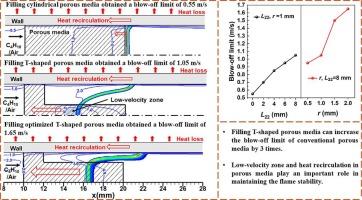
There exist urgent demands for miniature combustion-based power devices due to their high energy densities. We recently integrated a T-shaped porous zone into a meso-scale combustor with an inner radius (R) of 3 mm. Numerical simulation demonstrated that this new configuration harvested a maximum flame blow-off limit of 1.05 m/s for stoichiometric C4H10/air mixtures, which is almost twice of the counterpart (0.55 m/s) of original combustor with cylindrical porous media. In the present study, further optimization of this combustor was performed by varying the protruding part radius (r) of the T-shaped porous zone. The findings indicate that as r rises from 0.5 to 2.0 mm, flame blow-off limit keeps increasing to 1.65 m/s, whereas flame cannot be stabilized in the combustor when r = 2.5 mm. Analysis demonstrates that when r = 2.5 mm, flow resistance in the annular space increases drastically and the portion of gaseous mixture that passes through the protruding part increased sharply. Consequently, the low-velocity zone cannot be formed any longer and flame cannot be anchored. Moreover, the heat recirculation efficiency still increases with an increasing r. Therefore, the largest blow-off limit is achieved at r = 2.0 mm.
期刊介绍:
The exploration of energy sources remains a critical matter of study. For the past nine decades, fuel has consistently held the forefront in primary research efforts within the field of energy science. This area of investigation encompasses a wide range of subjects, with a particular emphasis on emerging concerns like environmental factors and pollution.




 京公网安备 11010802042870号
京ICP备2023020795号-1
京公网安备 11010802042870号
京ICP备2023020795号-1

 分享
分享
 求助内容:
求助内容: 应助结果提醒方式:
 扫码关注我们
