Xiangwen Wu , Xiaopeng Zhang , Dongwei Zhang , Imran Murtaza , Dongwen Zou , Meimei Zhu , Yanan Zhu , Yaowu He , Hong Meng
{"title":"智能变色窗:高对比度电致变色三芳胺聚酰亚胺器件","authors":"Xiangwen Wu , Xiaopeng Zhang , Dongwei Zhang , Imran Murtaza , Dongwen Zou , Meimei Zhu , Yanan Zhu , Yaowu He , Hong Meng","doi":"10.1016/j.susmat.2025.e01303","DOIUrl":null,"url":null,"abstract":"<div><div>Electrochromic devices (ECDs) spanning from colorless to black have garnered increasing attention in both fundamental scientific research and potential applications in recent years. To address the need for a multi-response optoelectronic material capable of efficient black conversion (black color/emission dual switching), we developed a novel triarylamine-based polyimide polymer, named CpO-PI, employing an innovative design strategy. This polymer incorporates two triphenylenediamine monomers linked to CpODA, resulting in exceptional properties. CpO-PI exhibits full wavelength absorption across the visible light spectrum in both natural and oxidized states, with boasting commendable solubility, thermal stability, and photoluminescence (PL) activity. Leveraging tungsten trioxide as the counter electrode in the optimized ECD, it achieved remarkable optical contrast (up to 99 %), distinct pure EC characteristics, robust memory performance, and high coloring efficiency (CE = 695 cm<sup>2</sup>·C<sup>−1</sup>) in the energized oxidation state. Our study not only presents a pioneering approach towards developing efficient EC materials but also underscores the potential of utilizing triphenylamine chromophore-based polyimides in the next generation of electrochromic fluorescent devices. These findings are poised to invigorate further exploration in the field of EC technology.</div></div>","PeriodicalId":22097,"journal":{"name":"Sustainable Materials and Technologies","volume":"43 ","pages":"Article e01303"},"PeriodicalIF":9.7000,"publicationDate":"2025-04-01","publicationTypes":"Journal Article","fieldsOfStudy":null,"isOpenAccess":false,"openAccessPdf":"","citationCount":"0","resultStr":"{\"title\":\"Intelligent color-varying windows: High contrast electrochromic triarylamine-based polyimide devices\",\"authors\":\"Xiangwen Wu , Xiaopeng Zhang , Dongwei Zhang , Imran Murtaza , Dongwen Zou , Meimei Zhu , Yanan Zhu , Yaowu He , Hong Meng\",\"doi\":\"10.1016/j.susmat.2025.e01303\",\"DOIUrl\":null,\"url\":null,\"abstract\":\"<div><div>Electrochromic devices (ECDs) spanning from colorless to black have garnered increasing attention in both fundamental scientific research and potential applications in recent years. To address the need for a multi-response optoelectronic material capable of efficient black conversion (black color/emission dual switching), we developed a novel triarylamine-based polyimide polymer, named CpO-PI, employing an innovative design strategy. This polymer incorporates two triphenylenediamine monomers linked to CpODA, resulting in exceptional properties. CpO-PI exhibits full wavelength absorption across the visible light spectrum in both natural and oxidized states, with boasting commendable solubility, thermal stability, and photoluminescence (PL) activity. Leveraging tungsten trioxide as the counter electrode in the optimized ECD, it achieved remarkable optical contrast (up to 99 %), distinct pure EC characteristics, robust memory performance, and high coloring efficiency (CE = 695 cm<sup>2</sup>·C<sup>−1</sup>) in the energized oxidation state. Our study not only presents a pioneering approach towards developing efficient EC materials but also underscores the potential of utilizing triphenylamine chromophore-based polyimides in the next generation of electrochromic fluorescent devices. These findings are poised to invigorate further exploration in the field of EC technology.</div></div>\",\"PeriodicalId\":22097,\"journal\":{\"name\":\"Sustainable Materials and Technologies\",\"volume\":\"43 \",\"pages\":\"Article e01303\"},\"PeriodicalIF\":9.7000,\"publicationDate\":\"2025-04-01\",\"publicationTypes\":\"Journal Article\",\"fieldsOfStudy\":null,\"isOpenAccess\":false,\"openAccessPdf\":\"\",\"citationCount\":\"0\",\"resultStr\":null,\"platform\":\"Semanticscholar\",\"paperid\":null,\"PeriodicalName\":\"Sustainable Materials and Technologies\",\"FirstCategoryId\":\"5\",\"ListUrlMain\":\"https://www.sciencedirect.com/science/article/pii/S2214993725000715\",\"RegionNum\":2,\"RegionCategory\":\"工程技术\",\"ArticlePicture\":[],\"TitleCN\":null,\"AbstractTextCN\":null,\"PMCID\":null,\"EPubDate\":\"2025/2/18 0:00:00\",\"PubModel\":\"Epub\",\"JCR\":\"Q1\",\"JCRName\":\"ENERGY & FUELS\",\"Score\":null,\"Total\":0}","platform":"Semanticscholar","paperid":null,"PeriodicalName":"Sustainable Materials and Technologies","FirstCategoryId":"5","ListUrlMain":"https://www.sciencedirect.com/science/article/pii/S2214993725000715","RegionNum":2,"RegionCategory":"工程技术","ArticlePicture":[],"TitleCN":null,"AbstractTextCN":null,"PMCID":null,"EPubDate":"2025/2/18 0:00:00","PubModel":"Epub","JCR":"Q1","JCRName":"ENERGY & FUELS","Score":null,"Total":0}
Intelligent color-varying windows: High contrast electrochromic triarylamine-based polyimide devices
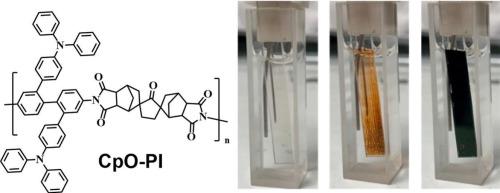
Electrochromic devices (ECDs) spanning from colorless to black have garnered increasing attention in both fundamental scientific research and potential applications in recent years. To address the need for a multi-response optoelectronic material capable of efficient black conversion (black color/emission dual switching), we developed a novel triarylamine-based polyimide polymer, named CpO-PI, employing an innovative design strategy. This polymer incorporates two triphenylenediamine monomers linked to CpODA, resulting in exceptional properties. CpO-PI exhibits full wavelength absorption across the visible light spectrum in both natural and oxidized states, with boasting commendable solubility, thermal stability, and photoluminescence (PL) activity. Leveraging tungsten trioxide as the counter electrode in the optimized ECD, it achieved remarkable optical contrast (up to 99 %), distinct pure EC characteristics, robust memory performance, and high coloring efficiency (CE = 695 cm2·C−1) in the energized oxidation state. Our study not only presents a pioneering approach towards developing efficient EC materials but also underscores the potential of utilizing triphenylamine chromophore-based polyimides in the next generation of electrochromic fluorescent devices. These findings are poised to invigorate further exploration in the field of EC technology.
期刊介绍:
Sustainable Materials and Technologies (SM&T), an international, cross-disciplinary, fully open access journal published by Elsevier, focuses on original full-length research articles and reviews. It covers applied or fundamental science of nano-, micro-, meso-, and macro-scale aspects of materials and technologies for sustainable development. SM&T gives special attention to contributions that bridge the knowledge gap between materials and system designs.




 京公网安备 11010802042870号
京ICP备2023020795号-1
京公网安备 11010802042870号
京ICP备2023020795号-1

 分享
分享
 求助内容:
求助内容: 应助结果提醒方式:
 扫码关注我们
