{"title":"基于时间分辨冷冻电镜的动态药物发现","authors":"Youdong Mao","doi":"10.1016/j.sbi.2025.103001","DOIUrl":null,"url":null,"abstract":"<div><div>Rational structure-based drug design (SBDD) depends on high-resolution structural models of target macromolecules or their complexes. However, the lack of atomic-level functional molecular dynamics hinders the applications of SBDD and limits their effective translation into clinically successful therapeutics. Time-resolved cryo-electron microscopy (cryo-EM) has emerged as a powerful tool in structural biology, capable of capturing high-resolution snapshots of biomolecular machines in action. Unlike molecular dynamics (MD) simulations, time-resolved cryo-EM can visualize rare intermediate states across a broader range of timescales, providing invaluable insights into drug-binding kinetics, dynamic protein-ligand interactions, and allosteric regulation. Integration of time-resolved cryo-EM with machine learning (ML) and artificial intelligence (AI) expands SBDD into a dynamics-based approach, allowing for more accurate pharmacological modeling of challenging drug targets that are beyond the reach of MD simulations. Time-resolved cryo-EM can help researchers to identify novel druggable conformations, overcome drug resistance, and reduce the time and cost of clinical translations. Despite current challenges, the future development of time-resolved cryo-EM with AI and <em>in situ</em> imaging strategy, such as cryo-electron tomography, holds the potential to revolutionize drug discovery by revealing <em>in vivo</em> molecular dynamics of drug actions at an unprecedented spatiotemporal scale.</div></div>","PeriodicalId":10887,"journal":{"name":"Current opinion in structural biology","volume":"91 ","pages":"Article 103001"},"PeriodicalIF":6.1000,"publicationDate":"2025-04-01","publicationTypes":"Journal Article","fieldsOfStudy":null,"isOpenAccess":false,"openAccessPdf":"","citationCount":"0","resultStr":"{\"title\":\"Dynamics-based drug discovery by time-resolved cryo-EM\",\"authors\":\"Youdong Mao\",\"doi\":\"10.1016/j.sbi.2025.103001\",\"DOIUrl\":null,\"url\":null,\"abstract\":\"<div><div>Rational structure-based drug design (SBDD) depends on high-resolution structural models of target macromolecules or their complexes. However, the lack of atomic-level functional molecular dynamics hinders the applications of SBDD and limits their effective translation into clinically successful therapeutics. Time-resolved cryo-electron microscopy (cryo-EM) has emerged as a powerful tool in structural biology, capable of capturing high-resolution snapshots of biomolecular machines in action. Unlike molecular dynamics (MD) simulations, time-resolved cryo-EM can visualize rare intermediate states across a broader range of timescales, providing invaluable insights into drug-binding kinetics, dynamic protein-ligand interactions, and allosteric regulation. Integration of time-resolved cryo-EM with machine learning (ML) and artificial intelligence (AI) expands SBDD into a dynamics-based approach, allowing for more accurate pharmacological modeling of challenging drug targets that are beyond the reach of MD simulations. Time-resolved cryo-EM can help researchers to identify novel druggable conformations, overcome drug resistance, and reduce the time and cost of clinical translations. Despite current challenges, the future development of time-resolved cryo-EM with AI and <em>in situ</em> imaging strategy, such as cryo-electron tomography, holds the potential to revolutionize drug discovery by revealing <em>in vivo</em> molecular dynamics of drug actions at an unprecedented spatiotemporal scale.</div></div>\",\"PeriodicalId\":10887,\"journal\":{\"name\":\"Current opinion in structural biology\",\"volume\":\"91 \",\"pages\":\"Article 103001\"},\"PeriodicalIF\":6.1000,\"publicationDate\":\"2025-04-01\",\"publicationTypes\":\"Journal Article\",\"fieldsOfStudy\":null,\"isOpenAccess\":false,\"openAccessPdf\":\"\",\"citationCount\":\"0\",\"resultStr\":null,\"platform\":\"Semanticscholar\",\"paperid\":null,\"PeriodicalName\":\"Current opinion in structural biology\",\"FirstCategoryId\":\"99\",\"ListUrlMain\":\"https://www.sciencedirect.com/science/article/pii/S0959440X25000193\",\"RegionNum\":2,\"RegionCategory\":\"生物学\",\"ArticlePicture\":[],\"TitleCN\":null,\"AbstractTextCN\":null,\"PMCID\":null,\"EPubDate\":\"2025/2/21 0:00:00\",\"PubModel\":\"Epub\",\"JCR\":\"Q1\",\"JCRName\":\"BIOCHEMISTRY & MOLECULAR BIOLOGY\",\"Score\":null,\"Total\":0}","platform":"Semanticscholar","paperid":null,"PeriodicalName":"Current opinion in structural biology","FirstCategoryId":"99","ListUrlMain":"https://www.sciencedirect.com/science/article/pii/S0959440X25000193","RegionNum":2,"RegionCategory":"生物学","ArticlePicture":[],"TitleCN":null,"AbstractTextCN":null,"PMCID":null,"EPubDate":"2025/2/21 0:00:00","PubModel":"Epub","JCR":"Q1","JCRName":"BIOCHEMISTRY & MOLECULAR BIOLOGY","Score":null,"Total":0}
Dynamics-based drug discovery by time-resolved cryo-EM
Rational structure-based drug design (SBDD) depends on high-resolution structural models of target macromolecules or their complexes. However, the lack of atomic-level functional molecular dynamics hinders the applications of SBDD and limits their effective translation into clinically successful therapeutics. Time-resolved cryo-electron microscopy (cryo-EM) has emerged as a powerful tool in structural biology, capable of capturing high-resolution snapshots of biomolecular machines in action. Unlike molecular dynamics (MD) simulations, time-resolved cryo-EM can visualize rare intermediate states across a broader range of timescales, providing invaluable insights into drug-binding kinetics, dynamic protein-ligand interactions, and allosteric regulation. Integration of time-resolved cryo-EM with machine learning (ML) and artificial intelligence (AI) expands SBDD into a dynamics-based approach, allowing for more accurate pharmacological modeling of challenging drug targets that are beyond the reach of MD simulations. Time-resolved cryo-EM can help researchers to identify novel druggable conformations, overcome drug resistance, and reduce the time and cost of clinical translations. Despite current challenges, the future development of time-resolved cryo-EM with AI and in situ imaging strategy, such as cryo-electron tomography, holds the potential to revolutionize drug discovery by revealing in vivo molecular dynamics of drug actions at an unprecedented spatiotemporal scale.
期刊介绍:
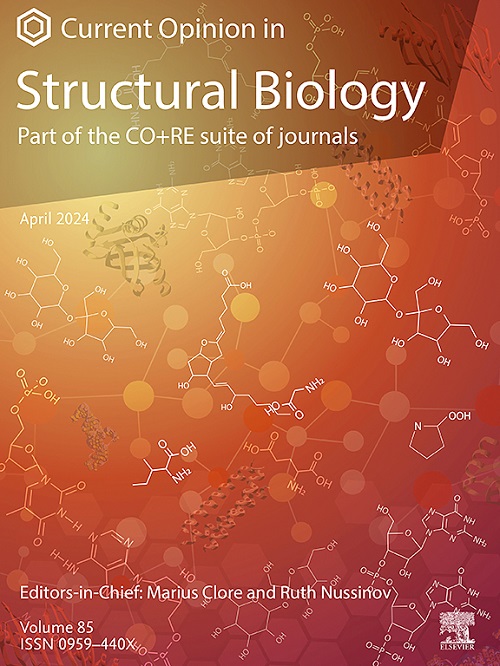
Current Opinion in Structural Biology (COSB) aims to stimulate scientifically grounded, interdisciplinary, multi-scale debate and exchange of ideas. It contains polished, concise and timely reviews and opinions, with particular emphasis on those articles published in the past two years. In addition to describing recent trends, the authors are encouraged to give their subjective opinion of the topics discussed.
In COSB, we help the reader by providing in a systematic manner:
1. The views of experts on current advances in their field in a clear and readable form.
2. Evaluations of the most interesting papers, annotated by experts, from the great wealth of original publications.
[...]
The subject of Structural Biology is divided into twelve themed sections, each of which is reviewed once a year. Each issue contains two sections, and the amount of space devoted to each section is related to its importance.
-Folding and Binding-
Nucleic acids and their protein complexes-
Macromolecular Machines-
Theory and Simulation-
Sequences and Topology-
New constructs and expression of proteins-
Membranes-
Engineering and Design-
Carbohydrate-protein interactions and glycosylation-
Biophysical and molecular biological methods-
Multi-protein assemblies in signalling-
Catalysis and Regulation




 京公网安备 11010802042870号
京ICP备2023020795号-1
京公网安备 11010802042870号
京ICP备2023020795号-1

 分享
分享
 求助内容:
求助内容: 应助结果提醒方式:
 扫码关注我们
