{"title":"自供电CsPbCl3紫外探测器的V2CTx MXene调制增强钙钛矿薄膜质量和空穴传输。","authors":"Baofen Cen, Wenpeng Han, Ziling Zhang, Qun Deng, Mingfen Mao, Yabing Wang, Tengfei Wang, Kaixiang Liu, Qinghong Li, Jing Zhang, Shengyun Luo, Guangcan Luo, Hong Lin","doi":"10.1021/acsami.4c19955","DOIUrl":null,"url":null,"abstract":"<p><p>Enhancement of the perovskite film quality and charge transfer capability is crucial for enhancing device performance. The all-inorganic CsPbCl<sub>3</sub> perovskite, which shows great potential as an absorber layer in ultraviolet photodetectors (UV PDs), has been hindered by poor material stability and high interface states, limiting its widespread application. In this work, the quality of the CsPbCl<sub>3</sub> films and the perovskite/Au electrode interface were synergistically modulated using V<sub>2</sub>CT<sub><i>x</i></sub> MXene. After additive (CsPbCl<sub>3</sub>@V<sub>2</sub>CT<sub><i>x</i></sub>) and interface (CsPbCl<sub>3</sub>/V<sub>2</sub>CT<sub><i>x</i></sub>) engineering, the optimal properties of CsPbCl<sub>3</sub> films and the van der Waals (vdW) bonding of V<sub>2</sub>CT<sub><i>x</i></sub> strengthen the charge extraction and hole transport while reducing nonradiative charge recombination caused by internal defects and interface states. Ultimately, the UV PD featuring the FTO/SnO<sub>2</sub>/CsPbCl<sub>3</sub>@V<sub>2</sub>CT<sub><i>x</i></sub>/V<sub>2</sub>CT<sub><i>x</i></sub>/Au structure manifests outstanding performance under the self-powered mode, attaining an extremely high responsivity of up to 1.01 × 10<sup>3</sup> mA/W and a considerable specific detectivity of 5.46 × 10<sup>11</sup> cm Hz<sup>1/2</sup>/W (365 nm, 0.16 mW/cm<sup>2</sup>) coupled with a swift rise/decay time of 1.54/1.50 μs. Even after 30 days under an air atmosphere, the responsivity of the device remains at 8.46 × 10<sup>2</sup> mA/W, indicating extraordinary stability. This approach offers a novel way to enhance the performance of UV PD based on the CsPbCl<sub>3</sub> perovskite through the dual strategy of V<sub>2</sub>CT<sub><i>x</i></sub> MXene modulation.</p>","PeriodicalId":5,"journal":{"name":"ACS Applied Materials & Interfaces","volume":" ","pages":"14188-14200"},"PeriodicalIF":8.2000,"publicationDate":"2025-03-05","publicationTypes":"Journal Article","fieldsOfStudy":null,"isOpenAccess":false,"openAccessPdf":"","citationCount":"0","resultStr":"{\"title\":\"Enhanced Perovskite Film Quality and Hole Transport through V<sub>2</sub>CT<sub><i>x</i></sub> MXene Modulation for Self-Powered CsPbCl<sub>3</sub> UV Photodetectors.\",\"authors\":\"Baofen Cen, Wenpeng Han, Ziling Zhang, Qun Deng, Mingfen Mao, Yabing Wang, Tengfei Wang, Kaixiang Liu, Qinghong Li, Jing Zhang, Shengyun Luo, Guangcan Luo, Hong Lin\",\"doi\":\"10.1021/acsami.4c19955\",\"DOIUrl\":null,\"url\":null,\"abstract\":\"<p><p>Enhancement of the perovskite film quality and charge transfer capability is crucial for enhancing device performance. The all-inorganic CsPbCl<sub>3</sub> perovskite, which shows great potential as an absorber layer in ultraviolet photodetectors (UV PDs), has been hindered by poor material stability and high interface states, limiting its widespread application. In this work, the quality of the CsPbCl<sub>3</sub> films and the perovskite/Au electrode interface were synergistically modulated using V<sub>2</sub>CT<sub><i>x</i></sub> MXene. After additive (CsPbCl<sub>3</sub>@V<sub>2</sub>CT<sub><i>x</i></sub>) and interface (CsPbCl<sub>3</sub>/V<sub>2</sub>CT<sub><i>x</i></sub>) engineering, the optimal properties of CsPbCl<sub>3</sub> films and the van der Waals (vdW) bonding of V<sub>2</sub>CT<sub><i>x</i></sub> strengthen the charge extraction and hole transport while reducing nonradiative charge recombination caused by internal defects and interface states. Ultimately, the UV PD featuring the FTO/SnO<sub>2</sub>/CsPbCl<sub>3</sub>@V<sub>2</sub>CT<sub><i>x</i></sub>/V<sub>2</sub>CT<sub><i>x</i></sub>/Au structure manifests outstanding performance under the self-powered mode, attaining an extremely high responsivity of up to 1.01 × 10<sup>3</sup> mA/W and a considerable specific detectivity of 5.46 × 10<sup>11</sup> cm Hz<sup>1/2</sup>/W (365 nm, 0.16 mW/cm<sup>2</sup>) coupled with a swift rise/decay time of 1.54/1.50 μs. Even after 30 days under an air atmosphere, the responsivity of the device remains at 8.46 × 10<sup>2</sup> mA/W, indicating extraordinary stability. This approach offers a novel way to enhance the performance of UV PD based on the CsPbCl<sub>3</sub> perovskite through the dual strategy of V<sub>2</sub>CT<sub><i>x</i></sub> MXene modulation.</p>\",\"PeriodicalId\":5,\"journal\":{\"name\":\"ACS Applied Materials & Interfaces\",\"volume\":\" \",\"pages\":\"14188-14200\"},\"PeriodicalIF\":8.2000,\"publicationDate\":\"2025-03-05\",\"publicationTypes\":\"Journal Article\",\"fieldsOfStudy\":null,\"isOpenAccess\":false,\"openAccessPdf\":\"\",\"citationCount\":\"0\",\"resultStr\":null,\"platform\":\"Semanticscholar\",\"paperid\":null,\"PeriodicalName\":\"ACS Applied Materials & Interfaces\",\"FirstCategoryId\":\"88\",\"ListUrlMain\":\"https://doi.org/10.1021/acsami.4c19955\",\"RegionNum\":2,\"RegionCategory\":\"材料科学\",\"ArticlePicture\":[],\"TitleCN\":null,\"AbstractTextCN\":null,\"PMCID\":null,\"EPubDate\":\"2025/2/20 0:00:00\",\"PubModel\":\"Epub\",\"JCR\":\"Q1\",\"JCRName\":\"MATERIALS SCIENCE, MULTIDISCIPLINARY\",\"Score\":null,\"Total\":0}","platform":"Semanticscholar","paperid":null,"PeriodicalName":"ACS Applied Materials & Interfaces","FirstCategoryId":"88","ListUrlMain":"https://doi.org/10.1021/acsami.4c19955","RegionNum":2,"RegionCategory":"材料科学","ArticlePicture":[],"TitleCN":null,"AbstractTextCN":null,"PMCID":null,"EPubDate":"2025/2/20 0:00:00","PubModel":"Epub","JCR":"Q1","JCRName":"MATERIALS SCIENCE, MULTIDISCIPLINARY","Score":null,"Total":0}
Enhanced Perovskite Film Quality and Hole Transport through V2CTx MXene Modulation for Self-Powered CsPbCl3 UV Photodetectors.
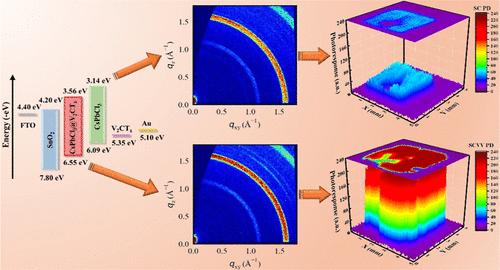
Enhancement of the perovskite film quality and charge transfer capability is crucial for enhancing device performance. The all-inorganic CsPbCl3 perovskite, which shows great potential as an absorber layer in ultraviolet photodetectors (UV PDs), has been hindered by poor material stability and high interface states, limiting its widespread application. In this work, the quality of the CsPbCl3 films and the perovskite/Au electrode interface were synergistically modulated using V2CTx MXene. After additive (CsPbCl3@V2CTx) and interface (CsPbCl3/V2CTx) engineering, the optimal properties of CsPbCl3 films and the van der Waals (vdW) bonding of V2CTx strengthen the charge extraction and hole transport while reducing nonradiative charge recombination caused by internal defects and interface states. Ultimately, the UV PD featuring the FTO/SnO2/CsPbCl3@V2CTx/V2CTx/Au structure manifests outstanding performance under the self-powered mode, attaining an extremely high responsivity of up to 1.01 × 10³ mA/W and a considerable specific detectivity of 5.46 × 1011 cm Hz1/2/W (365 nm, 0.16 mW/cm2) coupled with a swift rise/decay time of 1.54/1.50 μs. Even after 30 days under an air atmosphere, the responsivity of the device remains at 8.46 × 10² mA/W, indicating extraordinary stability. This approach offers a novel way to enhance the performance of UV PD based on the CsPbCl3 perovskite through the dual strategy of V2CTx MXene modulation.
期刊介绍:
ACS Applied Materials & Interfaces is a leading interdisciplinary journal that brings together chemists, engineers, physicists, and biologists to explore the development and utilization of newly-discovered materials and interfacial processes for specific applications. Our journal has experienced remarkable growth since its establishment in 2009, both in terms of the number of articles published and the impact of the research showcased. We are proud to foster a truly global community, with the majority of published articles originating from outside the United States, reflecting the rapid growth of applied research worldwide.




 京公网安备 11010802042870号
京ICP备2023020795号-1
京公网安备 11010802042870号
京ICP备2023020795号-1

 分享
分享
 求助内容:
求助内容: 应助结果提醒方式:
 扫码关注我们
