{"title":"黄瓜幼苗耐盐性:开心果木醋对提高生化参数和幼苗活力的作用。","authors":"Sediqeh Afsharipour, Azam Seyedi, Abdolmajid Mirzaalian Dastjerdi","doi":"10.1186/s12870-025-06237-y","DOIUrl":null,"url":null,"abstract":"<p><strong>Background: </strong>Soil salinity is a major environmental concern that affects the production of salt-sensitive crops such as cucumbers by limiting their growth and development. Wood vinegar is used as a biostimulant in agriculture to enhance crop productivity and improve the plant's defense system against pathogens, while studies show that it can also protect against oxidative stresses. A factorial experiment was arranged based on a randomized completely design with three replicates and carried out to mitigate the negative effects of sodium chloride (NaCl) on cucumber seedlings through pistachio wood vinegar (PWV) foliar spraying. The seedling was sprayed at the three-leaf stage of growth by PWV (0, 1500, and 3000 ppm) and salinity stress (0, and 150 mM NaCl) was imposed at the five-leaf stage gradually (from 25 to 150 mM NaCl) in the modified Hoagland's solution.</p><p><strong>Results: </strong>The intense salinity stress reduced the fresh and dry mass of root and shoot by 25, 5, 34, and 13%, and decreased chlorophyll a, b, total, and carotenoids by 14, 45, 28, and 44%, respectively compared to the control. Also, in the treated plants with PWV decreased levels of total protein (14%). While PWV treatment decreased the negative effects of the intense salinity stress and enhanced the fresh mass root (41%), dry mass shoot (33%), shoot length (23%), leaf area (34%), leaf number (63%), Chl a (14%), Chl b (11%) and carotenoids (56%). Under the intense salinity stress, the foliar spraying of PWV, 3000 ppm, decreased the reactive oxygen species (ROS) and malondialdehyde (MDA) by 7 and 10%, respectively compared to the control.</p><p><strong>Conclusions: </strong>This study shows that the use of PWV (1500 ppm) via its nutrient and bioactive components is effective in improving the negative effects of the salinity (150 mM NaCl) in cucumber seedlings.</p>","PeriodicalId":9198,"journal":{"name":"BMC Plant Biology","volume":"25 1","pages":"224"},"PeriodicalIF":5.6000,"publicationDate":"2025-02-19","publicationTypes":"Journal Article","fieldsOfStudy":null,"isOpenAccess":false,"openAccessPdf":"https://www.ncbi.nlm.nih.gov/pmc/articles/PMC11837706/pdf/","citationCount":"0","resultStr":"{\"title\":\"Salinity tolerance in Cucumis sativus seedlings: the role of pistachio wood vinegar on the improvement of biochemical parameters and seedlings vigor.\",\"authors\":\"Sediqeh Afsharipour, Azam Seyedi, Abdolmajid Mirzaalian Dastjerdi\",\"doi\":\"10.1186/s12870-025-06237-y\",\"DOIUrl\":null,\"url\":null,\"abstract\":\"<p><strong>Background: </strong>Soil salinity is a major environmental concern that affects the production of salt-sensitive crops such as cucumbers by limiting their growth and development. Wood vinegar is used as a biostimulant in agriculture to enhance crop productivity and improve the plant's defense system against pathogens, while studies show that it can also protect against oxidative stresses. A factorial experiment was arranged based on a randomized completely design with three replicates and carried out to mitigate the negative effects of sodium chloride (NaCl) on cucumber seedlings through pistachio wood vinegar (PWV) foliar spraying. The seedling was sprayed at the three-leaf stage of growth by PWV (0, 1500, and 3000 ppm) and salinity stress (0, and 150 mM NaCl) was imposed at the five-leaf stage gradually (from 25 to 150 mM NaCl) in the modified Hoagland's solution.</p><p><strong>Results: </strong>The intense salinity stress reduced the fresh and dry mass of root and shoot by 25, 5, 34, and 13%, and decreased chlorophyll a, b, total, and carotenoids by 14, 45, 28, and 44%, respectively compared to the control. Also, in the treated plants with PWV decreased levels of total protein (14%). While PWV treatment decreased the negative effects of the intense salinity stress and enhanced the fresh mass root (41%), dry mass shoot (33%), shoot length (23%), leaf area (34%), leaf number (63%), Chl a (14%), Chl b (11%) and carotenoids (56%). Under the intense salinity stress, the foliar spraying of PWV, 3000 ppm, decreased the reactive oxygen species (ROS) and malondialdehyde (MDA) by 7 and 10%, respectively compared to the control.</p><p><strong>Conclusions: </strong>This study shows that the use of PWV (1500 ppm) via its nutrient and bioactive components is effective in improving the negative effects of the salinity (150 mM NaCl) in cucumber seedlings.</p>\",\"PeriodicalId\":9198,\"journal\":{\"name\":\"BMC Plant Biology\",\"volume\":\"25 1\",\"pages\":\"224\"},\"PeriodicalIF\":5.6000,\"publicationDate\":\"2025-02-19\",\"publicationTypes\":\"Journal Article\",\"fieldsOfStudy\":null,\"isOpenAccess\":false,\"openAccessPdf\":\"https://www.ncbi.nlm.nih.gov/pmc/articles/PMC11837706/pdf/\",\"citationCount\":\"0\",\"resultStr\":null,\"platform\":\"Semanticscholar\",\"paperid\":null,\"PeriodicalName\":\"BMC Plant Biology\",\"FirstCategoryId\":\"99\",\"ListUrlMain\":\"https://doi.org/10.1186/s12870-025-06237-y\",\"RegionNum\":2,\"RegionCategory\":\"生物学\",\"ArticlePicture\":[],\"TitleCN\":null,\"AbstractTextCN\":null,\"PMCID\":null,\"EPubDate\":\"\",\"PubModel\":\"\",\"JCR\":\"Q1\",\"JCRName\":\"PLANT SCIENCES\",\"Score\":null,\"Total\":0}","platform":"Semanticscholar","paperid":null,"PeriodicalName":"BMC Plant Biology","FirstCategoryId":"99","ListUrlMain":"https://doi.org/10.1186/s12870-025-06237-y","RegionNum":2,"RegionCategory":"生物学","ArticlePicture":[],"TitleCN":null,"AbstractTextCN":null,"PMCID":null,"EPubDate":"","PubModel":"","JCR":"Q1","JCRName":"PLANT SCIENCES","Score":null,"Total":0}
引用次数: 0
摘要
背景:土壤盐分是一个主要的环境问题,它通过限制黄瓜等盐敏感作物的生长和发育来影响其生产。木醋在农业中被用作生物刺激剂,以提高作物生产力,改善植物对病原体的防御系统,同时研究表明,它还可以防止氧化应激。采用随机完全设计(3个重复)的析因试验,通过叶面喷施开心果木醋(PWV)减轻氯化钠(NaCl)对黄瓜幼苗的负面影响。在三叶期施用PWV(0、1500、3000 ppm),在五叶期施用改良的Hoagland’s溶液(0、150 mM NaCl),逐渐施加盐胁迫(25 ~ 150 mM NaCl)。结果:与对照相比,强盐胁迫使根和地上部鲜质量、干质量分别降低了25%、5%、34%和13%,叶绿素a、b、总含量和类胡萝卜素分别降低了14%、45%、28%和44%。此外,在PWV处理的植株中,总蛋白水平降低(14%)。PWV处理降低了强盐胁迫的负面影响,增加了鲜质量根(41%)、干质量芽(33%)、芽长(23%)、叶面积(34%)、叶数(63%)、Chl a(14%)、Chl b(11%)和类胡萝卜素(56%)。在强盐胁迫下,叶面喷施3000 ppm PWV可使活性氧(ROS)和丙二醛(MDA)含量分别比对照降低7%和10%。结论:1500 ppm的PWV通过其营养成分和生物活性成分可有效改善盐分(150 mM NaCl)对黄瓜幼苗的负面影响。
Salinity tolerance in Cucumis sativus seedlings: the role of pistachio wood vinegar on the improvement of biochemical parameters and seedlings vigor.
Background: Soil salinity is a major environmental concern that affects the production of salt-sensitive crops such as cucumbers by limiting their growth and development. Wood vinegar is used as a biostimulant in agriculture to enhance crop productivity and improve the plant's defense system against pathogens, while studies show that it can also protect against oxidative stresses. A factorial experiment was arranged based on a randomized completely design with three replicates and carried out to mitigate the negative effects of sodium chloride (NaCl) on cucumber seedlings through pistachio wood vinegar (PWV) foliar spraying. The seedling was sprayed at the three-leaf stage of growth by PWV (0, 1500, and 3000 ppm) and salinity stress (0, and 150 mM NaCl) was imposed at the five-leaf stage gradually (from 25 to 150 mM NaCl) in the modified Hoagland's solution.
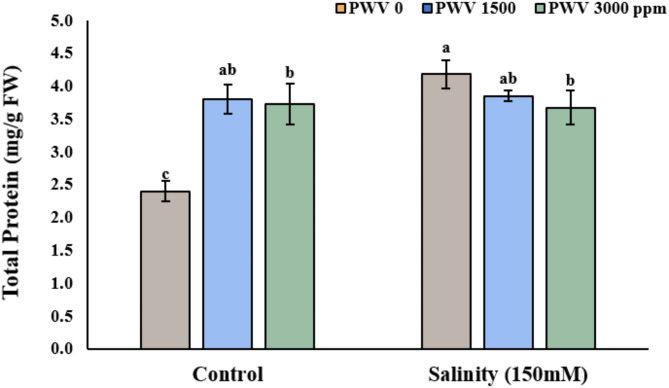
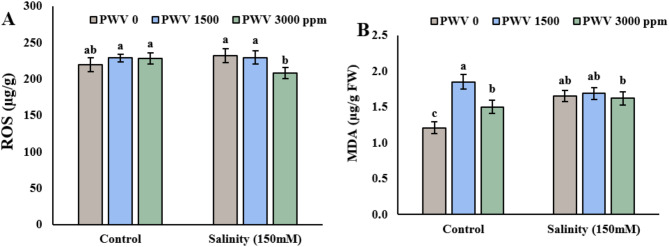
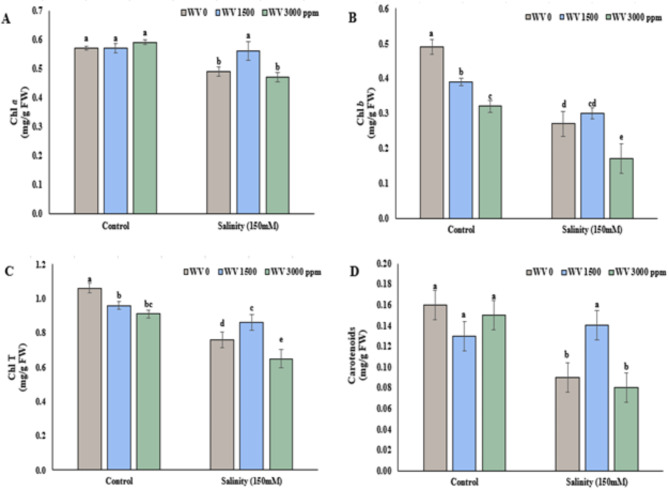
Results: The intense salinity stress reduced the fresh and dry mass of root and shoot by 25, 5, 34, and 13%, and decreased chlorophyll a, b, total, and carotenoids by 14, 45, 28, and 44%, respectively compared to the control. Also, in the treated plants with PWV decreased levels of total protein (14%). While PWV treatment decreased the negative effects of the intense salinity stress and enhanced the fresh mass root (41%), dry mass shoot (33%), shoot length (23%), leaf area (34%), leaf number (63%), Chl a (14%), Chl b (11%) and carotenoids (56%). Under the intense salinity stress, the foliar spraying of PWV, 3000 ppm, decreased the reactive oxygen species (ROS) and malondialdehyde (MDA) by 7 and 10%, respectively compared to the control.
Conclusions: This study shows that the use of PWV (1500 ppm) via its nutrient and bioactive components is effective in improving the negative effects of the salinity (150 mM NaCl) in cucumber seedlings.
期刊介绍:
BMC Plant Biology is an open access, peer-reviewed journal that considers articles on all aspects of plant biology, including molecular, cellular, tissue, organ and whole organism research.




 京公网安备 11010802042870号
京ICP备2023020795号-1
京公网安备 11010802042870号
京ICP备2023020795号-1

 分享
分享
 求助内容:
求助内容: 应助结果提醒方式:
 扫码关注我们
