{"title":"视觉功能和日常生活活动在轻度认知障碍患者认知功能中的作用:一项横断面研究。","authors":"Chunhui Zhou, Ganfeng Yang, Marc Theeboom, Hua Yang, Ruiting Zhu, Zijian Zhou, Dong Zhu","doi":"10.3389/fnagi.2025.1505815","DOIUrl":null,"url":null,"abstract":"<p><strong>Background: </strong>Mild cognitive impairment (MCI) is a precursor to dementia, with many patients showing early decline in activities of daily living (ADLs). However, the role of visual impairment in this process is underexplored despite evidence suggesting it may accelerate cognitive decline. Current research does not understand how visual dysfunction affects cognitive abilities and how ADLs might moderate this relationship. This gap is crucial because early interventions targeting visual impairments could potentially delay progression to dementia, offering new avenues for supporting MCI patients.</p><p><strong>Objective: </strong>This study investigates the relationship between visual function and cognitive abilities in patients with MCI. Specifically, it seeks to determine how different aspects of visual function, such as visual field indices and visual acuity, correlate with various cognitive domains measured by standardized assessments. Additionally, the study aims to examine the role of ADLs as a potential moderating factor in this relationship. By analyzing how ADL performance influences the strength and direction of the association between visual impairments and cognitive function, this research intends to identify key areas where visual deficits may contribute to cognitive decline in MCI.</p><p><strong>Methods: </strong>This is a cross-sectional study. Two hundred and seventy four elderly patients were diagnosed with MCI from various communities in Taicang City, Jiangsu Province, China. Most participants were women (68.6%), and the average age was 69 years. Notable comorbidities included hypertension (41.6%) and diabetes (33.2%), indicating a higher burden of health conditions than typical older adult populations. Visual function, Montreal Cognitive Assessment (MoCA), and the ADLs were measured. Pearson's correlation coefficients were used to examine the unadjusted associations between visual function measures and cognitive performance. Multivariable linear regression models were employed to further explore these relationships and to assess the moderating role of ADLs.</p><p><strong>Results: </strong>Significant positive correlations were found between visual function and cognitive performance, particularly with Visual Function Index (VFI) showing a strong initial correlation with the total MoCA score (<i>r</i> = 0.61, <i>p</i> < 0.001), which was attenuated after adjusting for ADL (β = 0.06, <i>p</i> = 0.23). Maximum Visual Field (Max VF) was positively correlated with language skills (<i>r</i> = 0.13, <i>p</i> < 0.05). The negative correlation of Minimum Visual Field (Min VF) with cognitive performance became positive after ADL adjustment (β = 0.12, <i>p</i> = 0.04).</p><p><strong>Conclusions: </strong>These findings suggest that visual function plays a crucial role in the cognitive and functional abilities of patients with MCI. Early interventions targeting visual impairments may help mitigate cognitive decline and improve the quality of life for these patients.</p>","PeriodicalId":12450,"journal":{"name":"Frontiers in Aging Neuroscience","volume":"17 ","pages":"1505815"},"PeriodicalIF":4.5000,"publicationDate":"2025-02-05","publicationTypes":"Journal Article","fieldsOfStudy":null,"isOpenAccess":false,"openAccessPdf":"https://www.ncbi.nlm.nih.gov/pmc/articles/PMC11835840/pdf/","citationCount":"0","resultStr":"{\"title\":\"Role of visual function and performance of activities of daily living in cognitive function in patients with mild cognitive impairment: a cross-sectional study.\",\"authors\":\"Chunhui Zhou, Ganfeng Yang, Marc Theeboom, Hua Yang, Ruiting Zhu, Zijian Zhou, Dong Zhu\",\"doi\":\"10.3389/fnagi.2025.1505815\",\"DOIUrl\":null,\"url\":null,\"abstract\":\"<p><strong>Background: </strong>Mild cognitive impairment (MCI) is a precursor to dementia, with many patients showing early decline in activities of daily living (ADLs). However, the role of visual impairment in this process is underexplored despite evidence suggesting it may accelerate cognitive decline. Current research does not understand how visual dysfunction affects cognitive abilities and how ADLs might moderate this relationship. This gap is crucial because early interventions targeting visual impairments could potentially delay progression to dementia, offering new avenues for supporting MCI patients.</p><p><strong>Objective: </strong>This study investigates the relationship between visual function and cognitive abilities in patients with MCI. Specifically, it seeks to determine how different aspects of visual function, such as visual field indices and visual acuity, correlate with various cognitive domains measured by standardized assessments. Additionally, the study aims to examine the role of ADLs as a potential moderating factor in this relationship. By analyzing how ADL performance influences the strength and direction of the association between visual impairments and cognitive function, this research intends to identify key areas where visual deficits may contribute to cognitive decline in MCI.</p><p><strong>Methods: </strong>This is a cross-sectional study. Two hundred and seventy four elderly patients were diagnosed with MCI from various communities in Taicang City, Jiangsu Province, China. Most participants were women (68.6%), and the average age was 69 years. Notable comorbidities included hypertension (41.6%) and diabetes (33.2%), indicating a higher burden of health conditions than typical older adult populations. Visual function, Montreal Cognitive Assessment (MoCA), and the ADLs were measured. Pearson's correlation coefficients were used to examine the unadjusted associations between visual function measures and cognitive performance. Multivariable linear regression models were employed to further explore these relationships and to assess the moderating role of ADLs.</p><p><strong>Results: </strong>Significant positive correlations were found between visual function and cognitive performance, particularly with Visual Function Index (VFI) showing a strong initial correlation with the total MoCA score (<i>r</i> = 0.61, <i>p</i> < 0.001), which was attenuated after adjusting for ADL (β = 0.06, <i>p</i> = 0.23). Maximum Visual Field (Max VF) was positively correlated with language skills (<i>r</i> = 0.13, <i>p</i> < 0.05). The negative correlation of Minimum Visual Field (Min VF) with cognitive performance became positive after ADL adjustment (β = 0.12, <i>p</i> = 0.04).</p><p><strong>Conclusions: </strong>These findings suggest that visual function plays a crucial role in the cognitive and functional abilities of patients with MCI. Early interventions targeting visual impairments may help mitigate cognitive decline and improve the quality of life for these patients.</p>\",\"PeriodicalId\":12450,\"journal\":{\"name\":\"Frontiers in Aging Neuroscience\",\"volume\":\"17 \",\"pages\":\"1505815\"},\"PeriodicalIF\":4.5000,\"publicationDate\":\"2025-02-05\",\"publicationTypes\":\"Journal Article\",\"fieldsOfStudy\":null,\"isOpenAccess\":false,\"openAccessPdf\":\"https://www.ncbi.nlm.nih.gov/pmc/articles/PMC11835840/pdf/\",\"citationCount\":\"0\",\"resultStr\":null,\"platform\":\"Semanticscholar\",\"paperid\":null,\"PeriodicalName\":\"Frontiers in Aging Neuroscience\",\"FirstCategoryId\":\"3\",\"ListUrlMain\":\"https://doi.org/10.3389/fnagi.2025.1505815\",\"RegionNum\":2,\"RegionCategory\":\"医学\",\"ArticlePicture\":[],\"TitleCN\":null,\"AbstractTextCN\":null,\"PMCID\":null,\"EPubDate\":\"2025/1/1 0:00:00\",\"PubModel\":\"eCollection\",\"JCR\":\"Q2\",\"JCRName\":\"GERIATRICS & GERONTOLOGY\",\"Score\":null,\"Total\":0}","platform":"Semanticscholar","paperid":null,"PeriodicalName":"Frontiers in Aging Neuroscience","FirstCategoryId":"3","ListUrlMain":"https://doi.org/10.3389/fnagi.2025.1505815","RegionNum":2,"RegionCategory":"医学","ArticlePicture":[],"TitleCN":null,"AbstractTextCN":null,"PMCID":null,"EPubDate":"2025/1/1 0:00:00","PubModel":"eCollection","JCR":"Q2","JCRName":"GERIATRICS & GERONTOLOGY","Score":null,"Total":0}
引用次数: 0
摘要
背景:轻度认知障碍(MCI)是痴呆的前兆,许多患者表现出早期日常生活能力下降(adl)。然而,尽管有证据表明视力障碍可能会加速认知能力下降,但人们对视力障碍在这一过程中的作用尚未充分研究。目前的研究还不清楚视觉功能障碍如何影响认知能力,以及adl如何缓和这种关系。这一差距至关重要,因为针对视觉障碍的早期干预可能会延缓痴呆症的进展,为支持轻度认知障碍患者提供新的途径。目的:探讨轻度认知损伤患者视觉功能与认知能力的关系。具体来说,它试图确定视觉功能的不同方面,如视野指数和视觉敏锐度,如何与标准化评估测量的各种认知领域相关联。此外,本研究旨在检验ADLs在这一关系中作为潜在调节因素的作用。通过分析ADL表现如何影响视觉障碍与认知功能之间关联的强度和方向,本研究旨在确定视觉缺陷可能导致MCI认知能力下降的关键领域。方法:这是一个横断面研究。本文研究了来自江苏省太仓市不同社区的274例老年轻度认知损伤患者。大多数参与者为女性(68.6%),平均年龄为69岁。值得注意的合并症包括高血压(41.6%)和糖尿病(33.2%),表明健康状况的负担高于典型的老年成人人群。测量视觉功能、蒙特利尔认知评估(MoCA)和adl。Pearson相关系数用于检验视觉功能测量与认知表现之间未经调整的关联。采用多变量线性回归模型进一步探讨这些关系,并评估adl的调节作用。结果:视觉功能与认知表现之间存在显著正相关,尤其是视觉功能指数(VFI)与MoCA总分有很强的初始相关性(r = 0.61, p < 0.001),在调整ADL后减弱(β = 0.06, p = 0.23)。最大视野(Max VF)与语言能力呈正相关(r = 0.13, p < 0.05)。调整ADL后,最小视野(Min VF)与认知表现呈负相关(β = 0.12, p = 0.04)。结论:这些发现表明视觉功能在轻度认知损伤患者的认知和功能能力中起着至关重要的作用。针对视力障碍的早期干预可能有助于减轻这些患者的认知能力下降和改善生活质量。
Role of visual function and performance of activities of daily living in cognitive function in patients with mild cognitive impairment: a cross-sectional study.
Background: Mild cognitive impairment (MCI) is a precursor to dementia, with many patients showing early decline in activities of daily living (ADLs). However, the role of visual impairment in this process is underexplored despite evidence suggesting it may accelerate cognitive decline. Current research does not understand how visual dysfunction affects cognitive abilities and how ADLs might moderate this relationship. This gap is crucial because early interventions targeting visual impairments could potentially delay progression to dementia, offering new avenues for supporting MCI patients.
Objective: This study investigates the relationship between visual function and cognitive abilities in patients with MCI. Specifically, it seeks to determine how different aspects of visual function, such as visual field indices and visual acuity, correlate with various cognitive domains measured by standardized assessments. Additionally, the study aims to examine the role of ADLs as a potential moderating factor in this relationship. By analyzing how ADL performance influences the strength and direction of the association between visual impairments and cognitive function, this research intends to identify key areas where visual deficits may contribute to cognitive decline in MCI.
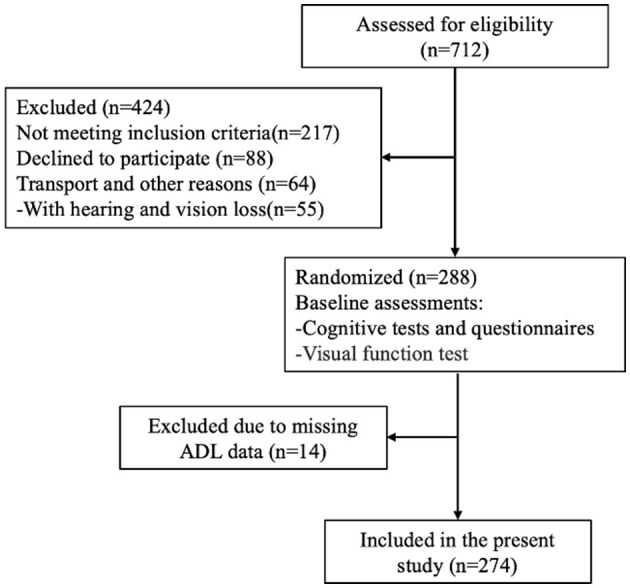
Methods: This is a cross-sectional study. Two hundred and seventy four elderly patients were diagnosed with MCI from various communities in Taicang City, Jiangsu Province, China. Most participants were women (68.6%), and the average age was 69 years. Notable comorbidities included hypertension (41.6%) and diabetes (33.2%), indicating a higher burden of health conditions than typical older adult populations. Visual function, Montreal Cognitive Assessment (MoCA), and the ADLs were measured. Pearson's correlation coefficients were used to examine the unadjusted associations between visual function measures and cognitive performance. Multivariable linear regression models were employed to further explore these relationships and to assess the moderating role of ADLs.
Results: Significant positive correlations were found between visual function and cognitive performance, particularly with Visual Function Index (VFI) showing a strong initial correlation with the total MoCA score (r = 0.61, p < 0.001), which was attenuated after adjusting for ADL (β = 0.06, p = 0.23). Maximum Visual Field (Max VF) was positively correlated with language skills (r = 0.13, p < 0.05). The negative correlation of Minimum Visual Field (Min VF) with cognitive performance became positive after ADL adjustment (β = 0.12, p = 0.04).
Conclusions: These findings suggest that visual function plays a crucial role in the cognitive and functional abilities of patients with MCI. Early interventions targeting visual impairments may help mitigate cognitive decline and improve the quality of life for these patients.
期刊介绍:
Frontiers in Aging Neuroscience is a leading journal in its field, publishing rigorously peer-reviewed research that advances our understanding of the mechanisms of Central Nervous System aging and age-related neural diseases. Specialty Chief Editor Thomas Wisniewski at the New York University School of Medicine is supported by an outstanding Editorial Board of international researchers. This multidisciplinary open-access journal is at the forefront of disseminating and communicating scientific knowledge and impactful discoveries to researchers, academics, clinicians and the public worldwide.



 京公网安备 11010802042870号
京ICP备2023020795号-1
京公网安备 11010802042870号
京ICP备2023020795号-1

 分享
分享
 求助内容:
求助内容: 应助结果提醒方式:
 扫码关注我们
