Ziling Zhang, Yan Zhao, Junpeng Wen, Yuxiang Wang, Juan Li
{"title":"局限性小细胞肺癌患者全身免疫炎症指数的影响及其最佳阈值评价:基于572例的回顾性研究","authors":"Ziling Zhang, Yan Zhao, Junpeng Wen, Yuxiang Wang, Juan Li","doi":"10.21037/tcr-24-1266","DOIUrl":null,"url":null,"abstract":"<p><strong>Background: </strong>Given the role of inflammation in cancer progression, the systemic immune-inflammation index (SII, defined as platelet × neutrophil/lymphocyte) has been suggested as an emerging prognostic marker in several solid malignant neoplasms. However, there are few studies on the prognostic value of SII in patients with limited-stage small cell lung cancer (LS-SCLC), and the optimal threshold of SII remains unclear in this population. This study calculated the optimal threshold of SII by a reasonable method and explored its association with survival outcomes.</p><p><strong>Methods: </strong>This retrospective study reviewed clinical data of 572 patients with LS-SCLC. The threshold for SII was determined using an outcome-based method by maximizing the log-rank test statistic and the survival differences. Continuous time-dependent receiver operating characteristic curves (time-dependent ROC curves) were used to clarify the predictive ability of SII.</p><p><strong>Results: </strong>The thresholds of SII for overall survival (OS) and progression-free survival (PFS) were both 760.6, based on which patients were divided into low [292 cases (51.0%)] and high [280 cases (49.0%)] SII groups. The area under the time-dependent ROC curves of SII in 12-, 24-, and 36-months were 0.727, 0.708, and 0.680, respectively. The overall median OS and PFS were 26.0 months [95% confidence interval (CI): 23.8-28.2] and 13.0 months (95% CI: 11.3-14.7), respectively. Significantly improved OS [35.0 (95% CI: 30.0-40.0) <i>vs.</i> 19.0 months (95% CI: 17.1-20.9), P<0.001] and PFS [20.0 (95% CI: 17.3-22.7) <i>vs.</i> 11.0 months (95% CI: 9.9-12.1), P<0.001] was seen in the low SII group than that in the high SII group. In the multivariable survival analysis, SII remained an independent prognostic factor for OS [hazard ratio (HR): 1.699; 95% CI: 1.374-2.100; P=0.001] and PFS (HR: 1.482; 95% CI: 1.214-1.809; P<0.001).</p><p><strong>Conclusions: </strong>Our study demonstrates that elevated SII is an independent adverse prognostic factor for LS-SCLC.</p>","PeriodicalId":23216,"journal":{"name":"Translational cancer research","volume":"14 1","pages":"371-382"},"PeriodicalIF":1.7000,"publicationDate":"2025-01-31","publicationTypes":"Journal Article","fieldsOfStudy":null,"isOpenAccess":false,"openAccessPdf":"https://www.ncbi.nlm.nih.gov/pmc/articles/PMC11833402/pdf/","citationCount":"0","resultStr":"{\"title\":\"Impact of systemic immune-inflammation index and its evaluation of optimal threshold in patients with limited-stage small cell lung cancer: a retrospective study based on 572 cases.\",\"authors\":\"Ziling Zhang, Yan Zhao, Junpeng Wen, Yuxiang Wang, Juan Li\",\"doi\":\"10.21037/tcr-24-1266\",\"DOIUrl\":null,\"url\":null,\"abstract\":\"<p><strong>Background: </strong>Given the role of inflammation in cancer progression, the systemic immune-inflammation index (SII, defined as platelet × neutrophil/lymphocyte) has been suggested as an emerging prognostic marker in several solid malignant neoplasms. However, there are few studies on the prognostic value of SII in patients with limited-stage small cell lung cancer (LS-SCLC), and the optimal threshold of SII remains unclear in this population. This study calculated the optimal threshold of SII by a reasonable method and explored its association with survival outcomes.</p><p><strong>Methods: </strong>This retrospective study reviewed clinical data of 572 patients with LS-SCLC. The threshold for SII was determined using an outcome-based method by maximizing the log-rank test statistic and the survival differences. Continuous time-dependent receiver operating characteristic curves (time-dependent ROC curves) were used to clarify the predictive ability of SII.</p><p><strong>Results: </strong>The thresholds of SII for overall survival (OS) and progression-free survival (PFS) were both 760.6, based on which patients were divided into low [292 cases (51.0%)] and high [280 cases (49.0%)] SII groups. The area under the time-dependent ROC curves of SII in 12-, 24-, and 36-months were 0.727, 0.708, and 0.680, respectively. The overall median OS and PFS were 26.0 months [95% confidence interval (CI): 23.8-28.2] and 13.0 months (95% CI: 11.3-14.7), respectively. Significantly improved OS [35.0 (95% CI: 30.0-40.0) <i>vs.</i> 19.0 months (95% CI: 17.1-20.9), P<0.001] and PFS [20.0 (95% CI: 17.3-22.7) <i>vs.</i> 11.0 months (95% CI: 9.9-12.1), P<0.001] was seen in the low SII group than that in the high SII group. In the multivariable survival analysis, SII remained an independent prognostic factor for OS [hazard ratio (HR): 1.699; 95% CI: 1.374-2.100; P=0.001] and PFS (HR: 1.482; 95% CI: 1.214-1.809; P<0.001).</p><p><strong>Conclusions: </strong>Our study demonstrates that elevated SII is an independent adverse prognostic factor for LS-SCLC.</p>\",\"PeriodicalId\":23216,\"journal\":{\"name\":\"Translational cancer research\",\"volume\":\"14 1\",\"pages\":\"371-382\"},\"PeriodicalIF\":1.7000,\"publicationDate\":\"2025-01-31\",\"publicationTypes\":\"Journal Article\",\"fieldsOfStudy\":null,\"isOpenAccess\":false,\"openAccessPdf\":\"https://www.ncbi.nlm.nih.gov/pmc/articles/PMC11833402/pdf/\",\"citationCount\":\"0\",\"resultStr\":null,\"platform\":\"Semanticscholar\",\"paperid\":null,\"PeriodicalName\":\"Translational cancer research\",\"FirstCategoryId\":\"3\",\"ListUrlMain\":\"https://doi.org/10.21037/tcr-24-1266\",\"RegionNum\":4,\"RegionCategory\":\"医学\",\"ArticlePicture\":[],\"TitleCN\":null,\"AbstractTextCN\":null,\"PMCID\":null,\"EPubDate\":\"2025/1/16 0:00:00\",\"PubModel\":\"Epub\",\"JCR\":\"Q4\",\"JCRName\":\"ONCOLOGY\",\"Score\":null,\"Total\":0}","platform":"Semanticscholar","paperid":null,"PeriodicalName":"Translational cancer research","FirstCategoryId":"3","ListUrlMain":"https://doi.org/10.21037/tcr-24-1266","RegionNum":4,"RegionCategory":"医学","ArticlePicture":[],"TitleCN":null,"AbstractTextCN":null,"PMCID":null,"EPubDate":"2025/1/16 0:00:00","PubModel":"Epub","JCR":"Q4","JCRName":"ONCOLOGY","Score":null,"Total":0}
引用次数: 0
摘要
背景:考虑到炎症在癌症进展中的作用,系统性免疫炎症指数(SII,定义为血小板×中性粒细胞/淋巴细胞)已被认为是几种实体恶性肿瘤的新兴预后指标。然而,关于SII在有限期小细胞肺癌(LS-SCLC)患者预后价值的研究很少,SII的最佳阈值在该人群中尚不清楚。本研究通过合理的方法计算SII的最佳阈值,并探讨其与生存结局的关系。方法:回顾性分析572例LS-SCLC患者的临床资料。SII的阈值采用基于结果的方法,通过最大化log-rank检验统计量和生存差异来确定。采用连续时间依赖的受试者工作特征曲线(时间依赖的ROC曲线)来阐明SII的预测能力。结果:SII总生存期(OS)和无进展生存期(PFS)阈值均为760.6,根据SII阈值将患者分为低SII组[292例(51.0%)]和高SII组[280例(49.0%)]。12个月、24个月和36个月SII随时间变化的ROC曲线下面积分别为0.727、0.708和0.680。总中位OS和PFS分别为26.0个月[95%可信区间(CI): 23.8-28.2]和13.0个月(95% CI: 11.3-14.7)。显著改善OS [35.0 (95% CI: 30.0-40.0) vs. 19.0个月(95% CI: 17.1-20.9), pv vs. 11.0个月(95% CI: 9.9-12.1), p]结论:我们的研究表明SII升高是LS-SCLC的独立不良预后因素。
Impact of systemic immune-inflammation index and its evaluation of optimal threshold in patients with limited-stage small cell lung cancer: a retrospective study based on 572 cases.
Background: Given the role of inflammation in cancer progression, the systemic immune-inflammation index (SII, defined as platelet × neutrophil/lymphocyte) has been suggested as an emerging prognostic marker in several solid malignant neoplasms. However, there are few studies on the prognostic value of SII in patients with limited-stage small cell lung cancer (LS-SCLC), and the optimal threshold of SII remains unclear in this population. This study calculated the optimal threshold of SII by a reasonable method and explored its association with survival outcomes.
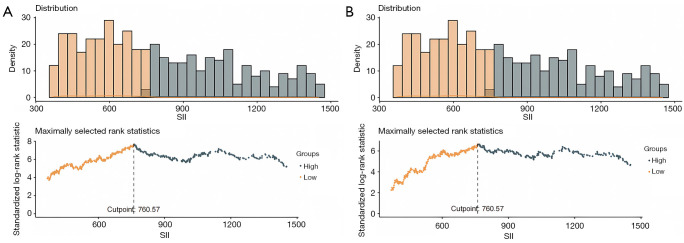
Methods: This retrospective study reviewed clinical data of 572 patients with LS-SCLC. The threshold for SII was determined using an outcome-based method by maximizing the log-rank test statistic and the survival differences. Continuous time-dependent receiver operating characteristic curves (time-dependent ROC curves) were used to clarify the predictive ability of SII.
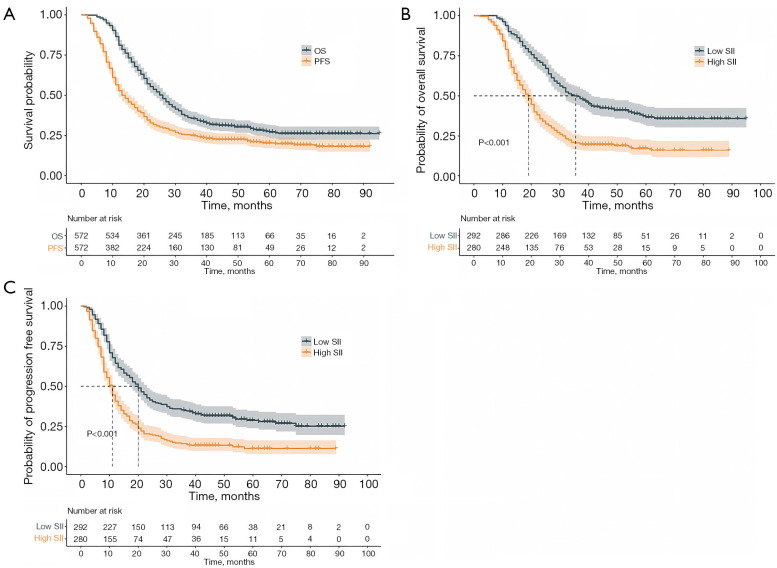
Results: The thresholds of SII for overall survival (OS) and progression-free survival (PFS) were both 760.6, based on which patients were divided into low [292 cases (51.0%)] and high [280 cases (49.0%)] SII groups. The area under the time-dependent ROC curves of SII in 12-, 24-, and 36-months were 0.727, 0.708, and 0.680, respectively. The overall median OS and PFS were 26.0 months [95% confidence interval (CI): 23.8-28.2] and 13.0 months (95% CI: 11.3-14.7), respectively. Significantly improved OS [35.0 (95% CI: 30.0-40.0) vs. 19.0 months (95% CI: 17.1-20.9), P<0.001] and PFS [20.0 (95% CI: 17.3-22.7) vs. 11.0 months (95% CI: 9.9-12.1), P<0.001] was seen in the low SII group than that in the high SII group. In the multivariable survival analysis, SII remained an independent prognostic factor for OS [hazard ratio (HR): 1.699; 95% CI: 1.374-2.100; P=0.001] and PFS (HR: 1.482; 95% CI: 1.214-1.809; P<0.001).
Conclusions: Our study demonstrates that elevated SII is an independent adverse prognostic factor for LS-SCLC.
期刊介绍:
Translational Cancer Research (Transl Cancer Res TCR; Print ISSN: 2218-676X; Online ISSN 2219-6803; http://tcr.amegroups.com/) is an Open Access, peer-reviewed journal, indexed in Science Citation Index Expanded (SCIE). TCR publishes laboratory studies of novel therapeutic interventions as well as clinical trials which evaluate new treatment paradigms for cancer; results of novel research investigations which bridge the laboratory and clinical settings including risk assessment, cellular and molecular characterization, prevention, detection, diagnosis and treatment of human cancers with the overall goal of improving the clinical care of cancer patients. The focus of TCR is original, peer-reviewed, science-based research that successfully advances clinical medicine toward the goal of improving patients'' quality of life. The editors and an international advisory group of scientists and clinician-scientists as well as other experts will hold TCR articles to the high-quality standards. We accept Original Articles as well as Review Articles, Editorials and Brief Articles.





 京公网安备 11010802042870号
京ICP备2023020795号-1
京公网安备 11010802042870号
京ICP备2023020795号-1

 分享
分享
 求助内容:
求助内容: 应助结果提醒方式:
 扫码关注我们
