{"title":"建立预后评分系统并探索I期非小细胞肺癌淋巴结数量的预后价值:一项监测、流行病学和最终结果(SEER)数据库和中国队列的回顾性研究。","authors":"Siyuan Wang, Xin Yin, Lingyun Wu, Hao Yu, Zhongjie Lu, Feng Zhao, Danfang Yan, Senxiang Yan","doi":"10.21037/tcr-24-1474","DOIUrl":null,"url":null,"abstract":"<p><strong>Background: </strong>There is currently no recognized assessment system to predict disease outcomes for stage I non-small cell lung cancer (NSCLC). This research aimed to develop a prognostic scoring system for predicting 5-year overall survival (OS) of individuals with stage I NSCLC following definitive therapeutic intervention. Additionally, the optimal number of examined lymph nodes (ELNs) count for tumors no larger than 30 mm was determined.</p><p><strong>Methods: </strong>Patients (n=22,617) diagnosed with stage I NSCLC from 2007 to 2015 who underwent definitive treatment (pulmonary lobectomy, pulmonary sublobectomy, or radiotherapy) were identified from the Surveillance, Epidemiology, and End Results (SEER) database. There were 400 Chinese patients with stage I NSCLC diagnosed in 2017 enrolled for external validation. The nomogram was constructed based on gradient boosting machine. The optimal ELNs in patients with tumors ≤30 mm and node-negative undergoing pulmonary lobectomy or pulmonary sublobectomy were determined using log-rank test and validated by multivariable analysis.</p><p><strong>Results: </strong>Age at diagnosis, histology, differentiated grade, tumor staging, number of ELNs, and definitive treatment pattern were recognized as important factors for 5-year OS. The prognostic scoring system exhibited superior discrimination accuracy, calibration ability, and net clinical benefit compared to the tumor, node, metastasis (TNM) staging system. For patients with tumors ≤30 mm, more than 10 and 20 ELNs demonstrated the maximum OS difference during lobectomy and sublobectomy, respectively.</p><p><strong>Conclusions: </strong>This prognostic scoring system will anticipate the prognosis of stage I NSCLC patients after radical treatment, thereby offering individualized treatment recommendations for both clinicians and patients. A minimum of 10 ELNs during lobectomy and 20 ELNs during sublobectomy are necessary for small-sized NSCLC.</p>","PeriodicalId":23216,"journal":{"name":"Translational cancer research","volume":"14 1","pages":"404-423"},"PeriodicalIF":1.7000,"publicationDate":"2025-01-31","publicationTypes":"Journal Article","fieldsOfStudy":null,"isOpenAccess":false,"openAccessPdf":"https://www.ncbi.nlm.nih.gov/pmc/articles/PMC11833396/pdf/","citationCount":"0","resultStr":"{\"title\":\"Establishing a prognostic scoring system and exploring prognostic value of examined lymph node numbers for stage I non-small cell lung cancer: a retrospective study of Surveillance, Epidemiology, and End Results (SEER) database and a Chinese cohort.\",\"authors\":\"Siyuan Wang, Xin Yin, Lingyun Wu, Hao Yu, Zhongjie Lu, Feng Zhao, Danfang Yan, Senxiang Yan\",\"doi\":\"10.21037/tcr-24-1474\",\"DOIUrl\":null,\"url\":null,\"abstract\":\"<p><strong>Background: </strong>There is currently no recognized assessment system to predict disease outcomes for stage I non-small cell lung cancer (NSCLC). This research aimed to develop a prognostic scoring system for predicting 5-year overall survival (OS) of individuals with stage I NSCLC following definitive therapeutic intervention. Additionally, the optimal number of examined lymph nodes (ELNs) count for tumors no larger than 30 mm was determined.</p><p><strong>Methods: </strong>Patients (n=22,617) diagnosed with stage I NSCLC from 2007 to 2015 who underwent definitive treatment (pulmonary lobectomy, pulmonary sublobectomy, or radiotherapy) were identified from the Surveillance, Epidemiology, and End Results (SEER) database. There were 400 Chinese patients with stage I NSCLC diagnosed in 2017 enrolled for external validation. The nomogram was constructed based on gradient boosting machine. The optimal ELNs in patients with tumors ≤30 mm and node-negative undergoing pulmonary lobectomy or pulmonary sublobectomy were determined using log-rank test and validated by multivariable analysis.</p><p><strong>Results: </strong>Age at diagnosis, histology, differentiated grade, tumor staging, number of ELNs, and definitive treatment pattern were recognized as important factors for 5-year OS. The prognostic scoring system exhibited superior discrimination accuracy, calibration ability, and net clinical benefit compared to the tumor, node, metastasis (TNM) staging system. For patients with tumors ≤30 mm, more than 10 and 20 ELNs demonstrated the maximum OS difference during lobectomy and sublobectomy, respectively.</p><p><strong>Conclusions: </strong>This prognostic scoring system will anticipate the prognosis of stage I NSCLC patients after radical treatment, thereby offering individualized treatment recommendations for both clinicians and patients. A minimum of 10 ELNs during lobectomy and 20 ELNs during sublobectomy are necessary for small-sized NSCLC.</p>\",\"PeriodicalId\":23216,\"journal\":{\"name\":\"Translational cancer research\",\"volume\":\"14 1\",\"pages\":\"404-423\"},\"PeriodicalIF\":1.7000,\"publicationDate\":\"2025-01-31\",\"publicationTypes\":\"Journal Article\",\"fieldsOfStudy\":null,\"isOpenAccess\":false,\"openAccessPdf\":\"https://www.ncbi.nlm.nih.gov/pmc/articles/PMC11833396/pdf/\",\"citationCount\":\"0\",\"resultStr\":null,\"platform\":\"Semanticscholar\",\"paperid\":null,\"PeriodicalName\":\"Translational cancer research\",\"FirstCategoryId\":\"3\",\"ListUrlMain\":\"https://doi.org/10.21037/tcr-24-1474\",\"RegionNum\":4,\"RegionCategory\":\"医学\",\"ArticlePicture\":[],\"TitleCN\":null,\"AbstractTextCN\":null,\"PMCID\":null,\"EPubDate\":\"2025/1/23 0:00:00\",\"PubModel\":\"Epub\",\"JCR\":\"Q4\",\"JCRName\":\"ONCOLOGY\",\"Score\":null,\"Total\":0}","platform":"Semanticscholar","paperid":null,"PeriodicalName":"Translational cancer research","FirstCategoryId":"3","ListUrlMain":"https://doi.org/10.21037/tcr-24-1474","RegionNum":4,"RegionCategory":"医学","ArticlePicture":[],"TitleCN":null,"AbstractTextCN":null,"PMCID":null,"EPubDate":"2025/1/23 0:00:00","PubModel":"Epub","JCR":"Q4","JCRName":"ONCOLOGY","Score":null,"Total":0}
Establishing a prognostic scoring system and exploring prognostic value of examined lymph node numbers for stage I non-small cell lung cancer: a retrospective study of Surveillance, Epidemiology, and End Results (SEER) database and a Chinese cohort.
Background: There is currently no recognized assessment system to predict disease outcomes for stage I non-small cell lung cancer (NSCLC). This research aimed to develop a prognostic scoring system for predicting 5-year overall survival (OS) of individuals with stage I NSCLC following definitive therapeutic intervention. Additionally, the optimal number of examined lymph nodes (ELNs) count for tumors no larger than 30 mm was determined.
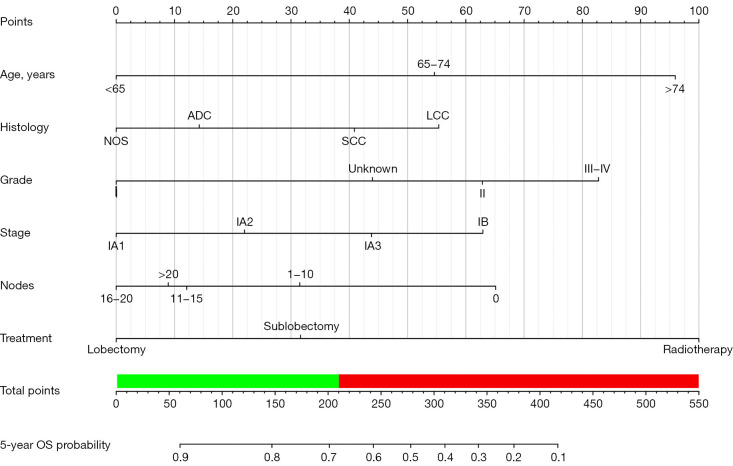
Methods: Patients (n=22,617) diagnosed with stage I NSCLC from 2007 to 2015 who underwent definitive treatment (pulmonary lobectomy, pulmonary sublobectomy, or radiotherapy) were identified from the Surveillance, Epidemiology, and End Results (SEER) database. There were 400 Chinese patients with stage I NSCLC diagnosed in 2017 enrolled for external validation. The nomogram was constructed based on gradient boosting machine. The optimal ELNs in patients with tumors ≤30 mm and node-negative undergoing pulmonary lobectomy or pulmonary sublobectomy were determined using log-rank test and validated by multivariable analysis.
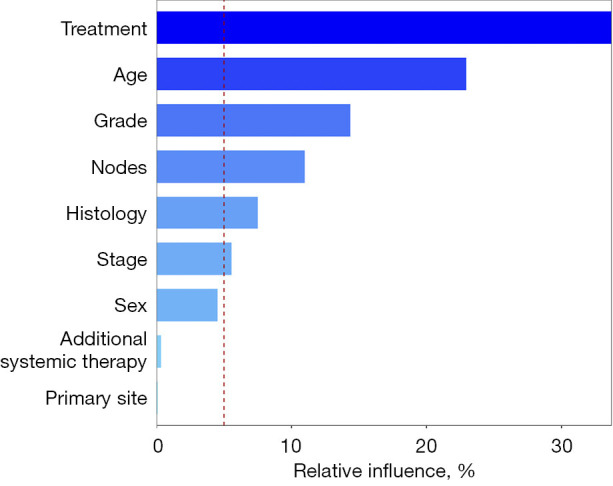
Results: Age at diagnosis, histology, differentiated grade, tumor staging, number of ELNs, and definitive treatment pattern were recognized as important factors for 5-year OS. The prognostic scoring system exhibited superior discrimination accuracy, calibration ability, and net clinical benefit compared to the tumor, node, metastasis (TNM) staging system. For patients with tumors ≤30 mm, more than 10 and 20 ELNs demonstrated the maximum OS difference during lobectomy and sublobectomy, respectively.
Conclusions: This prognostic scoring system will anticipate the prognosis of stage I NSCLC patients after radical treatment, thereby offering individualized treatment recommendations for both clinicians and patients. A minimum of 10 ELNs during lobectomy and 20 ELNs during sublobectomy are necessary for small-sized NSCLC.
期刊介绍:
Translational Cancer Research (Transl Cancer Res TCR; Print ISSN: 2218-676X; Online ISSN 2219-6803; http://tcr.amegroups.com/) is an Open Access, peer-reviewed journal, indexed in Science Citation Index Expanded (SCIE). TCR publishes laboratory studies of novel therapeutic interventions as well as clinical trials which evaluate new treatment paradigms for cancer; results of novel research investigations which bridge the laboratory and clinical settings including risk assessment, cellular and molecular characterization, prevention, detection, diagnosis and treatment of human cancers with the overall goal of improving the clinical care of cancer patients. The focus of TCR is original, peer-reviewed, science-based research that successfully advances clinical medicine toward the goal of improving patients'' quality of life. The editors and an international advisory group of scientists and clinician-scientists as well as other experts will hold TCR articles to the high-quality standards. We accept Original Articles as well as Review Articles, Editorials and Brief Articles.





 京公网安备 11010802042870号
京ICP备2023020795号-1
京公网安备 11010802042870号
京ICP备2023020795号-1

 分享
分享
 求助内容:
求助内容: 应助结果提醒方式:
 扫码关注我们
