Alejandro Escamilla-Sanchez, Juan Antonio López-Villodres, Carmen Alba-Tercedor, María Victoria Ortega-Jiménez, Francisca Rius-Díaz, Raquel Sanchez-Varo, Diego Bermúdez
{"title":"Instagram作为提高医学教育中人类组织学学习的工具:描述性研究。","authors":"Alejandro Escamilla-Sanchez, Juan Antonio López-Villodres, Carmen Alba-Tercedor, María Victoria Ortega-Jiménez, Francisca Rius-Díaz, Raquel Sanchez-Varo, Diego Bermúdez","doi":"10.2196/55861","DOIUrl":null,"url":null,"abstract":"<p><strong>Background: </strong>Student development is currently taking place in an environment governed by new technologies and social media. Some platforms, such as Instagram or X (previously known as \"Twitter\"), have been incorporated as additional tools for teaching and learning processes in higher education, especially in the framework of image-based applied disciplines, including radiology and pathology. Nevertheless, the role of social media in the teaching of core subjects such as histology has hardly been studied, and there are very few reports on this issue.</p><p><strong>Objective: </strong>The aim of this work was to investigate the impact of implementing social media on the ability to learn human histology. For this purpose, a set of voluntary e-learning activities was shared on Instagram as a complement to traditional face-to-face teaching.</p><p><strong>Methods: </strong>The proposal included questionnaires based on multiple-choice questions, descriptions of histological images, and schematic diagrams about the subject content. These activities were posted on an Instagram account only accessible by second-year medical students from the University of Malaga. In addition, students could share their own images taken during the laboratory practice and interact with their peers.</p><p><strong>Results: </strong>Of the students enrolled in Human Histology 2, 85.6% (143/167) agreed to participate in the platform. Most of the students valued the initiative positively and considered it an adequate instrument to improve their final marks. Specifically, 68.5% (98/143) of the student body regarded the multiple-choice questions and image-based questions as the most useful activities. Interestingly, there were statistically significant differences between the marks on the final exam (without considering other evaluation activities) for students who participated in the activity compared with those who did not or barely participated in the activity (P<.001). There were no significant differences by degree of participation between the more active groups.</p><p><strong>Conclusions: </strong>These results provide evidence that incorporating social media may be considered a useful, easy, and accessible tool to improve the learning of human histology in the context of medical degrees.</p>","PeriodicalId":36236,"journal":{"name":"JMIR Medical Education","volume":"11 ","pages":"e55861"},"PeriodicalIF":13.9000,"publicationDate":"2025-02-19","publicationTypes":"Journal Article","fieldsOfStudy":null,"isOpenAccess":false,"openAccessPdf":"https://www.ncbi.nlm.nih.gov/pmc/articles/PMC11888019/pdf/","citationCount":"0","resultStr":"{\"title\":\"Instagram as a Tool to Improve Human Histology Learning in Medical Education: Descriptive Study.\",\"authors\":\"Alejandro Escamilla-Sanchez, Juan Antonio López-Villodres, Carmen Alba-Tercedor, María Victoria Ortega-Jiménez, Francisca Rius-Díaz, Raquel Sanchez-Varo, Diego Bermúdez\",\"doi\":\"10.2196/55861\",\"DOIUrl\":null,\"url\":null,\"abstract\":\"<p><strong>Background: </strong>Student development is currently taking place in an environment governed by new technologies and social media. Some platforms, such as Instagram or X (previously known as \\\"Twitter\\\"), have been incorporated as additional tools for teaching and learning processes in higher education, especially in the framework of image-based applied disciplines, including radiology and pathology. Nevertheless, the role of social media in the teaching of core subjects such as histology has hardly been studied, and there are very few reports on this issue.</p><p><strong>Objective: </strong>The aim of this work was to investigate the impact of implementing social media on the ability to learn human histology. For this purpose, a set of voluntary e-learning activities was shared on Instagram as a complement to traditional face-to-face teaching.</p><p><strong>Methods: </strong>The proposal included questionnaires based on multiple-choice questions, descriptions of histological images, and schematic diagrams about the subject content. These activities were posted on an Instagram account only accessible by second-year medical students from the University of Malaga. In addition, students could share their own images taken during the laboratory practice and interact with their peers.</p><p><strong>Results: </strong>Of the students enrolled in Human Histology 2, 85.6% (143/167) agreed to participate in the platform. Most of the students valued the initiative positively and considered it an adequate instrument to improve their final marks. Specifically, 68.5% (98/143) of the student body regarded the multiple-choice questions and image-based questions as the most useful activities. Interestingly, there were statistically significant differences between the marks on the final exam (without considering other evaluation activities) for students who participated in the activity compared with those who did not or barely participated in the activity (P<.001). There were no significant differences by degree of participation between the more active groups.</p><p><strong>Conclusions: </strong>These results provide evidence that incorporating social media may be considered a useful, easy, and accessible tool to improve the learning of human histology in the context of medical degrees.</p>\",\"PeriodicalId\":36236,\"journal\":{\"name\":\"JMIR Medical Education\",\"volume\":\"11 \",\"pages\":\"e55861\"},\"PeriodicalIF\":13.9000,\"publicationDate\":\"2025-02-19\",\"publicationTypes\":\"Journal Article\",\"fieldsOfStudy\":null,\"isOpenAccess\":false,\"openAccessPdf\":\"https://www.ncbi.nlm.nih.gov/pmc/articles/PMC11888019/pdf/\",\"citationCount\":\"0\",\"resultStr\":null,\"platform\":\"Semanticscholar\",\"paperid\":null,\"PeriodicalName\":\"JMIR Medical Education\",\"FirstCategoryId\":\"1085\",\"ListUrlMain\":\"https://doi.org/10.2196/55861\",\"RegionNum\":0,\"RegionCategory\":null,\"ArticlePicture\":[],\"TitleCN\":null,\"AbstractTextCN\":null,\"PMCID\":null,\"EPubDate\":\"\",\"PubModel\":\"\",\"JCR\":\"Q1\",\"JCRName\":\"EDUCATION, SCIENTIFIC DISCIPLINES\",\"Score\":null,\"Total\":0}","platform":"Semanticscholar","paperid":null,"PeriodicalName":"JMIR Medical Education","FirstCategoryId":"1085","ListUrlMain":"https://doi.org/10.2196/55861","RegionNum":0,"RegionCategory":null,"ArticlePicture":[],"TitleCN":null,"AbstractTextCN":null,"PMCID":null,"EPubDate":"","PubModel":"","JCR":"Q1","JCRName":"EDUCATION, SCIENTIFIC DISCIPLINES","Score":null,"Total":0}
Instagram as a Tool to Improve Human Histology Learning in Medical Education: Descriptive Study.
Background: Student development is currently taking place in an environment governed by new technologies and social media. Some platforms, such as Instagram or X (previously known as "Twitter"), have been incorporated as additional tools for teaching and learning processes in higher education, especially in the framework of image-based applied disciplines, including radiology and pathology. Nevertheless, the role of social media in the teaching of core subjects such as histology has hardly been studied, and there are very few reports on this issue.
Objective: The aim of this work was to investigate the impact of implementing social media on the ability to learn human histology. For this purpose, a set of voluntary e-learning activities was shared on Instagram as a complement to traditional face-to-face teaching.
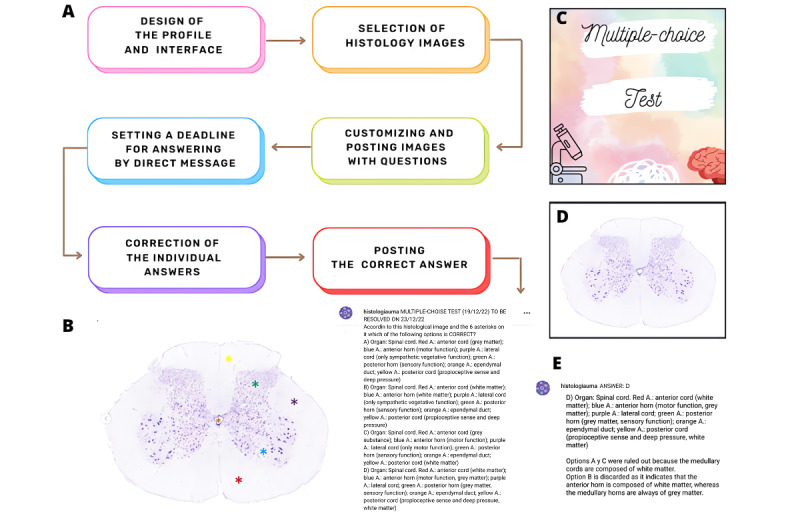
Methods: The proposal included questionnaires based on multiple-choice questions, descriptions of histological images, and schematic diagrams about the subject content. These activities were posted on an Instagram account only accessible by second-year medical students from the University of Malaga. In addition, students could share their own images taken during the laboratory practice and interact with their peers.
Results: Of the students enrolled in Human Histology 2, 85.6% (143/167) agreed to participate in the platform. Most of the students valued the initiative positively and considered it an adequate instrument to improve their final marks. Specifically, 68.5% (98/143) of the student body regarded the multiple-choice questions and image-based questions as the most useful activities. Interestingly, there were statistically significant differences between the marks on the final exam (without considering other evaluation activities) for students who participated in the activity compared with those who did not or barely participated in the activity (P<.001). There were no significant differences by degree of participation between the more active groups.
Conclusions: These results provide evidence that incorporating social media may be considered a useful, easy, and accessible tool to improve the learning of human histology in the context of medical degrees.







 京公网安备 11010802042870号
京ICP备2023020795号-1
京公网安备 11010802042870号
京ICP备2023020795号-1

 分享
分享
 求助内容:
求助内容: 应助结果提醒方式:
 扫码关注我们
