{"title":"基于血栓弹性成像预测急性缺血性脑卒中患者脑血管疾病负担:一项初步研究","authors":"Min Xia, DaiZong Wu, NengWei Yu, GuoXiang Huang","doi":"10.12659/MSM.946303","DOIUrl":null,"url":null,"abstract":"<p><p>BACKGROUND This study aimed to investigate the relationship between the coagulation function measured by thromboelastography (TEG) in patients with acute ischemic stroke (AIS) and total burden of cerebral small vessel disease (CSVD), to further establish a nomogram tool based on regular clinical risk factors and TEG, to conveniently predict the risk of high-grade white matter hyperintensities (WMH) and CSVD burden in AIS patients. MATERIAL AND METHODS A cross-sectional study included 143 AIS patients who underwent TEG tests and 3.0T head MRI scans after admission. They were grouped according to total burden CSVD score and WMH Fazekas score. Differences in regular clinical data (RCD), TEG, and conventional coagulation tests (CCT) between groups were compared. Three sets of logistic regression models were established: RCD model, and models combining RCD with TEG and CCT respectively, to evaluate their predictive performance for WMH and SVD in patients with AIS. RESULTS Univariate analysis revealed age, hypertension, stroke history, fibrinogen, and TEG indicators maximum amplitude, Angle, K, and coagulation index were risk factors for increased WMH Fazekas score and CSVD burden in patients with AIS (OR>1, P<0.05). Logistic regression model combining RCD and TEG had a higher AUC value in predicting WMH (Fazekas score ≥2) and SVD (SVD burden score ≥3). CONCLUSIONS TEG parameters of patients with AIS are related to CSVD burden and its imaging features. Based on regular clinical risk factors, TEG can provide additional predictive information on the severity of WMHs and the burden of CSVD in patients with AIS.</p>","PeriodicalId":48888,"journal":{"name":"Medical Science Monitor","volume":"31 ","pages":"e946303"},"PeriodicalIF":2.1000,"publicationDate":"2025-02-20","publicationTypes":"Journal Article","fieldsOfStudy":null,"isOpenAccess":false,"openAccessPdf":"https://www.ncbi.nlm.nih.gov/pmc/articles/PMC11853390/pdf/","citationCount":"0","resultStr":"{\"title\":\"Predicting Cerebral Small Vessel Disease Burden Based on Thromboelastography in Patients with Acute Ischemic Stroke: A Pilot Study.\",\"authors\":\"Min Xia, DaiZong Wu, NengWei Yu, GuoXiang Huang\",\"doi\":\"10.12659/MSM.946303\",\"DOIUrl\":null,\"url\":null,\"abstract\":\"<p><p>BACKGROUND This study aimed to investigate the relationship between the coagulation function measured by thromboelastography (TEG) in patients with acute ischemic stroke (AIS) and total burden of cerebral small vessel disease (CSVD), to further establish a nomogram tool based on regular clinical risk factors and TEG, to conveniently predict the risk of high-grade white matter hyperintensities (WMH) and CSVD burden in AIS patients. MATERIAL AND METHODS A cross-sectional study included 143 AIS patients who underwent TEG tests and 3.0T head MRI scans after admission. They were grouped according to total burden CSVD score and WMH Fazekas score. Differences in regular clinical data (RCD), TEG, and conventional coagulation tests (CCT) between groups were compared. Three sets of logistic regression models were established: RCD model, and models combining RCD with TEG and CCT respectively, to evaluate their predictive performance for WMH and SVD in patients with AIS. RESULTS Univariate analysis revealed age, hypertension, stroke history, fibrinogen, and TEG indicators maximum amplitude, Angle, K, and coagulation index were risk factors for increased WMH Fazekas score and CSVD burden in patients with AIS (OR>1, P<0.05). Logistic regression model combining RCD and TEG had a higher AUC value in predicting WMH (Fazekas score ≥2) and SVD (SVD burden score ≥3). CONCLUSIONS TEG parameters of patients with AIS are related to CSVD burden and its imaging features. Based on regular clinical risk factors, TEG can provide additional predictive information on the severity of WMHs and the burden of CSVD in patients with AIS.</p>\",\"PeriodicalId\":48888,\"journal\":{\"name\":\"Medical Science Monitor\",\"volume\":\"31 \",\"pages\":\"e946303\"},\"PeriodicalIF\":2.1000,\"publicationDate\":\"2025-02-20\",\"publicationTypes\":\"Journal Article\",\"fieldsOfStudy\":null,\"isOpenAccess\":false,\"openAccessPdf\":\"https://www.ncbi.nlm.nih.gov/pmc/articles/PMC11853390/pdf/\",\"citationCount\":\"0\",\"resultStr\":null,\"platform\":\"Semanticscholar\",\"paperid\":null,\"PeriodicalName\":\"Medical Science Monitor\",\"FirstCategoryId\":\"3\",\"ListUrlMain\":\"https://doi.org/10.12659/MSM.946303\",\"RegionNum\":4,\"RegionCategory\":\"医学\",\"ArticlePicture\":[],\"TitleCN\":null,\"AbstractTextCN\":null,\"PMCID\":null,\"EPubDate\":\"\",\"PubModel\":\"\",\"JCR\":\"Q1\",\"JCRName\":\"Medicine\",\"Score\":null,\"Total\":0}","platform":"Semanticscholar","paperid":null,"PeriodicalName":"Medical Science Monitor","FirstCategoryId":"3","ListUrlMain":"https://doi.org/10.12659/MSM.946303","RegionNum":4,"RegionCategory":"医学","ArticlePicture":[],"TitleCN":null,"AbstractTextCN":null,"PMCID":null,"EPubDate":"","PubModel":"","JCR":"Q1","JCRName":"Medicine","Score":null,"Total":0}
Predicting Cerebral Small Vessel Disease Burden Based on Thromboelastography in Patients with Acute Ischemic Stroke: A Pilot Study.
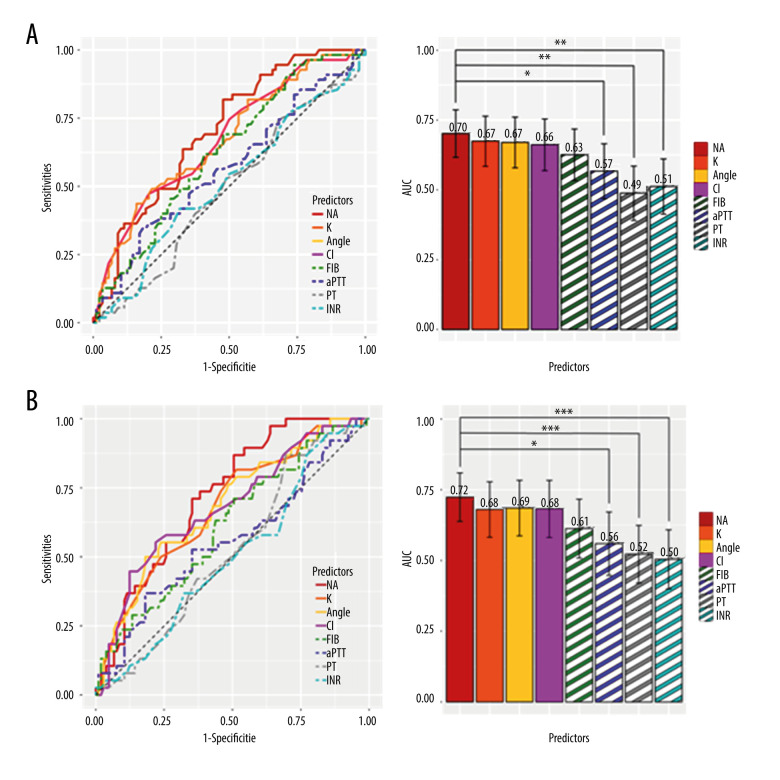
BACKGROUND This study aimed to investigate the relationship between the coagulation function measured by thromboelastography (TEG) in patients with acute ischemic stroke (AIS) and total burden of cerebral small vessel disease (CSVD), to further establish a nomogram tool based on regular clinical risk factors and TEG, to conveniently predict the risk of high-grade white matter hyperintensities (WMH) and CSVD burden in AIS patients. MATERIAL AND METHODS A cross-sectional study included 143 AIS patients who underwent TEG tests and 3.0T head MRI scans after admission. They were grouped according to total burden CSVD score and WMH Fazekas score. Differences in regular clinical data (RCD), TEG, and conventional coagulation tests (CCT) between groups were compared. Three sets of logistic regression models were established: RCD model, and models combining RCD with TEG and CCT respectively, to evaluate their predictive performance for WMH and SVD in patients with AIS. RESULTS Univariate analysis revealed age, hypertension, stroke history, fibrinogen, and TEG indicators maximum amplitude, Angle, K, and coagulation index were risk factors for increased WMH Fazekas score and CSVD burden in patients with AIS (OR>1, P<0.05). Logistic regression model combining RCD and TEG had a higher AUC value in predicting WMH (Fazekas score ≥2) and SVD (SVD burden score ≥3). CONCLUSIONS TEG parameters of patients with AIS are related to CSVD burden and its imaging features. Based on regular clinical risk factors, TEG can provide additional predictive information on the severity of WMHs and the burden of CSVD in patients with AIS.
期刊介绍:
Medical Science Monitor (MSM) established in 1995 is an international, peer-reviewed scientific journal which publishes original articles in Clinical Medicine and related disciplines such as Epidemiology and Population Studies, Product Investigations, Development of Laboratory Techniques :: Diagnostics and Medical Technology which enable presentation of research or review works in overlapping areas of medicine and technology such us (but not limited to): medical diagnostics, medical imaging systems, computer simulation of health and disease processes, new medical devices, etc. Reviews and Special Reports - papers may be accepted on the basis that they provide a systematic, critical and up-to-date overview of literature pertaining to research or clinical topics. Meta-analyses are considered as reviews. A special attention will be paid to a teaching value of a review paper.
Medical Science Monitor is internationally indexed in Thomson-Reuters Web of Science, Journals Citation Report (JCR), Science Citation Index Expanded (SCI), Index Medicus MEDLINE, PubMed, PMC, EMBASE/Excerpta Medica, Chemical Abstracts CAS and Index Copernicus.







 京公网安备 11010802042870号
京ICP备2023020795号-1
京公网安备 11010802042870号
京ICP备2023020795号-1

 分享
分享
 求助内容:
求助内容: 应助结果提醒方式:
 扫码关注我们
