Joshin Kumar, Meng Xu, Yuezhi August Li, Shu-Wen You, Brookelyn M. Doherty, Woodrow D. Gardiner, John R. Cirrito, Carla M. Yuede, Ananya Benegal, Michael D. Vahey, Astha Joshi, Kuljeet Seehra, Adrianus C.M. Boon, Yin-Yuan Huang, Joseph V. Puthussery, Rajan K. Chakrabarty
{"title":"快速检测气溶胶中禽流感(H5N1)和大肠杆菌的电容式生物传感器","authors":"Joshin Kumar, Meng Xu, Yuezhi August Li, Shu-Wen You, Brookelyn M. Doherty, Woodrow D. Gardiner, John R. Cirrito, Carla M. Yuede, Ananya Benegal, Michael D. Vahey, Astha Joshi, Kuljeet Seehra, Adrianus C.M. Boon, Yin-Yuan Huang, Joseph V. Puthussery, Rajan K. Chakrabarty","doi":"10.1021/acssensors.4c03087","DOIUrl":null,"url":null,"abstract":"Airborne transmission via aerosols is a dominant route for the transmission of respiratory pathogens, including avian H5N1 influenza A virus and <i>E. coli</i> bacteria. Rapid and direct detection of respiratory pathogen aerosols has been a long-standing technical challenge. Herein, we develop a novel label-free capacitive biosensor using an interlocked Prussian blue (PB)/graphene oxide (GO) network on a screen-printed carbon electrode (SPCE) for direct detection of avian H5N1 and <i>E. coli</i>. A single-step electro-<i>co</i>-deposition process grows GO branches on the SPCE surface, while the PB nanocrystals simultaneously decorate around the GO branches, resulting in an ultrasensitive capacitive response at nanofarad levels. We tested the biosensor for H5N1 concentrations from 2.0 viral RNA copies/mL to 1.6 × 10<sup>5</sup> viral RNA copies/mL, with a limit of detection (LoD) of 56 viral RNA copies/mL. We tested it on <i>E. coli</i> for concentrations ranging from 2.0 bacterial cells/mL to 1.8 × 10<sup>4</sup> bacterial cells/mL, with a LoD of 5 bacterial cells/mL. The detection times for both pathogens were under 5 min. When integrated with a custom-built wet cyclone bioaerosol sampler, our biosensor could detect and quasi-quantitatively estimate H5N1 and <i>E. coli</i> concentrations in air with spatial resolutions of 93 viral RNA copies/m<sup>3</sup> and 8 bacterial cells/m<sup>3</sup>, respectively. The quasi-quantification method, based on dilution and binary detection (positive/negative), achieved an overall accuracy of >90% for pathogen-laden aerosol samples. This biosensor is adaptable for multiplexed detection of other respiratory pathogens, making it a versatile tool for real-time airborne pathogen monitoring and risk assessment.","PeriodicalId":24,"journal":{"name":"ACS Sensors","volume":"69 1","pages":""},"PeriodicalIF":9.1000,"publicationDate":"2025-02-21","publicationTypes":"Journal Article","fieldsOfStudy":null,"isOpenAccess":false,"openAccessPdf":"","citationCount":"0","resultStr":"{\"title\":\"Capacitive Biosensor for Rapid Detection of Avian (H5N1) Influenza and E. coli in Aerosols\",\"authors\":\"Joshin Kumar, Meng Xu, Yuezhi August Li, Shu-Wen You, Brookelyn M. Doherty, Woodrow D. Gardiner, John R. Cirrito, Carla M. Yuede, Ananya Benegal, Michael D. Vahey, Astha Joshi, Kuljeet Seehra, Adrianus C.M. Boon, Yin-Yuan Huang, Joseph V. Puthussery, Rajan K. Chakrabarty\",\"doi\":\"10.1021/acssensors.4c03087\",\"DOIUrl\":null,\"url\":null,\"abstract\":\"Airborne transmission via aerosols is a dominant route for the transmission of respiratory pathogens, including avian H5N1 influenza A virus and <i>E. coli</i> bacteria. Rapid and direct detection of respiratory pathogen aerosols has been a long-standing technical challenge. Herein, we develop a novel label-free capacitive biosensor using an interlocked Prussian blue (PB)/graphene oxide (GO) network on a screen-printed carbon electrode (SPCE) for direct detection of avian H5N1 and <i>E. coli</i>. A single-step electro-<i>co</i>-deposition process grows GO branches on the SPCE surface, while the PB nanocrystals simultaneously decorate around the GO branches, resulting in an ultrasensitive capacitive response at nanofarad levels. We tested the biosensor for H5N1 concentrations from 2.0 viral RNA copies/mL to 1.6 × 10<sup>5</sup> viral RNA copies/mL, with a limit of detection (LoD) of 56 viral RNA copies/mL. We tested it on <i>E. coli</i> for concentrations ranging from 2.0 bacterial cells/mL to 1.8 × 10<sup>4</sup> bacterial cells/mL, with a LoD of 5 bacterial cells/mL. The detection times for both pathogens were under 5 min. When integrated with a custom-built wet cyclone bioaerosol sampler, our biosensor could detect and quasi-quantitatively estimate H5N1 and <i>E. coli</i> concentrations in air with spatial resolutions of 93 viral RNA copies/m<sup>3</sup> and 8 bacterial cells/m<sup>3</sup>, respectively. The quasi-quantification method, based on dilution and binary detection (positive/negative), achieved an overall accuracy of >90% for pathogen-laden aerosol samples. This biosensor is adaptable for multiplexed detection of other respiratory pathogens, making it a versatile tool for real-time airborne pathogen monitoring and risk assessment.\",\"PeriodicalId\":24,\"journal\":{\"name\":\"ACS Sensors\",\"volume\":\"69 1\",\"pages\":\"\"},\"PeriodicalIF\":9.1000,\"publicationDate\":\"2025-02-21\",\"publicationTypes\":\"Journal Article\",\"fieldsOfStudy\":null,\"isOpenAccess\":false,\"openAccessPdf\":\"\",\"citationCount\":\"0\",\"resultStr\":null,\"platform\":\"Semanticscholar\",\"paperid\":null,\"PeriodicalName\":\"ACS Sensors\",\"FirstCategoryId\":\"92\",\"ListUrlMain\":\"https://doi.org/10.1021/acssensors.4c03087\",\"RegionNum\":1,\"RegionCategory\":\"化学\",\"ArticlePicture\":[],\"TitleCN\":null,\"AbstractTextCN\":null,\"PMCID\":null,\"EPubDate\":\"\",\"PubModel\":\"\",\"JCR\":\"Q1\",\"JCRName\":\"CHEMISTRY, ANALYTICAL\",\"Score\":null,\"Total\":0}","platform":"Semanticscholar","paperid":null,"PeriodicalName":"ACS Sensors","FirstCategoryId":"92","ListUrlMain":"https://doi.org/10.1021/acssensors.4c03087","RegionNum":1,"RegionCategory":"化学","ArticlePicture":[],"TitleCN":null,"AbstractTextCN":null,"PMCID":null,"EPubDate":"","PubModel":"","JCR":"Q1","JCRName":"CHEMISTRY, ANALYTICAL","Score":null,"Total":0}
Capacitive Biosensor for Rapid Detection of Avian (H5N1) Influenza and E. coli in Aerosols
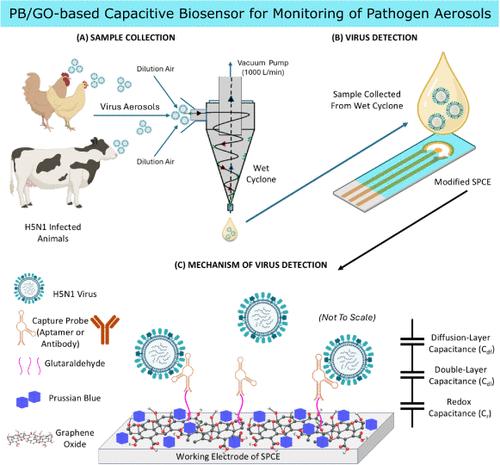
Airborne transmission via aerosols is a dominant route for the transmission of respiratory pathogens, including avian H5N1 influenza A virus and E. coli bacteria. Rapid and direct detection of respiratory pathogen aerosols has been a long-standing technical challenge. Herein, we develop a novel label-free capacitive biosensor using an interlocked Prussian blue (PB)/graphene oxide (GO) network on a screen-printed carbon electrode (SPCE) for direct detection of avian H5N1 and E. coli. A single-step electro-co-deposition process grows GO branches on the SPCE surface, while the PB nanocrystals simultaneously decorate around the GO branches, resulting in an ultrasensitive capacitive response at nanofarad levels. We tested the biosensor for H5N1 concentrations from 2.0 viral RNA copies/mL to 1.6 × 10⁵ viral RNA copies/mL, with a limit of detection (LoD) of 56 viral RNA copies/mL. We tested it on E. coli for concentrations ranging from 2.0 bacterial cells/mL to 1.8 × 10⁴ bacterial cells/mL, with a LoD of 5 bacterial cells/mL. The detection times for both pathogens were under 5 min. When integrated with a custom-built wet cyclone bioaerosol sampler, our biosensor could detect and quasi-quantitatively estimate H5N1 and E. coli concentrations in air with spatial resolutions of 93 viral RNA copies/m3 and 8 bacterial cells/m3, respectively. The quasi-quantification method, based on dilution and binary detection (positive/negative), achieved an overall accuracy of >90% for pathogen-laden aerosol samples. This biosensor is adaptable for multiplexed detection of other respiratory pathogens, making it a versatile tool for real-time airborne pathogen monitoring and risk assessment.
期刊介绍:
ACS Sensors is a peer-reviewed research journal that focuses on the dissemination of new and original knowledge in the field of sensor science, particularly those that selectively sense chemical or biological species or processes. The journal covers a broad range of topics, including but not limited to biosensors, chemical sensors, gas sensors, intracellular sensors, single molecule sensors, cell chips, and microfluidic devices. It aims to publish articles that address conceptual advances in sensing technology applicable to various types of analytes or application papers that report on the use of existing sensing concepts in new ways or for new analytes.




 京公网安备 11010802042870号
京ICP备2023020795号-1
京公网安备 11010802042870号
京ICP备2023020795号-1

 分享
分享
 求助内容:
求助内容: 应助结果提醒方式:
 扫码关注我们
