{"title":"柔性多层压力传感器在睡眠监测中的界面粘接自适应策略","authors":"Qian Wang, Panwang Guo, Quancai Li, Jing Liang, Wei Wu","doi":"10.1021/acssensors.4c03273","DOIUrl":null,"url":null,"abstract":"Flexible devices assembled with low-surface-energy PDMS substrates often face challenges, such as poor interfacial adhesion among multilayer films and mismatched mechanical moduli, complicating the development of stable and repeatable pressure sensors. Herein, a PDMS with internal dynamic cross-linking ability is synthesized to alleviate these issues, which shows good tensile properties, flexibility, and self-healing ability at room temperature. Taking advantage of the material homogeneity, the electrodes and sensing layer of the sensor made of the composite ink and PDMS, serving as the additive, have strong peeling resistance and interfacial adhesion. Furthermore, the multilayer sensing layer of the microconvex structures formed by pressing with a microstructural template effectively improves the sensitivity and sensing range of the multilayer pressure sensor. This multilayer flexible pressure sensor can be applied in medical health monitoring, effectively classifying symptoms related to sleep apnea-hypopnea syndrome through machine learning. The constructed neural network accurately learns the sleep conditions, including normal sleep, tachycardia, sleep apnea, sleep talking, snoring, and rapid eye movement. Utilizing the homogeneity and dynamic interfacial cross-linking of multilayer sensor materials, this design aims to improve the interfacial stability of flexible devices, expanding their application potential for long-term and reliable use.","PeriodicalId":24,"journal":{"name":"ACS Sensors","volume":"25 1","pages":""},"PeriodicalIF":9.1000,"publicationDate":"2025-02-20","publicationTypes":"Journal Article","fieldsOfStudy":null,"isOpenAccess":false,"openAccessPdf":"","citationCount":"0","resultStr":"{\"title\":\"Interfacial Adhesive Adaptation Strategies for Flexible Multilayer Pressure Sensors in Sleep Monitoring\",\"authors\":\"Qian Wang, Panwang Guo, Quancai Li, Jing Liang, Wei Wu\",\"doi\":\"10.1021/acssensors.4c03273\",\"DOIUrl\":null,\"url\":null,\"abstract\":\"Flexible devices assembled with low-surface-energy PDMS substrates often face challenges, such as poor interfacial adhesion among multilayer films and mismatched mechanical moduli, complicating the development of stable and repeatable pressure sensors. Herein, a PDMS with internal dynamic cross-linking ability is synthesized to alleviate these issues, which shows good tensile properties, flexibility, and self-healing ability at room temperature. Taking advantage of the material homogeneity, the electrodes and sensing layer of the sensor made of the composite ink and PDMS, serving as the additive, have strong peeling resistance and interfacial adhesion. Furthermore, the multilayer sensing layer of the microconvex structures formed by pressing with a microstructural template effectively improves the sensitivity and sensing range of the multilayer pressure sensor. This multilayer flexible pressure sensor can be applied in medical health monitoring, effectively classifying symptoms related to sleep apnea-hypopnea syndrome through machine learning. The constructed neural network accurately learns the sleep conditions, including normal sleep, tachycardia, sleep apnea, sleep talking, snoring, and rapid eye movement. Utilizing the homogeneity and dynamic interfacial cross-linking of multilayer sensor materials, this design aims to improve the interfacial stability of flexible devices, expanding their application potential for long-term and reliable use.\",\"PeriodicalId\":24,\"journal\":{\"name\":\"ACS Sensors\",\"volume\":\"25 1\",\"pages\":\"\"},\"PeriodicalIF\":9.1000,\"publicationDate\":\"2025-02-20\",\"publicationTypes\":\"Journal Article\",\"fieldsOfStudy\":null,\"isOpenAccess\":false,\"openAccessPdf\":\"\",\"citationCount\":\"0\",\"resultStr\":null,\"platform\":\"Semanticscholar\",\"paperid\":null,\"PeriodicalName\":\"ACS Sensors\",\"FirstCategoryId\":\"92\",\"ListUrlMain\":\"https://doi.org/10.1021/acssensors.4c03273\",\"RegionNum\":1,\"RegionCategory\":\"化学\",\"ArticlePicture\":[],\"TitleCN\":null,\"AbstractTextCN\":null,\"PMCID\":null,\"EPubDate\":\"\",\"PubModel\":\"\",\"JCR\":\"Q1\",\"JCRName\":\"CHEMISTRY, ANALYTICAL\",\"Score\":null,\"Total\":0}","platform":"Semanticscholar","paperid":null,"PeriodicalName":"ACS Sensors","FirstCategoryId":"92","ListUrlMain":"https://doi.org/10.1021/acssensors.4c03273","RegionNum":1,"RegionCategory":"化学","ArticlePicture":[],"TitleCN":null,"AbstractTextCN":null,"PMCID":null,"EPubDate":"","PubModel":"","JCR":"Q1","JCRName":"CHEMISTRY, ANALYTICAL","Score":null,"Total":0}
Interfacial Adhesive Adaptation Strategies for Flexible Multilayer Pressure Sensors in Sleep Monitoring
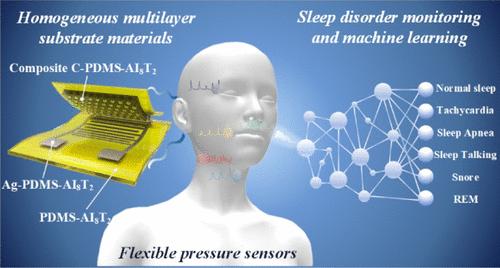
Flexible devices assembled with low-surface-energy PDMS substrates often face challenges, such as poor interfacial adhesion among multilayer films and mismatched mechanical moduli, complicating the development of stable and repeatable pressure sensors. Herein, a PDMS with internal dynamic cross-linking ability is synthesized to alleviate these issues, which shows good tensile properties, flexibility, and self-healing ability at room temperature. Taking advantage of the material homogeneity, the electrodes and sensing layer of the sensor made of the composite ink and PDMS, serving as the additive, have strong peeling resistance and interfacial adhesion. Furthermore, the multilayer sensing layer of the microconvex structures formed by pressing with a microstructural template effectively improves the sensitivity and sensing range of the multilayer pressure sensor. This multilayer flexible pressure sensor can be applied in medical health monitoring, effectively classifying symptoms related to sleep apnea-hypopnea syndrome through machine learning. The constructed neural network accurately learns the sleep conditions, including normal sleep, tachycardia, sleep apnea, sleep talking, snoring, and rapid eye movement. Utilizing the homogeneity and dynamic interfacial cross-linking of multilayer sensor materials, this design aims to improve the interfacial stability of flexible devices, expanding their application potential for long-term and reliable use.
期刊介绍:
ACS Sensors is a peer-reviewed research journal that focuses on the dissemination of new and original knowledge in the field of sensor science, particularly those that selectively sense chemical or biological species or processes. The journal covers a broad range of topics, including but not limited to biosensors, chemical sensors, gas sensors, intracellular sensors, single molecule sensors, cell chips, and microfluidic devices. It aims to publish articles that address conceptual advances in sensing technology applicable to various types of analytes or application papers that report on the use of existing sensing concepts in new ways or for new analytes.





 京公网安备 11010802042870号
京ICP备2023020795号-1
京公网安备 11010802042870号
京ICP备2023020795号-1

 分享
分享
 求助内容:
求助内容: 应助结果提醒方式:
 扫码关注我们
