{"title":"量子点闪烁的机理及抑制","authors":"Changgang Yang, Guofeng Zhang, Jialu Li, Ruiyun Chen, Chengbing Qin, Jianyong Hu, Zhichun Yang, Liantuan Xiao, Suotang Jia","doi":"10.1002/lpor.202402269","DOIUrl":null,"url":null,"abstract":"<p>Colloidal quantum dots (QDs) have been awarded the 2023 Nobel Prize in Chemistry for their unique optoelectronic properties and great potential for applications. QD photoluminescence (PL) blinking research has made a significant contribution to the development of high quality QD materials and related applications. Almost all colloidal QDs are subject to PL blinking, a phenomenon in which the PL intensity of single QD randomly switches between different emission states. The blinking behavior disrupts the PL emission of QDs and hinders related QD-based applications. Studies of QD blinking provide insight into the blinking mechanisms and contribute to the development of methods to suppress blinking. This review summarizes the significant advances in the understanding of PL blinking mechanisms and the development of suppression strategies since the first observation of PL blinking in single QDs. Specifically, it covers the Auger-blinking mechanism, the band-edge carrier blinking mechanism, the conversion of blinking types and their origins, the size dependence of blinking behavior, and various advanced blinking suppression strategies. Looking ahead, the integration of the advanced suppression strategies into various QD applications to unlock the full potential of colloidal QDs will be a key focus of future research.</p>","PeriodicalId":204,"journal":{"name":"Laser & Photonics Reviews","volume":"19 9","pages":""},"PeriodicalIF":10.0000,"publicationDate":"2025-02-19","publicationTypes":"Journal Article","fieldsOfStudy":null,"isOpenAccess":false,"openAccessPdf":"","citationCount":"0","resultStr":"{\"title\":\"Mechanisms and Suppression of Quantum Dot Blinking\",\"authors\":\"Changgang Yang, Guofeng Zhang, Jialu Li, Ruiyun Chen, Chengbing Qin, Jianyong Hu, Zhichun Yang, Liantuan Xiao, Suotang Jia\",\"doi\":\"10.1002/lpor.202402269\",\"DOIUrl\":null,\"url\":null,\"abstract\":\"<p>Colloidal quantum dots (QDs) have been awarded the 2023 Nobel Prize in Chemistry for their unique optoelectronic properties and great potential for applications. QD photoluminescence (PL) blinking research has made a significant contribution to the development of high quality QD materials and related applications. Almost all colloidal QDs are subject to PL blinking, a phenomenon in which the PL intensity of single QD randomly switches between different emission states. The blinking behavior disrupts the PL emission of QDs and hinders related QD-based applications. Studies of QD blinking provide insight into the blinking mechanisms and contribute to the development of methods to suppress blinking. This review summarizes the significant advances in the understanding of PL blinking mechanisms and the development of suppression strategies since the first observation of PL blinking in single QDs. Specifically, it covers the Auger-blinking mechanism, the band-edge carrier blinking mechanism, the conversion of blinking types and their origins, the size dependence of blinking behavior, and various advanced blinking suppression strategies. Looking ahead, the integration of the advanced suppression strategies into various QD applications to unlock the full potential of colloidal QDs will be a key focus of future research.</p>\",\"PeriodicalId\":204,\"journal\":{\"name\":\"Laser & Photonics Reviews\",\"volume\":\"19 9\",\"pages\":\"\"},\"PeriodicalIF\":10.0000,\"publicationDate\":\"2025-02-19\",\"publicationTypes\":\"Journal Article\",\"fieldsOfStudy\":null,\"isOpenAccess\":false,\"openAccessPdf\":\"\",\"citationCount\":\"0\",\"resultStr\":null,\"platform\":\"Semanticscholar\",\"paperid\":null,\"PeriodicalName\":\"Laser & Photonics Reviews\",\"FirstCategoryId\":\"101\",\"ListUrlMain\":\"https://onlinelibrary.wiley.com/doi/10.1002/lpor.202402269\",\"RegionNum\":1,\"RegionCategory\":\"物理与天体物理\",\"ArticlePicture\":[],\"TitleCN\":null,\"AbstractTextCN\":null,\"PMCID\":null,\"EPubDate\":\"\",\"PubModel\":\"\",\"JCR\":\"Q1\",\"JCRName\":\"OPTICS\",\"Score\":null,\"Total\":0}","platform":"Semanticscholar","paperid":null,"PeriodicalName":"Laser & Photonics Reviews","FirstCategoryId":"101","ListUrlMain":"https://onlinelibrary.wiley.com/doi/10.1002/lpor.202402269","RegionNum":1,"RegionCategory":"物理与天体物理","ArticlePicture":[],"TitleCN":null,"AbstractTextCN":null,"PMCID":null,"EPubDate":"","PubModel":"","JCR":"Q1","JCRName":"OPTICS","Score":null,"Total":0}
Mechanisms and Suppression of Quantum Dot Blinking
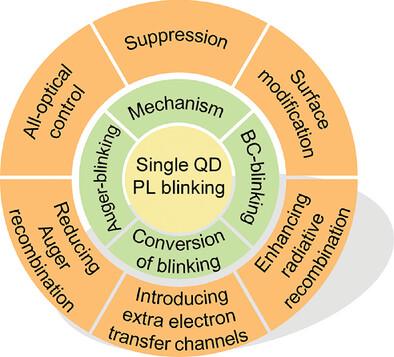
Colloidal quantum dots (QDs) have been awarded the 2023 Nobel Prize in Chemistry for their unique optoelectronic properties and great potential for applications. QD photoluminescence (PL) blinking research has made a significant contribution to the development of high quality QD materials and related applications. Almost all colloidal QDs are subject to PL blinking, a phenomenon in which the PL intensity of single QD randomly switches between different emission states. The blinking behavior disrupts the PL emission of QDs and hinders related QD-based applications. Studies of QD blinking provide insight into the blinking mechanisms and contribute to the development of methods to suppress blinking. This review summarizes the significant advances in the understanding of PL blinking mechanisms and the development of suppression strategies since the first observation of PL blinking in single QDs. Specifically, it covers the Auger-blinking mechanism, the band-edge carrier blinking mechanism, the conversion of blinking types and their origins, the size dependence of blinking behavior, and various advanced blinking suppression strategies. Looking ahead, the integration of the advanced suppression strategies into various QD applications to unlock the full potential of colloidal QDs will be a key focus of future research.
期刊介绍:
Laser & Photonics Reviews is a reputable journal that publishes high-quality Reviews, original Research Articles, and Perspectives in the field of photonics and optics. It covers both theoretical and experimental aspects, including recent groundbreaking research, specific advancements, and innovative applications.
As evidence of its impact and recognition, Laser & Photonics Reviews boasts a remarkable 2022 Impact Factor of 11.0, according to the Journal Citation Reports from Clarivate Analytics (2023). Moreover, it holds impressive rankings in the InCites Journal Citation Reports: in 2021, it was ranked 6th out of 101 in the field of Optics, 15th out of 161 in Applied Physics, and 12th out of 69 in Condensed Matter Physics.
The journal uses the ISSN numbers 1863-8880 for print and 1863-8899 for online publications.





 京公网安备 11010802042870号
京ICP备2023020795号-1
京公网安备 11010802042870号
京ICP备2023020795号-1

 分享
分享
 求助内容:
求助内容: 应助结果提醒方式:
 扫码关注我们
