Jordan A. Gusdorff, Pia Bhatia, Trey T. Shin, Alexandra Sofia Uy-Tioco, Benjamin N. Sailors, Rachael N. Keneipp, Marija Drndić, Lee C. Bassett
{"title":"六方氮化硼的相关结构和光学表征","authors":"Jordan A. Gusdorff, Pia Bhatia, Trey T. Shin, Alexandra Sofia Uy-Tioco, Benjamin N. Sailors, Rachael N. Keneipp, Marija Drndić, Lee C. Bassett","doi":"10.1021/acsnano.4c17676","DOIUrl":null,"url":null,"abstract":"Hexagonal boron nitride (hBN) plays a central role in nanoelectronics and nanophotonics. Moreover, hBN hosts room-temperature quantum emitters and optically addressable spins, making the material promising for quantum sensing and photonics. Despite significant investigation of the optical and structural properties of hBN, the role of contamination at surfaces and interfaces remains unexplored. We prepare hBN samples that are compatible with confocal photoluminescence (PL) microscopy, transmission electron microscopy (TEM), and atomic-force microscopy (AFM), and we use those techniques to quantitatively investigate correlations between fluorescent emission, flake morphology, and surface residue. We find that the microscopy techniques themselves induce changes in hBN’s optical activity and residue morphology: PL measurements induce photobleaching, whereas TEM measurements alter surface residue and emission characteristics. We also study the effects of common treatments─annealing and oxygen plasma cleaning─on the structure and optical activity of hBN. The methods can be broadly applied to study two-dimensional materials, and the results illustrate the importance of correlative studies to elucidate factors that influence hBN’s structural and optical properties.","PeriodicalId":21,"journal":{"name":"ACS Nano","volume":"87 1","pages":""},"PeriodicalIF":16.0000,"publicationDate":"2025-02-21","publicationTypes":"Journal Article","fieldsOfStudy":null,"isOpenAccess":false,"openAccessPdf":"","citationCount":"0","resultStr":"{\"title\":\"Correlated Structural and Optical Characterization of Hexagonal Boron Nitride\",\"authors\":\"Jordan A. Gusdorff, Pia Bhatia, Trey T. Shin, Alexandra Sofia Uy-Tioco, Benjamin N. Sailors, Rachael N. Keneipp, Marija Drndić, Lee C. Bassett\",\"doi\":\"10.1021/acsnano.4c17676\",\"DOIUrl\":null,\"url\":null,\"abstract\":\"Hexagonal boron nitride (hBN) plays a central role in nanoelectronics and nanophotonics. Moreover, hBN hosts room-temperature quantum emitters and optically addressable spins, making the material promising for quantum sensing and photonics. Despite significant investigation of the optical and structural properties of hBN, the role of contamination at surfaces and interfaces remains unexplored. We prepare hBN samples that are compatible with confocal photoluminescence (PL) microscopy, transmission electron microscopy (TEM), and atomic-force microscopy (AFM), and we use those techniques to quantitatively investigate correlations between fluorescent emission, flake morphology, and surface residue. We find that the microscopy techniques themselves induce changes in hBN’s optical activity and residue morphology: PL measurements induce photobleaching, whereas TEM measurements alter surface residue and emission characteristics. We also study the effects of common treatments─annealing and oxygen plasma cleaning─on the structure and optical activity of hBN. The methods can be broadly applied to study two-dimensional materials, and the results illustrate the importance of correlative studies to elucidate factors that influence hBN’s structural and optical properties.\",\"PeriodicalId\":21,\"journal\":{\"name\":\"ACS Nano\",\"volume\":\"87 1\",\"pages\":\"\"},\"PeriodicalIF\":16.0000,\"publicationDate\":\"2025-02-21\",\"publicationTypes\":\"Journal Article\",\"fieldsOfStudy\":null,\"isOpenAccess\":false,\"openAccessPdf\":\"\",\"citationCount\":\"0\",\"resultStr\":null,\"platform\":\"Semanticscholar\",\"paperid\":null,\"PeriodicalName\":\"ACS Nano\",\"FirstCategoryId\":\"88\",\"ListUrlMain\":\"https://doi.org/10.1021/acsnano.4c17676\",\"RegionNum\":1,\"RegionCategory\":\"材料科学\",\"ArticlePicture\":[],\"TitleCN\":null,\"AbstractTextCN\":null,\"PMCID\":null,\"EPubDate\":\"\",\"PubModel\":\"\",\"JCR\":\"Q1\",\"JCRName\":\"CHEMISTRY, MULTIDISCIPLINARY\",\"Score\":null,\"Total\":0}","platform":"Semanticscholar","paperid":null,"PeriodicalName":"ACS Nano","FirstCategoryId":"88","ListUrlMain":"https://doi.org/10.1021/acsnano.4c17676","RegionNum":1,"RegionCategory":"材料科学","ArticlePicture":[],"TitleCN":null,"AbstractTextCN":null,"PMCID":null,"EPubDate":"","PubModel":"","JCR":"Q1","JCRName":"CHEMISTRY, MULTIDISCIPLINARY","Score":null,"Total":0}
Correlated Structural and Optical Characterization of Hexagonal Boron Nitride
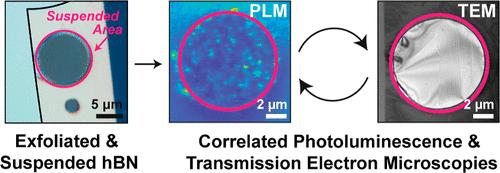
Hexagonal boron nitride (hBN) plays a central role in nanoelectronics and nanophotonics. Moreover, hBN hosts room-temperature quantum emitters and optically addressable spins, making the material promising for quantum sensing and photonics. Despite significant investigation of the optical and structural properties of hBN, the role of contamination at surfaces and interfaces remains unexplored. We prepare hBN samples that are compatible with confocal photoluminescence (PL) microscopy, transmission electron microscopy (TEM), and atomic-force microscopy (AFM), and we use those techniques to quantitatively investigate correlations between fluorescent emission, flake morphology, and surface residue. We find that the microscopy techniques themselves induce changes in hBN’s optical activity and residue morphology: PL measurements induce photobleaching, whereas TEM measurements alter surface residue and emission characteristics. We also study the effects of common treatments─annealing and oxygen plasma cleaning─on the structure and optical activity of hBN. The methods can be broadly applied to study two-dimensional materials, and the results illustrate the importance of correlative studies to elucidate factors that influence hBN’s structural and optical properties.
期刊介绍:
ACS Nano, published monthly, serves as an international forum for comprehensive articles on nanoscience and nanotechnology research at the intersections of chemistry, biology, materials science, physics, and engineering. The journal fosters communication among scientists in these communities, facilitating collaboration, new research opportunities, and advancements through discoveries. ACS Nano covers synthesis, assembly, characterization, theory, and simulation of nanostructures, nanobiotechnology, nanofabrication, methods and tools for nanoscience and nanotechnology, and self- and directed-assembly. Alongside original research articles, it offers thorough reviews, perspectives on cutting-edge research, and discussions envisioning the future of nanoscience and nanotechnology.




 京公网安备 11010802042870号
京ICP备2023020795号-1
京公网安备 11010802042870号
京ICP备2023020795号-1

 分享
分享
 求助内容:
求助内容: 应助结果提醒方式:
 扫码关注我们
