Joon Soo Park , Jiumei Hu , Liben Chen , Tza-Huei Wang
{"title":"FlexPCR:一个流线型的多路数字mRNA定量平台,具有通用引物和有限的荧光通道","authors":"Joon Soo Park , Jiumei Hu , Liben Chen , Tza-Huei Wang","doi":"10.1016/j.bios.2025.117277","DOIUrl":null,"url":null,"abstract":"<div><div>Accurate quantification of multiple messenger RNA (mRNA) targets is essential for biomedical research and disease diagnosis. Current PCR-based methods for mRNA analysis are limited by the number of fluorescent labels and the complexities associated with multiple target-specific primers, leading to amplification bias and limited multiplexing capability. Here, we introduce <u>Fl</u>uorescence-coding <u>ex</u>tension <u>PCR</u> (FlexPCR), a novel digital PCR-based assay that overcomes these limitations by employing a universal primer and probe strategy in conjugation with oligo extension. This method generates unique fluorescence-coded PCR templates for each mRNA target, enabling multiplexed detection using minimal fluorescence channels. FlexPCR simplifies assay design, reduces non-specific amplification, and enhances quantification accuracy. We demonstrate the efficacy by quantifying seven immune response mRNAs using only two fluorescence colors in various human total RNA samples. The results correlate strongly with gold-standard single-plex RT-qPCR, validating the accuracy of our method. FlexPCR offers a streamlined and scalable approach for multiplexed mRNA quantification with broad applications in gene expression analysis and molecular diagnostics.</div></div>","PeriodicalId":259,"journal":{"name":"Biosensors and Bioelectronics","volume":"277 ","pages":"Article 117277"},"PeriodicalIF":10.5000,"publicationDate":"2025-06-01","publicationTypes":"Journal Article","fieldsOfStudy":null,"isOpenAccess":false,"openAccessPdf":"","citationCount":"0","resultStr":"{\"title\":\"FlexPCR: A streamlined multiplexed digital mRNA quantification platform with universal primers and limited fluorescence channels\",\"authors\":\"Joon Soo Park , Jiumei Hu , Liben Chen , Tza-Huei Wang\",\"doi\":\"10.1016/j.bios.2025.117277\",\"DOIUrl\":null,\"url\":null,\"abstract\":\"<div><div>Accurate quantification of multiple messenger RNA (mRNA) targets is essential for biomedical research and disease diagnosis. Current PCR-based methods for mRNA analysis are limited by the number of fluorescent labels and the complexities associated with multiple target-specific primers, leading to amplification bias and limited multiplexing capability. Here, we introduce <u>Fl</u>uorescence-coding <u>ex</u>tension <u>PCR</u> (FlexPCR), a novel digital PCR-based assay that overcomes these limitations by employing a universal primer and probe strategy in conjugation with oligo extension. This method generates unique fluorescence-coded PCR templates for each mRNA target, enabling multiplexed detection using minimal fluorescence channels. FlexPCR simplifies assay design, reduces non-specific amplification, and enhances quantification accuracy. We demonstrate the efficacy by quantifying seven immune response mRNAs using only two fluorescence colors in various human total RNA samples. The results correlate strongly with gold-standard single-plex RT-qPCR, validating the accuracy of our method. FlexPCR offers a streamlined and scalable approach for multiplexed mRNA quantification with broad applications in gene expression analysis and molecular diagnostics.</div></div>\",\"PeriodicalId\":259,\"journal\":{\"name\":\"Biosensors and Bioelectronics\",\"volume\":\"277 \",\"pages\":\"Article 117277\"},\"PeriodicalIF\":10.5000,\"publicationDate\":\"2025-06-01\",\"publicationTypes\":\"Journal Article\",\"fieldsOfStudy\":null,\"isOpenAccess\":false,\"openAccessPdf\":\"\",\"citationCount\":\"0\",\"resultStr\":null,\"platform\":\"Semanticscholar\",\"paperid\":null,\"PeriodicalName\":\"Biosensors and Bioelectronics\",\"FirstCategoryId\":\"1\",\"ListUrlMain\":\"https://www.sciencedirect.com/science/article/pii/S0956566325001514\",\"RegionNum\":1,\"RegionCategory\":\"生物学\",\"ArticlePicture\":[],\"TitleCN\":null,\"AbstractTextCN\":null,\"PMCID\":null,\"EPubDate\":\"2025/2/17 0:00:00\",\"PubModel\":\"Epub\",\"JCR\":\"Q1\",\"JCRName\":\"BIOPHYSICS\",\"Score\":null,\"Total\":0}","platform":"Semanticscholar","paperid":null,"PeriodicalName":"Biosensors and Bioelectronics","FirstCategoryId":"1","ListUrlMain":"https://www.sciencedirect.com/science/article/pii/S0956566325001514","RegionNum":1,"RegionCategory":"生物学","ArticlePicture":[],"TitleCN":null,"AbstractTextCN":null,"PMCID":null,"EPubDate":"2025/2/17 0:00:00","PubModel":"Epub","JCR":"Q1","JCRName":"BIOPHYSICS","Score":null,"Total":0}
FlexPCR: A streamlined multiplexed digital mRNA quantification platform with universal primers and limited fluorescence channels
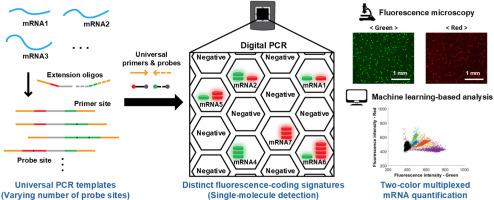
Accurate quantification of multiple messenger RNA (mRNA) targets is essential for biomedical research and disease diagnosis. Current PCR-based methods for mRNA analysis are limited by the number of fluorescent labels and the complexities associated with multiple target-specific primers, leading to amplification bias and limited multiplexing capability. Here, we introduce Fluorescence-coding extension PCR (FlexPCR), a novel digital PCR-based assay that overcomes these limitations by employing a universal primer and probe strategy in conjugation with oligo extension. This method generates unique fluorescence-coded PCR templates for each mRNA target, enabling multiplexed detection using minimal fluorescence channels. FlexPCR simplifies assay design, reduces non-specific amplification, and enhances quantification accuracy. We demonstrate the efficacy by quantifying seven immune response mRNAs using only two fluorescence colors in various human total RNA samples. The results correlate strongly with gold-standard single-plex RT-qPCR, validating the accuracy of our method. FlexPCR offers a streamlined and scalable approach for multiplexed mRNA quantification with broad applications in gene expression analysis and molecular diagnostics.
期刊介绍:
Biosensors & Bioelectronics, along with its open access companion journal Biosensors & Bioelectronics: X, is the leading international publication in the field of biosensors and bioelectronics. It covers research, design, development, and application of biosensors, which are analytical devices incorporating biological materials with physicochemical transducers. These devices, including sensors, DNA chips, electronic noses, and lab-on-a-chip, produce digital signals proportional to specific analytes. Examples include immunosensors and enzyme-based biosensors, applied in various fields such as medicine, environmental monitoring, and food industry. The journal also focuses on molecular and supramolecular structures for enhancing device performance.




 京公网安备 11010802042870号
京ICP备2023020795号-1
京公网安备 11010802042870号
京ICP备2023020795号-1

 分享
分享
 求助内容:
求助内容: 应助结果提醒方式:
 扫码关注我们
