{"title":"将功能优势种的概念应用于观测资料","authors":"Audréanne Loiselle , Raphaël Proulx , Stéphanie Pellerin","doi":"10.1016/j.ecolind.2025.113271","DOIUrl":null,"url":null,"abstract":"<div><div>Conservation ecologists often rely on surrogate species to identify biodiversity hotspots due to the high cost of monitoring programs. While the keystone species approach is an appealing framework for that purpose, it has been criticized for its lack of a clear threshold to identify functionally important species and for its limited ability to handle observational data variability. Here, we propose a modified version of the functionally dominant species (FDS) framework using a bootstrapping random sampling method implemented with either strict or flexible parameters to identify species that disproportionately contribute to the increase or the decrease of biodiversity. We tested our approach on plant, bird, and fish communities of 37 lake-edge wetlands. We identified eight FDS using a 95% confidence interval, of which two displayed a positive contribution to diversity while six had a negative contribution. Using a 99% confidence interval, we found four FDS, all displaying a negative contribution to biodiversity. Most of the identified FDS had ecological or biological traits that support their disproportionate impact on biodiversity. By addressing the limitations of the keystone species framework and providing a statistical framework for analyzing observational data, our method represents a promising tool for conservation ecology.</div></div>","PeriodicalId":11459,"journal":{"name":"Ecological Indicators","volume":"172 ","pages":"Article 113271"},"PeriodicalIF":8.7000,"publicationDate":"2025-03-01","publicationTypes":"Journal Article","fieldsOfStudy":null,"isOpenAccess":false,"openAccessPdf":"","citationCount":"0","resultStr":"{\"title\":\"Adapting the concept of functionally dominant species for observational data\",\"authors\":\"Audréanne Loiselle , Raphaël Proulx , Stéphanie Pellerin\",\"doi\":\"10.1016/j.ecolind.2025.113271\",\"DOIUrl\":null,\"url\":null,\"abstract\":\"<div><div>Conservation ecologists often rely on surrogate species to identify biodiversity hotspots due to the high cost of monitoring programs. While the keystone species approach is an appealing framework for that purpose, it has been criticized for its lack of a clear threshold to identify functionally important species and for its limited ability to handle observational data variability. Here, we propose a modified version of the functionally dominant species (FDS) framework using a bootstrapping random sampling method implemented with either strict or flexible parameters to identify species that disproportionately contribute to the increase or the decrease of biodiversity. We tested our approach on plant, bird, and fish communities of 37 lake-edge wetlands. We identified eight FDS using a 95% confidence interval, of which two displayed a positive contribution to diversity while six had a negative contribution. Using a 99% confidence interval, we found four FDS, all displaying a negative contribution to biodiversity. Most of the identified FDS had ecological or biological traits that support their disproportionate impact on biodiversity. By addressing the limitations of the keystone species framework and providing a statistical framework for analyzing observational data, our method represents a promising tool for conservation ecology.</div></div>\",\"PeriodicalId\":11459,\"journal\":{\"name\":\"Ecological Indicators\",\"volume\":\"172 \",\"pages\":\"Article 113271\"},\"PeriodicalIF\":8.7000,\"publicationDate\":\"2025-03-01\",\"publicationTypes\":\"Journal Article\",\"fieldsOfStudy\":null,\"isOpenAccess\":false,\"openAccessPdf\":\"\",\"citationCount\":\"0\",\"resultStr\":null,\"platform\":\"Semanticscholar\",\"paperid\":null,\"PeriodicalName\":\"Ecological Indicators\",\"FirstCategoryId\":\"93\",\"ListUrlMain\":\"https://www.sciencedirect.com/science/article/pii/S1470160X25002006\",\"RegionNum\":2,\"RegionCategory\":\"环境科学与生态学\",\"ArticlePicture\":[],\"TitleCN\":null,\"AbstractTextCN\":null,\"PMCID\":null,\"EPubDate\":\"2025/2/22 0:00:00\",\"PubModel\":\"Epub\",\"JCR\":\"Q1\",\"JCRName\":\"ENVIRONMENTAL SCIENCES\",\"Score\":null,\"Total\":0}","platform":"Semanticscholar","paperid":null,"PeriodicalName":"Ecological Indicators","FirstCategoryId":"93","ListUrlMain":"https://www.sciencedirect.com/science/article/pii/S1470160X25002006","RegionNum":2,"RegionCategory":"环境科学与生态学","ArticlePicture":[],"TitleCN":null,"AbstractTextCN":null,"PMCID":null,"EPubDate":"2025/2/22 0:00:00","PubModel":"Epub","JCR":"Q1","JCRName":"ENVIRONMENTAL SCIENCES","Score":null,"Total":0}
Adapting the concept of functionally dominant species for observational data
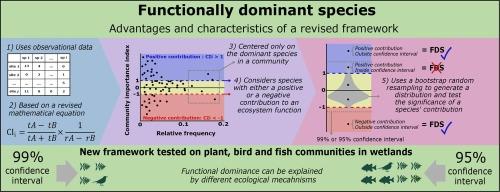
Conservation ecologists often rely on surrogate species to identify biodiversity hotspots due to the high cost of monitoring programs. While the keystone species approach is an appealing framework for that purpose, it has been criticized for its lack of a clear threshold to identify functionally important species and for its limited ability to handle observational data variability. Here, we propose a modified version of the functionally dominant species (FDS) framework using a bootstrapping random sampling method implemented with either strict or flexible parameters to identify species that disproportionately contribute to the increase or the decrease of biodiversity. We tested our approach on plant, bird, and fish communities of 37 lake-edge wetlands. We identified eight FDS using a 95% confidence interval, of which two displayed a positive contribution to diversity while six had a negative contribution. Using a 99% confidence interval, we found four FDS, all displaying a negative contribution to biodiversity. Most of the identified FDS had ecological or biological traits that support their disproportionate impact on biodiversity. By addressing the limitations of the keystone species framework and providing a statistical framework for analyzing observational data, our method represents a promising tool for conservation ecology.
期刊介绍:
The ultimate aim of Ecological Indicators is to integrate the monitoring and assessment of ecological and environmental indicators with management practices. The journal provides a forum for the discussion of the applied scientific development and review of traditional indicator approaches as well as for theoretical, modelling and quantitative applications such as index development. Research into the following areas will be published.
• All aspects of ecological and environmental indicators and indices.
• New indicators, and new approaches and methods for indicator development, testing and use.
• Development and modelling of indices, e.g. application of indicator suites across multiple scales and resources.
• Analysis and research of resource, system- and scale-specific indicators.
• Methods for integration of social and other valuation metrics for the production of scientifically rigorous and politically-relevant assessments using indicator-based monitoring and assessment programs.
• How research indicators can be transformed into direct application for management purposes.
• Broader assessment objectives and methods, e.g. biodiversity, biological integrity, and sustainability, through the use of indicators.
• Resource-specific indicators such as landscape, agroecosystems, forests, wetlands, etc.





 京公网安备 11010802042870号
京ICP备2023020795号-1
京公网安备 11010802042870号
京ICP备2023020795号-1

 分享
分享
 求助内容:
求助内容: 应助结果提醒方式:
 扫码关注我们
