Núria Balanza, Aura Hunguana, Sara Ajanovic, Rosauro Varo, Justina Bramugy, Teodimiro Matsena, Tacilta Nhampossa, Dan Ouchi, Arsénio Nhacolo, Jéssica Dalsuco, Antonio Sitoe, Llorenç Quintó, Sozinho Acácio, Ariel Nhacolo, Maria Maixenchs, Khátia Munguambe, Inácio Mandomando, Pedro Aide, Francisco Saúte, Caterina Guinovart, Charfudin Sacoor, Quique Bassat
{"title":"从性别角度看manhirada区的儿科保健:对17年发病率和人口监测数据的回顾性分析。","authors":"Núria Balanza, Aura Hunguana, Sara Ajanovic, Rosauro Varo, Justina Bramugy, Teodimiro Matsena, Tacilta Nhampossa, Dan Ouchi, Arsénio Nhacolo, Jéssica Dalsuco, Antonio Sitoe, Llorenç Quintó, Sozinho Acácio, Ariel Nhacolo, Maria Maixenchs, Khátia Munguambe, Inácio Mandomando, Pedro Aide, Francisco Saúte, Caterina Guinovart, Charfudin Sacoor, Quique Bassat","doi":"10.7189/jogh.15.04010","DOIUrl":null,"url":null,"abstract":"<p><strong>Background: </strong>Sex and gender are important determinants of health. Gender-based health inequities in the paediatric population have been reported in various countries, but data remain limited. In Mozambique, research on this topic is very scarce. Here we aimed to explore whether boys and girls in Manhiça district, southern Mozambique, differ in access to and provision of healthcare.</p><p><strong>Methods: </strong>This retrospective analysis includes data on all paediatric (<15 years old) visits to six outpatient clinics and admissions to one hospital in Manhiça district from 2004 to 2020, collected through the morbidity surveillance system of the Manhiça Health and Demographic Surveillance System (HDSS). We compared characteristics and outcomes between boys and girls using descriptive statistics, standardised mean differences, and logistic regression. Post-discharge events were analysed using Cox proportional hazards regression and Fine-Gray competing risk regression. Minimum community-based incidence rates of outpatient clinic visits and hospitalisations were calculated using demographic surveillance data from the Manhiça HDSS and analysed with negative binomial regression.</p><p><strong>Results: </strong>Girls represented 49.2% (560 630 out of 1 139 962) of paediatric visits to outpatient clinics and 45.1% (18 625 out of 41 278) of hospitalisations. The girls-to-boys incidence rate ratio (IRR) for hospitalisations was 0.81 (95% confidence interval (CI) = 0.79-0.84). Both boys and girls experienced symptoms for a median duration of one day (interquartile range (IQR) = 1-2) before seeking care. Severe manifestations at presentation to an outpatient clinic or upon hospitalisation tended to be less frequent in girls (girls-to-boys odds ratios (ORs) = 0.71-1.11). Girls were less frequently referred or admitted to hospital after an outpatient clinic visit (OR = 0.82; 95% CI = 0.79-0.86 and OR = 0.85; 95% CI = 0.84-0.87, respectively). The hospital case fatality ratio was 4.1% in boys and 4.2% in girls. The median duration of hospitalisation was three days (IQR = 2-5) and did not differ between boys and girls. Revisits to outpatient clinics, hospital readmissions, and hospital post-discharge mortality were similar in both groups.</p><p><strong>Conclusions: </strong>Girls had fewer referrals and admissions to hospital in Manhiça district, but they were also less likely to present with severe manifestations. Other studied indicators of healthcare access and provision were overall similar for boys and girls. Further research is needed to continue assessing potential gender biases and sex differences in paediatric healthcare in Mozambique.</p>","PeriodicalId":48734,"journal":{"name":"Journal of Global Health","volume":"15 ","pages":"04010"},"PeriodicalIF":5.5000,"publicationDate":"2025-02-21","publicationTypes":"Journal Article","fieldsOfStudy":null,"isOpenAccess":false,"openAccessPdf":"https://www.ncbi.nlm.nih.gov/pmc/articles/PMC11843520/pdf/","citationCount":"0","resultStr":"{\"title\":\"Paediatric healthcare in Manhiça district through a gender lens: a retrospective analysis of 17 years of morbidity and demographic surveillance data.\",\"authors\":\"Núria Balanza, Aura Hunguana, Sara Ajanovic, Rosauro Varo, Justina Bramugy, Teodimiro Matsena, Tacilta Nhampossa, Dan Ouchi, Arsénio Nhacolo, Jéssica Dalsuco, Antonio Sitoe, Llorenç Quintó, Sozinho Acácio, Ariel Nhacolo, Maria Maixenchs, Khátia Munguambe, Inácio Mandomando, Pedro Aide, Francisco Saúte, Caterina Guinovart, Charfudin Sacoor, Quique Bassat\",\"doi\":\"10.7189/jogh.15.04010\",\"DOIUrl\":null,\"url\":null,\"abstract\":\"<p><strong>Background: </strong>Sex and gender are important determinants of health. Gender-based health inequities in the paediatric population have been reported in various countries, but data remain limited. In Mozambique, research on this topic is very scarce. Here we aimed to explore whether boys and girls in Manhiça district, southern Mozambique, differ in access to and provision of healthcare.</p><p><strong>Methods: </strong>This retrospective analysis includes data on all paediatric (<15 years old) visits to six outpatient clinics and admissions to one hospital in Manhiça district from 2004 to 2020, collected through the morbidity surveillance system of the Manhiça Health and Demographic Surveillance System (HDSS). We compared characteristics and outcomes between boys and girls using descriptive statistics, standardised mean differences, and logistic regression. Post-discharge events were analysed using Cox proportional hazards regression and Fine-Gray competing risk regression. Minimum community-based incidence rates of outpatient clinic visits and hospitalisations were calculated using demographic surveillance data from the Manhiça HDSS and analysed with negative binomial regression.</p><p><strong>Results: </strong>Girls represented 49.2% (560 630 out of 1 139 962) of paediatric visits to outpatient clinics and 45.1% (18 625 out of 41 278) of hospitalisations. The girls-to-boys incidence rate ratio (IRR) for hospitalisations was 0.81 (95% confidence interval (CI) = 0.79-0.84). Both boys and girls experienced symptoms for a median duration of one day (interquartile range (IQR) = 1-2) before seeking care. Severe manifestations at presentation to an outpatient clinic or upon hospitalisation tended to be less frequent in girls (girls-to-boys odds ratios (ORs) = 0.71-1.11). Girls were less frequently referred or admitted to hospital after an outpatient clinic visit (OR = 0.82; 95% CI = 0.79-0.86 and OR = 0.85; 95% CI = 0.84-0.87, respectively). The hospital case fatality ratio was 4.1% in boys and 4.2% in girls. The median duration of hospitalisation was three days (IQR = 2-5) and did not differ between boys and girls. Revisits to outpatient clinics, hospital readmissions, and hospital post-discharge mortality were similar in both groups.</p><p><strong>Conclusions: </strong>Girls had fewer referrals and admissions to hospital in Manhiça district, but they were also less likely to present with severe manifestations. Other studied indicators of healthcare access and provision were overall similar for boys and girls. Further research is needed to continue assessing potential gender biases and sex differences in paediatric healthcare in Mozambique.</p>\",\"PeriodicalId\":48734,\"journal\":{\"name\":\"Journal of Global Health\",\"volume\":\"15 \",\"pages\":\"04010\"},\"PeriodicalIF\":5.5000,\"publicationDate\":\"2025-02-21\",\"publicationTypes\":\"Journal Article\",\"fieldsOfStudy\":null,\"isOpenAccess\":false,\"openAccessPdf\":\"https://www.ncbi.nlm.nih.gov/pmc/articles/PMC11843520/pdf/\",\"citationCount\":\"0\",\"resultStr\":null,\"platform\":\"Semanticscholar\",\"paperid\":null,\"PeriodicalName\":\"Journal of Global Health\",\"FirstCategoryId\":\"3\",\"ListUrlMain\":\"https://doi.org/10.7189/jogh.15.04010\",\"RegionNum\":3,\"RegionCategory\":\"医学\",\"ArticlePicture\":[],\"TitleCN\":null,\"AbstractTextCN\":null,\"PMCID\":null,\"EPubDate\":\"\",\"PubModel\":\"\",\"JCR\":\"Q1\",\"JCRName\":\"PUBLIC, ENVIRONMENTAL & OCCUPATIONAL HEALTH\",\"Score\":null,\"Total\":0}","platform":"Semanticscholar","paperid":null,"PeriodicalName":"Journal of Global Health","FirstCategoryId":"3","ListUrlMain":"https://doi.org/10.7189/jogh.15.04010","RegionNum":3,"RegionCategory":"医学","ArticlePicture":[],"TitleCN":null,"AbstractTextCN":null,"PMCID":null,"EPubDate":"","PubModel":"","JCR":"Q1","JCRName":"PUBLIC, ENVIRONMENTAL & OCCUPATIONAL HEALTH","Score":null,"Total":0}
引用次数: 0
摘要
背景:性和社会性别是健康的重要决定因素。许多国家都报告了儿科人口中基于性别的保健不平等现象,但数据仍然有限。在莫桑比克,关于这一主题的研究非常少。在这里,我们的目的是探讨是否男孩和女孩在获得和提供医疗保健,莫桑比克南部的曼希帕拉区不同。方法:该回顾性分析包括所有儿科的数据(结果:女孩占儿科门诊就诊人数的49.2%(1 139 962人中560 630人),占住院人数的45.1%(41 278人中18 625人)。住院的女孩与男孩发病率比(IRR)为0.81(95%可信区间(CI) = 0.79-0.84)。在求医之前,男孩和女孩的症状中位数持续时间为一天(四分位数间距(IQR) = 1-2)。到门诊就诊或住院时出现严重症状的女孩较少(女孩与男孩的比值比= 0.71-1.11)。女孩在门诊就诊后转诊或入院的频率较低(or = 0.82;95% CI = 0.79-0.86, OR = 0.85;95% CI = 0.84-0.87)。住院病死率男孩为4.1%,女孩为4.2%。中位住院时间为3天(IQR = 2-5),男孩和女孩之间没有差异。两组的门诊就诊次数、再入院率和出院后死亡率相似。结论:在manhia区,女孩转诊和入院的人数较少,但她们也不太可能出现严重症状。男孩和女孩获得和提供保健服务的其他研究指标总体上相似。需要进一步的研究来继续评估莫桑比克儿科保健中潜在的性别偏见和性别差异。
Paediatric healthcare in Manhiça district through a gender lens: a retrospective analysis of 17 years of morbidity and demographic surveillance data.
Background: Sex and gender are important determinants of health. Gender-based health inequities in the paediatric population have been reported in various countries, but data remain limited. In Mozambique, research on this topic is very scarce. Here we aimed to explore whether boys and girls in Manhiça district, southern Mozambique, differ in access to and provision of healthcare.
Methods: This retrospective analysis includes data on all paediatric (<15 years old) visits to six outpatient clinics and admissions to one hospital in Manhiça district from 2004 to 2020, collected through the morbidity surveillance system of the Manhiça Health and Demographic Surveillance System (HDSS). We compared characteristics and outcomes between boys and girls using descriptive statistics, standardised mean differences, and logistic regression. Post-discharge events were analysed using Cox proportional hazards regression and Fine-Gray competing risk regression. Minimum community-based incidence rates of outpatient clinic visits and hospitalisations were calculated using demographic surveillance data from the Manhiça HDSS and analysed with negative binomial regression.
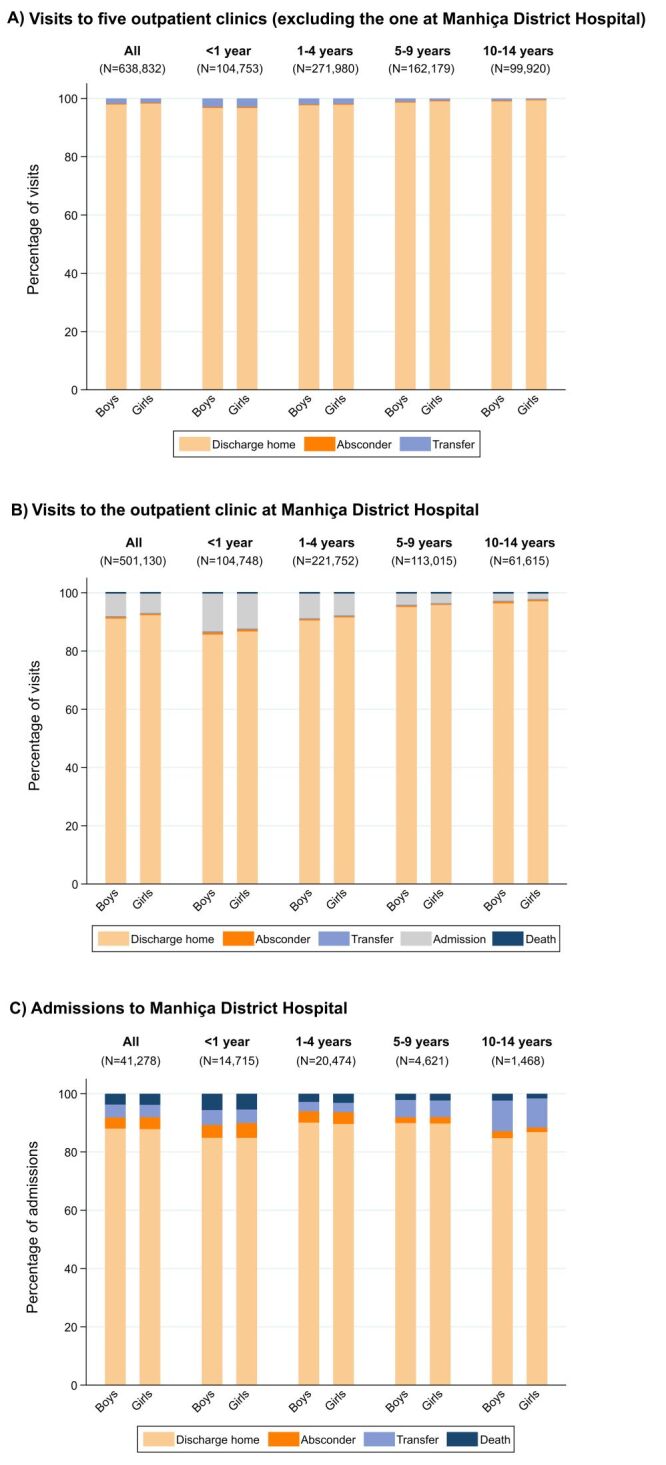
Results: Girls represented 49.2% (560 630 out of 1 139 962) of paediatric visits to outpatient clinics and 45.1% (18 625 out of 41 278) of hospitalisations. The girls-to-boys incidence rate ratio (IRR) for hospitalisations was 0.81 (95% confidence interval (CI) = 0.79-0.84). Both boys and girls experienced symptoms for a median duration of one day (interquartile range (IQR) = 1-2) before seeking care. Severe manifestations at presentation to an outpatient clinic or upon hospitalisation tended to be less frequent in girls (girls-to-boys odds ratios (ORs) = 0.71-1.11). Girls were less frequently referred or admitted to hospital after an outpatient clinic visit (OR = 0.82; 95% CI = 0.79-0.86 and OR = 0.85; 95% CI = 0.84-0.87, respectively). The hospital case fatality ratio was 4.1% in boys and 4.2% in girls. The median duration of hospitalisation was three days (IQR = 2-5) and did not differ between boys and girls. Revisits to outpatient clinics, hospital readmissions, and hospital post-discharge mortality were similar in both groups.
Conclusions: Girls had fewer referrals and admissions to hospital in Manhiça district, but they were also less likely to present with severe manifestations. Other studied indicators of healthcare access and provision were overall similar for boys and girls. Further research is needed to continue assessing potential gender biases and sex differences in paediatric healthcare in Mozambique.
期刊介绍:
Journal of Global Health is a peer-reviewed journal published by the Edinburgh University Global Health Society, a not-for-profit organization registered in the UK. We publish editorials, news, viewpoints, original research and review articles in two issues per year.






 京公网安备 11010802042870号
京ICP备2023020795号-1
京公网安备 11010802042870号
京ICP备2023020795号-1

 分享
分享
 求助内容:
求助内容: 应助结果提醒方式:
 扫码关注我们
